
Some components only work if the face they bolt against is genuinely flat. When that flatness is measured in microns rather than millimetres — and when the material is too hard for a cutting tool to touch — the surface grinder is the machine shops turn to.
The idea behind it is easy to state: an abrasive wheel spins while the workpiece travels underneath, shaving off a sliver of stock on each pass. What separates surface grinding from cylindrical or centerless grinding is the geometry it leaves behind. Here the output is a flat plane, not a round profile. In many shops the same machine has a second career sharpening cutting tools. Grinding of this kind sits closer to precision machining than to decorative surface finishing.
This article covers how the cut actually happens, the metals that behave well under the wheel, the flatness and finish worth writing on a drawing, and the production jobs that depend on the process.
How the Cut Is Made
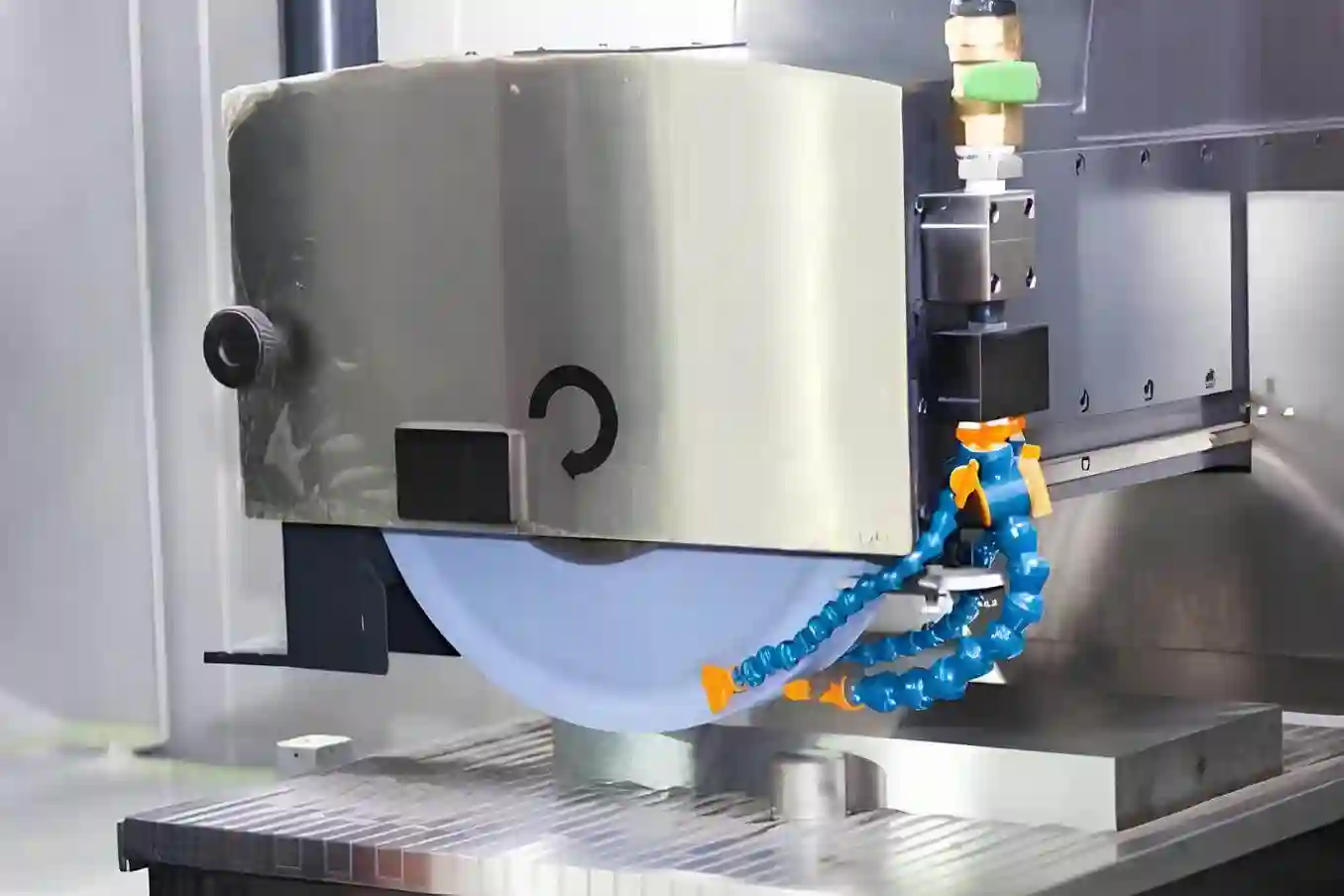
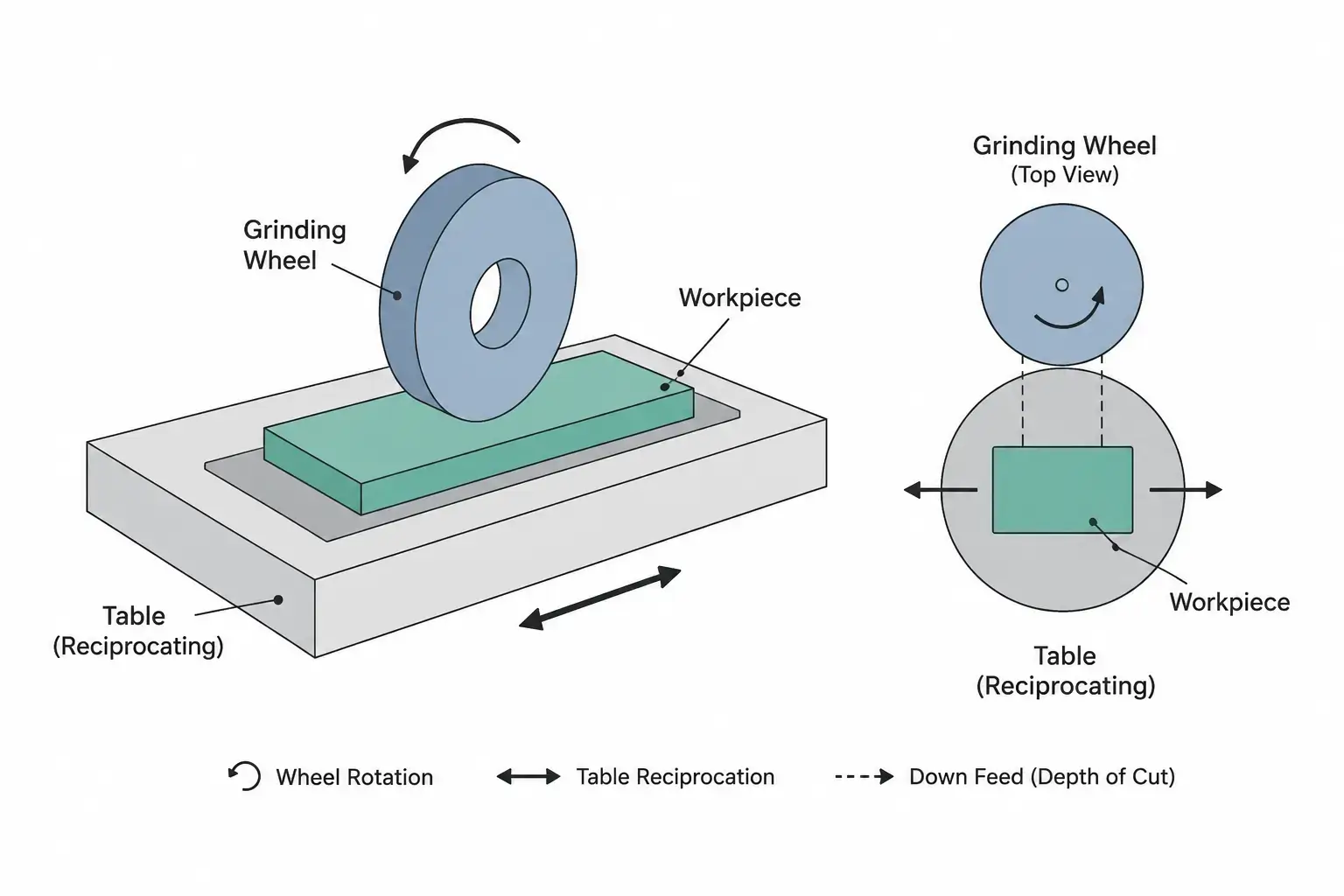
Cutting is done by abrasive grain — aluminium oxide or ceramic, bonded into a wheel. Because thousands of those grains share the work, the cutting edge has no defined geometry, unlike the single ground edge on an end mill. That difference is the whole point: no individual grain carries a heavy load, so cutting pressure and heat stay low.
Workholding sets the process apart as well. The part usually sits on a magnetic chuck, with a vacuum chuck used when the material will not respond to a magnet, and that chuck rides on a table which reciprocates back and forth.
A cycle runs like this. The wheel turns at high speed above the work while the table carries the part beneath it. At the end of a stroke the wheel indexes sideways by part of its width, the head drops a few microns, and the table comes back for the next pass. Once the stroke is set, a block of steel can be brought flat with nobody touching the controls.
Grinding Wheel Speeds and Coolant
Heat is the constant enemy. Flood coolant is directed into the contact zone to stop the part and the wheel from growing as they warm, and to wash away swarf before it scores the newly cut face. Even so, the porous face of the wheel gradually fills with metal and loses its bite.
The remedy is dressing: a diamond-tipped tool is swept across the wheel face to shear off loaded metal and glazed bond, exposing fresh grains underneath. How often this is needed depends on the material, but skipping it shows up immediately as burn marks, chatter or a finish that drifts out of tolerance.
Wheel surface speeds typically run between 5,500 and 6,500 fpm — around 28 to 33 m/s. Feeds and depths of cut stay deliberately modest, because the purpose of the process is to remove very little material, very accurately.
Which Materials Suit the Process
Ferrous stock is the natural fit. Two reasons drive that: the chuck can only hold work that responds to a magnet, and ferrous alloys shear into short, brittle chips that clear the wheel instead of smearing into its pores and glazing the face.
The materials we grind most often:
- Cast iron — everywhere in industrial and automotive work; it keeps its dimensions and breaks into short chips.
- Mild and carbon steel — low hardness makes them forgiving to grind, and they leave the abrasive face unclogged.
- Tool and hardened steel — after heat treatment grinding is often the only practical way to finish these grades, and they resist distortion while being cut.
- Stainless steel — workable but less common, because it builds heat quickly and can work-harden under the wheel.
- Non-ferrous metals and plastics — possible in principle, though soft gummy chips tend to load the wheel, so abrasive choice, coolant volume and depths of cut all have to change.
The abrasive itself is a second variable, matched to the material being cut:
- Aluminium oxide — the general-purpose grain, suitable for the widest spread of ferrous work.
- Silicon carbide — harder and sharper, used on cast iron and non-ferrous metals.
- Super-abrasives — diamond and cubic boron nitride, chosen where hardened steel or carbide has to be ground while the wheel keeps its form.
Accuracy and Surface Finish to Expect
Set against milling or turning, grinding wins on two counts: the flatness and finish it can hold, and its ability to cut material that has already been hardened. The figures below are the ones normally quoted for the process.
| Grade | Flatness | Surface finish |
|---|---|---|
| Standard | ±0.013 mm (±0.0005″) | 16–32 Ra |
| Precision | ±0.005 mm (±0.0002″) | 8–16 Ra |
Two factors explain those numbers. Cutting edges number in the millions and each one takes a very light bite, so the workpiece barely deflects and the machine never has to fight the cut. As a rule of thumb a surface grinder holds roughly ten times the precision of a CNC mill, which is exactly why it is used to finish features a mill has already brought close to size.
Applications in Precision Manufacturing
Because grinding removes material and improves the surface in a single setup, it earns its place in almost any machine shop. Its limitation is geometric rather than technical: a surface grinder produces planes far better than it produces complex three-dimensional shapes.
The work it handles most often:
Toolmaking
Dies, molds and other tooling rely on grinding for their accuracy, and for the reason that hardened tool steel is precisely the material other cutting tools cannot finish.
Tool and Cutter Sharpening
Beyond making tooling, these machines are widely used to re-sharpen end mills, drills and reamers, held in purpose-built fixtures so the original geometry is restored rather than approximated.
Automotive and Aerospace
Engine and drivetrain components are regularly ground to tolerances that would be uneconomic or impossible to hold by milling alone.
Precision Grinding
Across many industries, a surface grinder is put on the surfaces that carry the tightest flatness callouts and the finest Ra targets.
Ultra-Hard Materials
Parts made from hard alloys that would defeat a mill or other subtractive equipment are another regular application for the process.
Surface Grinding at SHBD Metal
In our shop grinding closes out the process route. Parts are milled or turned first and left with a small grinding allowance, heat treated where the drawing calls for it, then precision ground on reciprocating machines until the faces come out flat and parallel within the tolerance on the print.
The grinding cell is part of our wider CNC machining service, alongside 3-axis and 5-axis milling and CNC turning. Flatness down to ±0.005 mm and finishes up to mirror level are routine, and every batch is checked under the same ISO 9001:2015 quality system. The grades we run are listed in the materials library; if your part needs a material that is not there, ask, because the list is not exhaustive.
Choosing a grinding supplier comes down to experience across industries and the ability to carry a design from drawing to finished part. Send us the model or the 2D drawing with its flatness and Ra callouts and we will return a quotation, the grinding route we intend to use, and any allowance we would want changed before metal is cut.
Need flat, precision ground surfaces?
Get Instant QuoteFAQs
How do I decide between surface grinding, milling and cylindrical grinding?
Pick surface grinding for flat faces, hardened stock and the finest finish targets. Milling shapes metal quickly and cheaply. Cylindrical grinding is the answer for round parts that turn about their own axis.
What does dressing the wheel involve?
A diamond-tipped tool is passed across the rotating face of the wheel to shear away loaded metal and dulled bond, exposing sharp grain beneath. Carried out at intervals, it keeps cutting temperatures down and stops the finish from drifting.
Can the process cut anything other than flat faces?
Yes. The wheel can be dressed to a profile, which allows the same machine to produce contours, radii and grooves, so flat surfaces are a strength of the process rather than its limit.
Do non-ferrous metals work on a surface grinder?
They can be ground with the right abrasive and heavy coolant flow, but ferrous alloys remain the natural match because their chips are brittle and clear the wheel pores. Gummy metals need shorter passes and more lubrication to avoid loading the face.
What does a surface grinder cost?
Cost tracks size, condition and control system. A used manual machine can be bought for under $10,000, while a precision system from established builders such as Okamoto or Kent USA generally starts above $50,000.