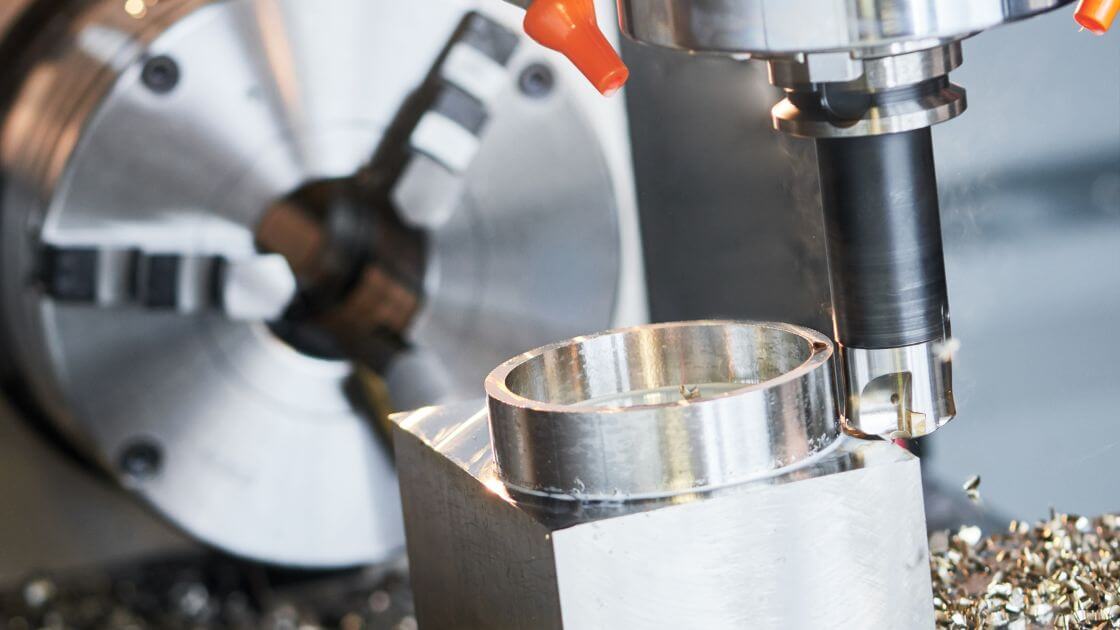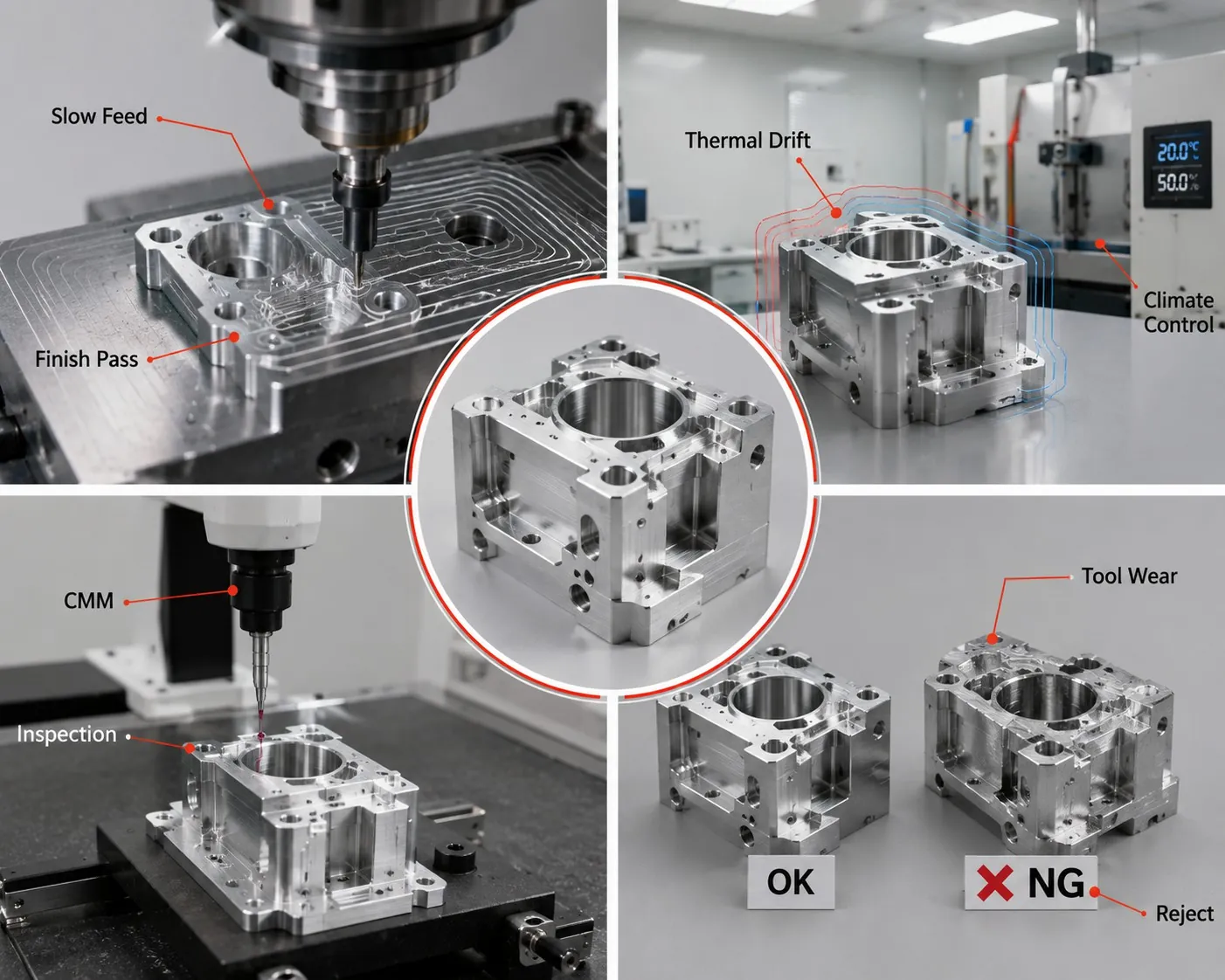

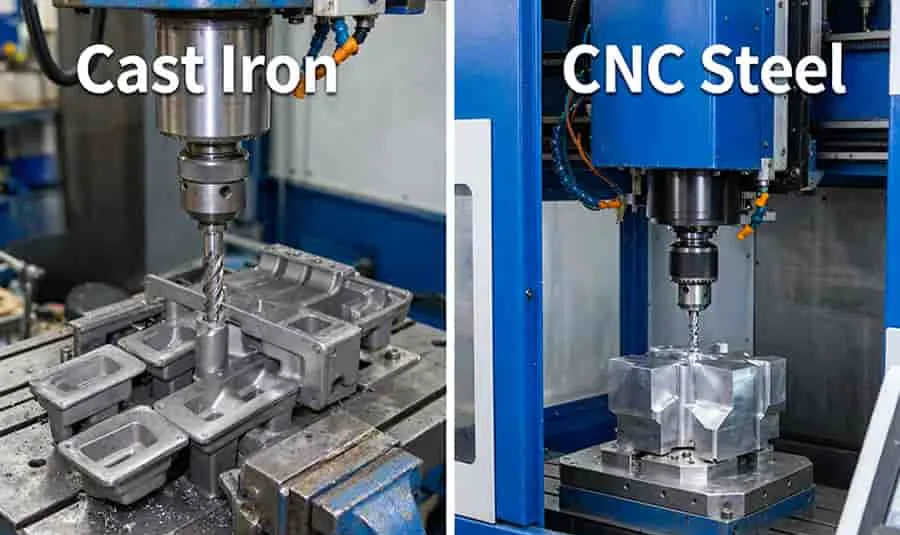
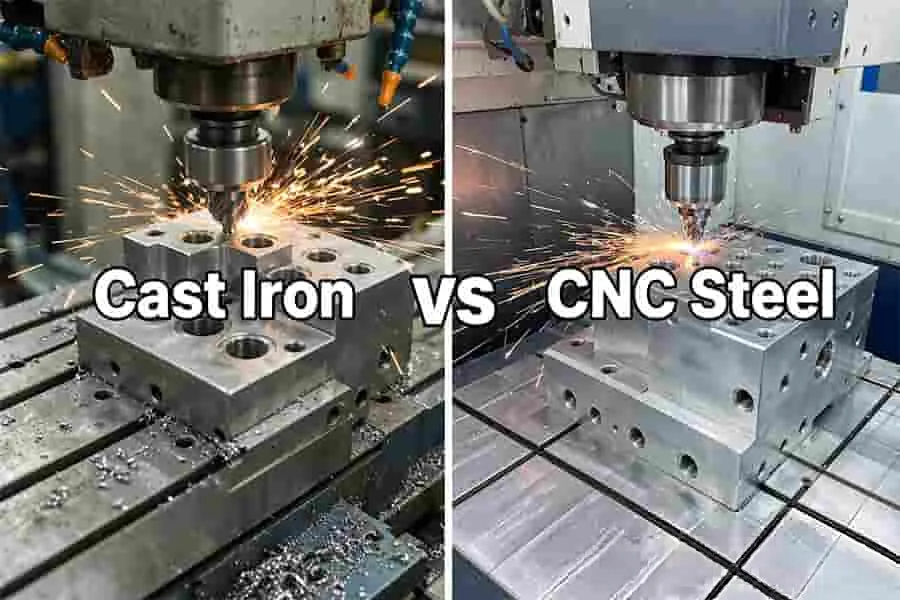
The same manifold family, two routes: a near-net cast blank with cored passages on the left, a billet machined from solid on the right.
Choosing between a cast iron and a CNC steel hydraulic manifold is really two decisions wearing one coat. Pressure class picks the material; order volume picks the tooling. Get the order backwards and you either pay for a pattern on a block that will be redesigned next quarter, or you clamp a 30 MPa circuit into a casting that was never rated for it.
Both routes start from the same drawing set, which is what makes the comparison fair. Casting delivers a near-net flow path with the galleries already cored and graphite flakes distributed through the iron. Machining from billet means every passage is drilled, milled or bored out of solid wrought steel, with no tooling in the way and no pattern to amortise.
The four numbers that decide most programs
- Material gate: working pressure above 25 MPa lands on billet steel, whose band runs 35 MPa to 70 MPa; continuous cast iron sits at or below 25 MPa.
- Tolerance gate: steel holds ±0.006 mm standard and ±0.003 mm at the limit with Ra 0.4 µm in cartridge cavities; cast iron sits at ±0.008 mm, ±0.004 mm and Ra 0.8 µm.
- Cost gate: roughly 45 pieces is where a pattern pays for itself. Under that, tooling-free steel is cheaper per unit.
- Schedule gate: sampling takes about 7 days on steel against 24 days for pattern, casting and ageing.
What Actually Separates a Cast Block From a Machined One
The difference is not iron versus steel as a material argument. It is a near-net cast shape with graphite flakes against a wrought block machined out of solid, and each brings its own failure modes and its own economics.
A cored casting arrives with the passage network already formed. Stock removal is limited to finishing the sealing faces and the valve bores, and the graphite flakes built into the iron act as tiny internal dampers that convert pressure spikes into heat instead of passing them along the circuit. The trade-off is a pattern, a longer route to the first good part, and thin wall sections that need care so edges do not chip during handling.
A billet machined in three, four or five axes has no tooling behind it and no porosity to argue about. Rolled or forged AISI 1045 is uniform and fatigue resistant, holds tighter bores and takes higher working pressures. What it costs you is material: opening a manifold's gallery network out of solid stock turns a large share of the block into chips, and every one of those passes takes machine time.
Where the decision is already made for you is the spool bore. Anything tighter than ±0.005 mm on a servo valve seat points at the machined route before cost enters the conversation.
Four Dimensions That Decide the Route
Four measurements separate the two routes on the same drawing: tolerance and finish, working pressure, unit cost at prototype and volume, and lead time. Each carries a threshold you can check in a minute.
| Dimension | Continuous cast iron | Billet CNC steel | Threshold |
|---|---|---|---|
| Tolerance & finish | Standard ±0.008 mm, limit ±0.004 mm, Ra 0.8 µm | Standard ±0.006 mm, limit ±0.003 mm, Ra 0.4 µm | Spool bores at ±0.005 mm and tighter go to steel |
| Working pressure | Duty above 25 MPa requires steel | ||
| Unit cost | Break-even near 45 pieces | ||
| Lead time |
The figures in this table are illustrative for the worked example below rather than a quotation for your part. Where they matter is the relationship: a pattern and core box around $1,980 divided by the $44 per-piece difference between $112 and $68 breaks even at 45 pieces, and from there the cast route runs about 39% below steel on unit price.
Pressure Rating and Fatigue Under Cyclic Duty
Cyclic duty, not static pressure, is what separates the two blocks in service. Cast iron's graphite absorbs the energy of pressure pulses and dissipates it, which is why the material still turns up in machine-tool bases and damping-critical structures. Forged steel takes the opposite approach: it resists fatigue crack initiation far better, but it wants significant material removal to open the same flow paths, and there is no internal damping of its own.
The practical line is the rated band, not the material's hardness. Continuous cast iron works to 25 MPa; billet steel covers 35 MPa to 70 MPa. Push a cast block past its rating and the failure mode is not gradual — it is a crack at a wall section or a leak at a gallery intersection. That is why pressure is checked before price in every routing decision on this page.
The Two-Gate Decision Tree
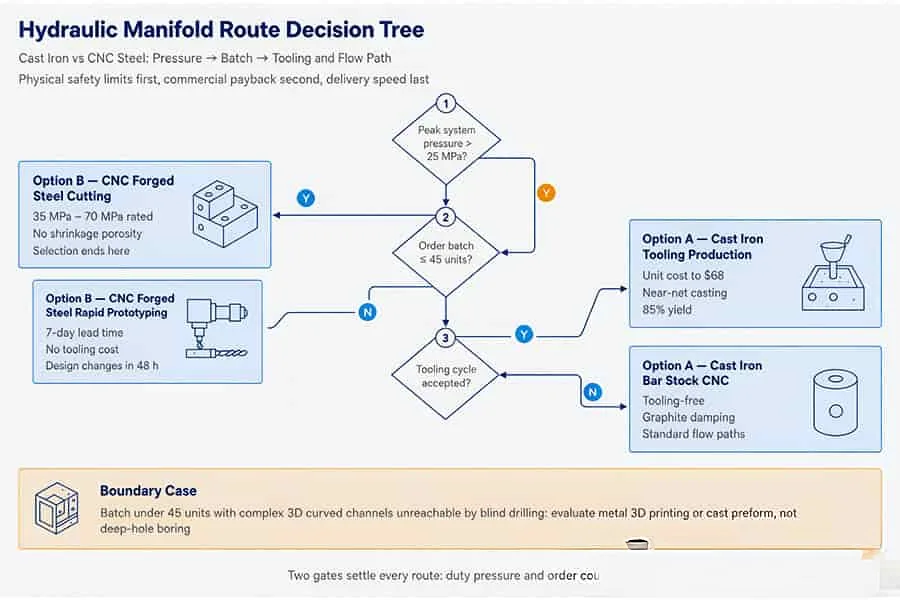
Route selection by pressure first, batch size second, tooling cycle third — with the boundary case for 3D-curved channels at the bottom.
Three questions settle nearly every manifold program, and they are answered in order:
- Peak system pressure above 25 MPa? If yes, take billet steel at 35–70 MPa. Nothing later in the tree overrides this.
- Order batch of 45 units or fewer? If yes, stay on tooling-free steel: seven-day sampling, and the design can still move.
- Is the tooling cycle acceptable — is the geometry frozen? Above the break-even volume with a frozen design, cast iron tooling becomes the low-cost route.
One boundary case sits outside the tree. A block with complex three-dimensional curved channels cannot be reached by straight drilling or by the usual cross-drilling pattern, and no amount of process selection fixes that. Those parts are worth evaluating as metal 3D printing or as a cast preform that is finish machined afterwards.
Where the Cost Curves Cross
The two routes cross once. Casting carries a fixed cost that machining does not, and a metal utilisation that machining cannot match: a near-net casting that only needs its valve bores finished uses around 85% of the metal melted, while opening the same passages from billet leaves roughly 65% of the block as swarf.
Worked example, with illustrative figures: a pattern and core box at $1,980, a cast block at $68 per piece in volume, and a tooling-free steel block at $112 per piece. The $44 difference recovers the pattern at exactly 45 pieces. Below that, steel wins because there is nothing to amortise; above it, cast iron wins and keeps winning until the design changes.
That is the trap in buying tooling early. A pattern is only cheap spread across a stable design, so the sensible sequence is to validate in machined steel while the flow paths are still moving, then commit to a pattern once the geometry stops changing. Programs that skip that step end up paying for a second pattern or for a revision the tooling cannot accept.
Prototype Speed and Design Iteration
Sampling a billet block takes about a week; sampling a casting takes a bit over three, because the pattern has to be made, the casting poured and the iron aged before anyone measures it. That difference compounds across iterations, and design loops are where the schedule risk actually lives.
With no tooling in the way, an engineering change is machined into the next block rather than waited upon: channel re-routing, an extra sensor port or a moved cartridge cavity can be folded in within about 48 hours. Once a pattern exists, the same change means either a tooling modification or an abandoned pattern.
That yields a clean handover rule. Before the geometry freeze, steel buys schedule flexibility and costs a little more per piece. After the freeze, above the break-even volume, cast iron converts that fixed cost into a permanently lower unit price.
Deburring Internal Channels: Why Steel Is Harder
Both routes leave a burr at every cross-drilled intersection — but steel burrs cling to the bore wall instead of breaking away.
Every cross-drilled intersection produces a burr, and in a manifold those burrs sit where no brush can reach. Their behaviour, however, differs by material, and that decides the deburring method.
Steel burrs are ductile. They bend with the drill instead of fracturing, so they stay attached to the bore wall, and high-pressure water washing alone tends to fold them over rather than remove them. The methods that work are thermal energy deburring, which burns the burr away in a controlled atmosphere, and abrasive flow machining, which pushes a loaded polymer through the passage until the edges are radiused.
Cast iron burrs crumble into particles and dust, which rinses out far more readily — at the cost of extra filtration and cleaning discipline, since that dust has to be captured. In both materials the villain is the same geometry: a drilled passage breaking into another passage at a shallow angle.
Weight, Damping and Material Efficiency
Cast iron is the denser material and it needs thicker walls for the same stiffness, so a cast manifold weighs more than a machined steel block of equal pressure rating. What it gives back is damping: the graphite flakes dissipate pulsation instead of transmitting it, which matters on robotics, machine tools and any platform where hydraulic noise shows up in the structure.
Steel sections can be thinner and lighter, which is why mobile and cart-mounted systems usually go that way, and the wrought structure tolerates higher fatigue loading. On the environmental side, both materials recycle completely, and the near-net casting route keeps more of the melt inside the finished part — 85% against roughly 35% when the same galleries are cut from solid.
Case Note: A Robotic Arm Valve Block
A university robotics group developing a multi-circuit servo-arm valve block started on QT500-7 continuous cast iron. The reasoning was sound on both counts that casting usually wins: low unit cost at volume, and graphite damping that suits a structure intended to stay quiet under pulsation.
Then the duty point came back from testing with peaks around 28 MPa, which sits above what the cast route is rated for. The block was re-routed to forged steel for the high-pressure circuits, while the pattern stayed in service for the lower-pressure variants in the same family.
The lesson is the ordering of the two gates. Pressure is a safety and reliability constraint; cost is a commercial one. Run the pressure gate first, and the tooling decision is only ever made once, on a design that is not about to move.
Manifold Machining at SHBD Metal
We machine hydraulic manifold blocks in three, four and five axes, in AISI 1045 and other steels as well as aluminium and stainless, and we keep the tolerances that make the decision above concrete: ±0.01 mm on critical fits, with CMM verification on every block and a pressure hold test before anything ships.
Deburring is handled in-house for both material families — thermal energy deburring and abrasive flow machining for steel passages, and filtration-controlled rinsing for cast iron. Work runs under an ISO 9001:2015 quality system, and the materials we machine are listed in the materials library.
If you are still deciding the route, send both the hydraulic schematic and the 3D model: our CNC machining service covers the machined route and 5-axis machining handles the complex intersecting galleries, while cast blanks can be finish machined through the same shop. Where a program is better served by casting from the start, our die casting and metal casting teams quote that route on the same drawing.
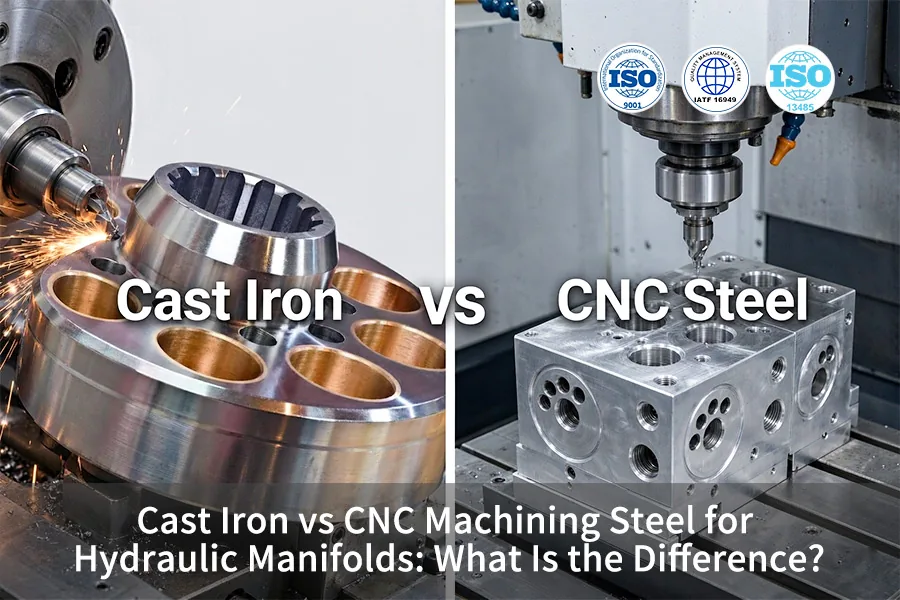
Both routes, one drawing set: the choice comes down to pressure class first, then order volume and tooling.
Have a manifold block to quote?
Upload Your CAD FilesFAQs
At what pressure does cast iron stop being an option?
Working pressure is the first gate. Continuous cast iron sits at 25 MPa or below, while billet CNC steel is rated from 35 MPa to 70 MPa. Above 25 MPa the cast route runs out of rating, and no amount of volume discount makes an under-rated block safe.
What tolerance and surface finish can each route hold?
On the same drawing, billet steel holds ±0.006 mm as standard with a ±0.003 mm limit and Ra 0.4 µm in cartridge cavities. Continuous cast iron sits at ±0.008 mm standard, ±0.004 mm limit and Ra 0.8 µm. Servo valve spool bores tighter than ±0.005 mm effectively choose steel by themselves.
When does cast iron become the cheaper route?
Once a pattern is amortised. In the worked example on this page, a $1,980 pattern against a $44 per-piece differential breaks even at 45 pieces, after which the cast route runs about 39% below steel per unit. Below 45 pieces, tooling-free steel is cheaper because there is nothing to amortise.
Can we switch from steel to cast iron later?
Yes, and that sequence is usually the cheapest one: validate the geometry in machined steel while the design still moves, then cut a pattern once the flow paths freeze. Cast tooling cannot absorb channel re-routing or added sensor ports, so a pattern bought before the freeze is money spent on a revision you are about to abandon.
Why is deburring harder in a steel manifold?
Steel burrs are ductile — they bend and cling to the bore wall instead of breaking off, so high-pressure water alone is not enough and thermal energy deburring or abrasive flow machining is needed. Cast iron burrs crumble into particles and dust, which rinses out more easily at the cost of extra filtration during cleaning.
Summary
Take the pressure gate first. Above 25 MPa working pressure, use billet CNC steel whatever the order size. At 25 MPa or below with fewer than 45 pieces, stay on tooling-free steel and keep the design free to move. At 25 MPa or below, above 45 pieces, on frozen geometry, cast iron tooling becomes the lower-cost route for the life of the program.