
Choosing the right material can determine whether a project succeeds — from how easily a part machines to how long it lasts in service. Bronze and brass are both copper-based alloys with thousands of years of history, and both remain essential in modern manufacturing. Whether your application is marine hardware, electrical connectors, or decorative elements, understanding how they differ is crucial.
SHBD Metal machines both alloys in our CNC machining facilities — see our dedicated brass CNC machining and bronze CNC machining pages. In this guide, we compare the composition, grades, properties, pros, cons, and cost of these two copper alloys.
What Are Brass and Bronze Alloys?
What Is Brass?
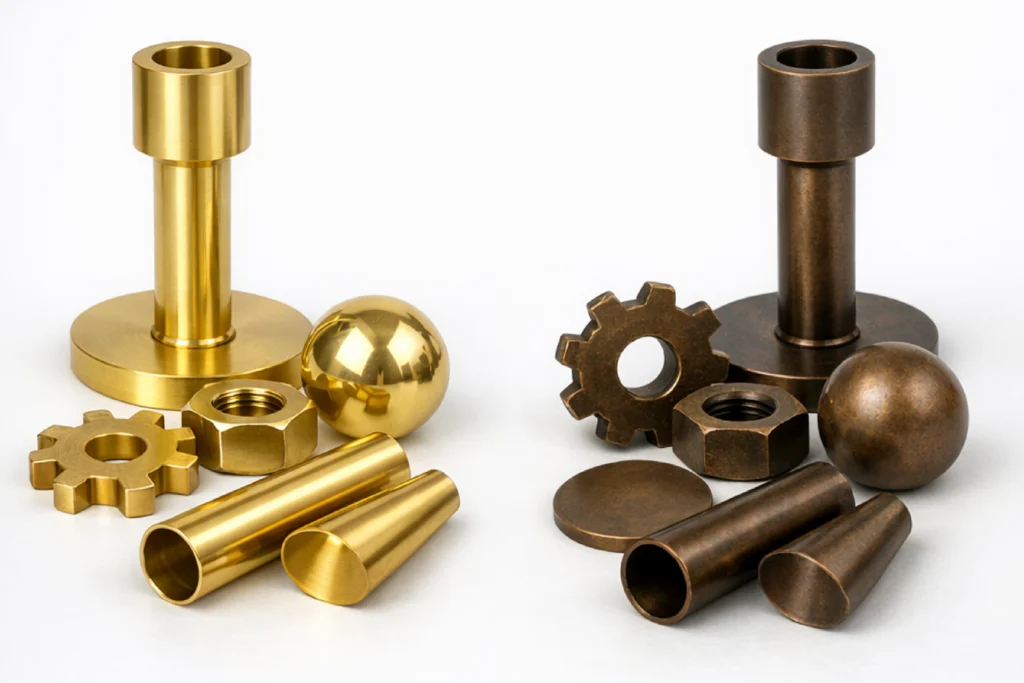
Brass is an alloy of copper and zinc, with small additions of elements such as lead, aluminum, or silicon to fine-tune its properties. Its bright, gold-like appearance makes it a natural fit for decorative hardware and interior design elements. Brass is also corrosion-resistant, durable, and very easy to machine, which is why it dominates plumbing and marine fittings.
Base Composition of Brass
Copper and zinc are the two main elements. Specific grades may also contain lead, tin, aluminum, or silicon.
Main Grades of Brass
- Cartridge Brass (C26000): 70% copper, 30% zinc.
- Free-Cutting Brass (C36000): 61.5% copper, 35.5% zinc, 3% lead.
- Naval Brass: 59% copper, 40% zinc, 1% tin.
- Architectural Bronze (C38500): 57–59% copper, 39–41% zinc, 2–3% lead.
Note: "Architectural bronze" is not a true bronze — it is a high-lead brass alloy.
What Is Bronze?
Bronze is an alloy of copper and tin, sometimes alloyed with aluminum, nickel, or zinc. Its reddish-brown color suits both industrial and artistic applications — statues are a classic example. Bronze is corrosion-resistant and performs well in salt water, making it a top choice for marine components, bearings, and gears.
Base Composition of Bronze
Bronze is primarily copper and tin. Certain alloys add aluminum, silicon, phosphorus, or manganese to achieve specific properties.
Main Grades of Bronze
- Phosphor Bronze: 85–95% copper, 4–10% tin, 0.01–0.35% phosphorus, with potentially trace lead.
- Aluminum Bronze: 75–90% copper, 4–14% aluminum, 1–5% iron (frequently), 5–6% nickel (often), plus trace manganese, silicon, or zinc.
- Manganese Bronze: 55–68% copper, 22–42% zinc, 2.5–5.0% manganese, often with trace iron and aluminum.
Material Properties: Brass vs Bronze
| Property | Phosphor Bronze | Brass C36000 |
|---|---|---|
| Tensile Strength (MPa) | 324–965 | 338–469 |
| Yield Strength (MPa) | 131–552 | 124–310 |
| Hardness (Brinell) | 50–90 | ~100–130 |
| Elongation (%) | 60–70 | 10–50 |
| Fatigue Resistance | Good–high | Moderate–good |
| Density (g/cm³) | 8.9 | 8.5 |
| Melting Point (°C) | 954 | 885 |
| Thermal Conductivity (W/m·K) | 84 | 115 |
| Electrical Conductivity (% IACS) | 11–20 | 26 |
| Corrosion Resistance | Excellent — patina and oxide films | Good — dezincification risk |
Summary: Brass is easy to machine, thermally and electrically conductive, and easy to form. Bronze offers higher strength, hardness, wear resistance, and corrosion resistance thanks to its protective oxide films.
Comparing Brass vs Bronze in Specific Environments
| Environment / Property | Brass | Bronze |
|---|---|---|
| Marine / Seawater | Can dezincify unless a specialty alloy is used | Excellent corrosion resistance (tin, silicon, and aluminum alloys) |
| High Temperature | Strength drops as temperature rises | Maintains properties at higher temperatures (silicon bronze) |
| High Pressure / Load | Light-duty bushings and gears | Bearings, bushings, and gears under heavy load |
| Electrical / Electronic | Most electrical connectors (conductivity and machinability) | Connectors where corrosion resistance is critical |
Decision-Making Considerations
- Cost: Brass is roughly $2.00–$2.70 per pound, stable and readily available. Bronze costs more, and the price varies significantly by grade and alloying elements.
- Machinability: Brass C36000 is the industry standard and extremely machinable. Bronze machines at 20–60% of that rate, with more tool wear and slower cutting speeds.
- Weldability: Brass C36000 solders well, brazes fairly, and welds poorly. Bronze is generally good for arc welding.
- Castability: Both alloys are excellent for casting.
- Formability: Brass is good, depending on grade. Bronze is moderate — some grades are less ductile.
- Recyclability: Both are highly recyclable; brass is especially valuable in the scrap market.
Questions to Ask Yourself When Choosing Between Brass and Bronze
- Is cost the main factor? Choose brass.
- Is machinability a requirement? Choose brass.
- Will the part face high wear, marine, or corrosive environments? Choose bronze.
- Is electrical conductivity essential? Choose brass.
- Is complex forming or bending required? Choose brass.
| Requirement | Brass | Bronze |
|---|---|---|
| Cost Sensitivity | Cost is the primary concern | Willing to pay more for performance |
| Machinability | High-speed, precision machining needed | Machining is secondary to wear and corrosion resistance |
| Corrosion Resistance | Moderate, for non-marine environments | High, especially in marine and chemical environments |
| Wear Resistance | Moderate | High — bearings, bushings, and springs |
| Electrical Conductivity | Important, e.g. terminals | Less critical |
| Formability | Complex shapes with bends | Less forming, more casting or wear parts |
| Weldability | Soldering and brazing preferred | Arc welding required |
Key Takeaways for Brass vs Bronze
- Brass excels in machinability, cost-sensitive projects, electrical applications, and decorative parts.
- Bronze is the go-to material for high-wear, corrosive, and heavy-load applications such as marine hardware and bearings.
- Know the grades: once you have chosen a family, evaluate the specific grades to match your performance and budget targets.
- Both metals are sustainable and easy to source — the real differences come down to performance, and those differences are significant.
For a deeper look at material options across our processes, browse the SHBD Metal materials library, or upload your CAD files for an instant quote and DFM feedback on brass or bronze parts.
FAQs
What is the difference between brass and bronze?
Brass is an alloy of copper and zinc; bronze is an alloy of copper and tin. Brass is known for its formability, machinability, and corrosion resistance, while bronze is valued for its strength and durability, particularly in marine and high-wear applications.
How can you define brass?
Brass typically contains 55–95% copper and 5–45% zinc. It has a golden color, good corrosion resistance, and excellent machinability, and it is widely used in plumbing fittings, musical instruments, and decorative items.
How can you define bronze?
Bronze is an alloy of copper and tin known for its durability, corrosion resistance, and attractive reddish-brown appearance. It has been used for centuries in sculptures, coins, and industrial components.
What does brass look like?
Brass is a yellowish-gold metal with a warm, lustrous appearance that is often described as rich and antique-looking, with a slight reddish tint. It can be polished to a high shine or left with a muted brushed finish.
What does bronze look like?
Bronze has a warm, rich reddish-brown hue with a smooth, lustrous surface, ranging from a deep, dark patina to a bright, polished finish. Color and texture vary with the specific alloy and finishing process.
Are bronze and brass non-ferrous metals?
Yes. Both bronze and brass are non-ferrous metals, containing no significant iron content.