

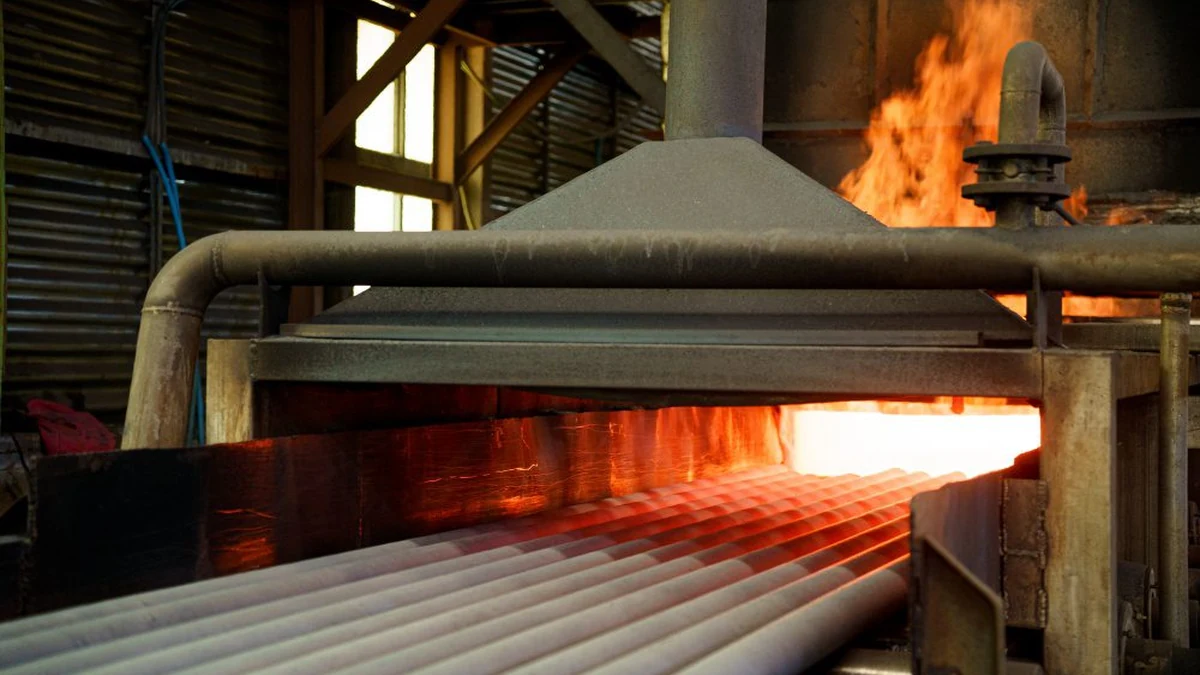
A stainless heat becomes strip in one continuous run of casting, reheating and rolling; everything after that is about surface and tolerance.
What Goes Into the Furnace
Stainless is an iron alloy with a deliberate addition of chromium — at least about 10.5% by weight, usually more — and whatever else the grade needs to do its job. Chromium is the element that forms the passive oxide film; nickel stabilises the austenitic structure and improves formability; molybdenum pushes up pitting resistance in chlorides; carbon raises hardness and, in the martensitic grades, makes the alloy hardenable; nitrogen strengthens the austenitic grades and improves their resistance to pitting.
Most of that chemistry arrives as scrap. Stainless scrap is sorted by grade and charged together with ferrochrome, ferro-nickel or pure nickel, and ferro-molybdenum to hit the target analysis. Using scrap is not only a cost decision: it is how the nickel and chromium units already in the metal are kept in circulation. It is also why mills watch residual elements so closely — copper and tin travel with the scrap stream and cannot be removed later in the process.
Melting the Heat
The charge goes into an electric arc furnace, where graphite electrodes strike an arc through the scrap and melt it at around 1,600 to 1,700°C. A furnace of this size holds a heat of many tonnes, and the whole heat becomes the unit of traceability: one chemistry, one heat number, and every coil, plate or bar cast from it carries that number.
Melting is a rough step. The furnace cannot hold a tight specification, and it does not try to. What it produces is liquid iron with roughly the right alloying elements and too much carbon, which the next step removes.
Refining: Where the Grade Is Decided
Refining is where the heat becomes a grade. The problem is straightforward: burning carbon out of steel with oxygen also burns out chromium, and chromium is the expensive part. The answer is to decarburise at a lower partial pressure of carbon monoxide, which is what an argon-oxygen decarburisation vessel does. Argon dilutes the oxygen, carbon leaves the melt as CO, and the chromium stays in the steel.
The same vessel trims the analysis: nickel, molybdenum and nitrogen are added to target, sulphur and phosphorus are reduced, and the temperature is set for casting. Vacuum oxygen decarburisation is used where carbon has to go very low, or where hydrogen and nitrogen have to be held to tight limits. By the end of refining, the heat has a chemistry sheet, not just a composition.
Casting Into Semi-Finished Form
The refined steel is cast into a semi-finished shape, and the shape chosen decides what the mill can roll it into.
| Cast form | Typical section | Rolled into |
|---|---|---|
| Slab | Wide, rectangular | Hot strip, coil, plate |
| Bloom | Large square | Structural sections, large bar, tube rounds |
| Billet | Smaller square | Bar, wire rod, rebar |
Most tonnage is continuously cast: the steel flows through a water-cooled mould and emerges as a solidifying strand that is cut to length. Continuous casting gives a more uniform structure than ingot casting and wastes less metal, which is why ingot routes survive mainly for very large forgings and for a few specialty grades.
Hot Rolling
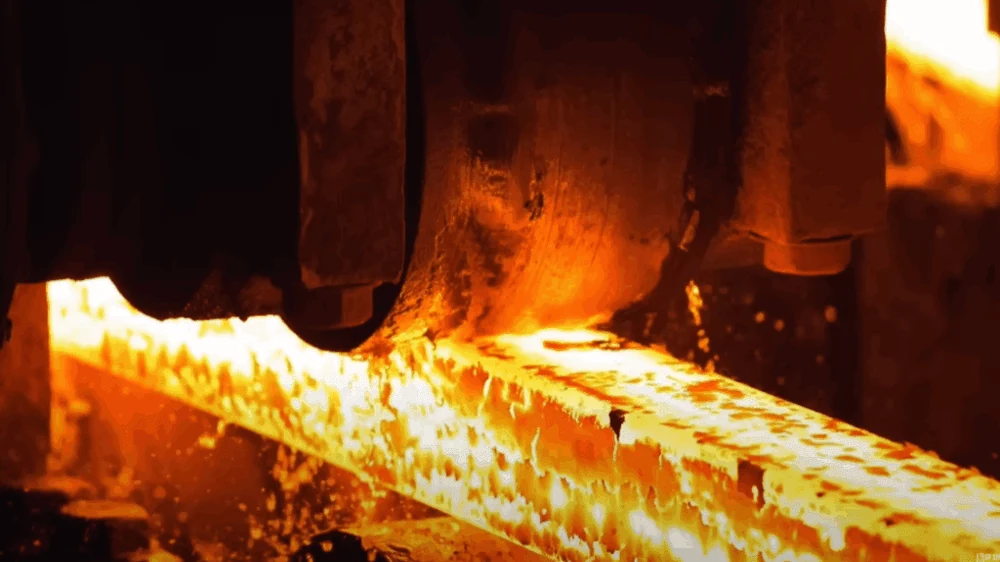
Hot rolling sets the internal structure and the starting gauge; the surface it leaves is deliberately removed later.
Before rolling, slabs are reheated and soaked so the structure is uniform through the thickness. The roughing mill then reduces the section in passes, and the finishing train rolls it to the target gauge while the steel is still above its recrystallisation temperature. Hot rolling is done at around 1,100 to 1,200°C, and the steel is ductile enough at that temperature to take large reductions.
What comes out is hot-rolled coil, plate or bar: the right gauge and the right structure, with a dark oxide scale on the surface and a thickness tolerance that is generous by cold-rolled standards. For structural work and for parts that will be machined all over, that is often enough. Where the surface or the tolerance matters, the coil goes on to cold rolling.
Cold Rolling, Annealing and Pickling
Cold rolling reduces the strip at room temperature, usually in a cluster mill that supports small work rolls against larger backup rolls. The strain hardens the steel — it gets stronger and less ductile with each pass — so the reduction is interrupted by annealing, which softens it again by allowing the structure to recrystallise.
Annealing is followed by pickling. Furnace annealing leaves an oxide scale, and the acid bath removes it; a skin pass then sets the final surface and the flatness. The result is the finish named on the order: 2B for the standard cold-rolled, annealed and pickled surface; BA for a bright annealed finish that is brighter and smoother; and the polished finishes — No. 4, hairline, 8K mirror — applied afterwards.
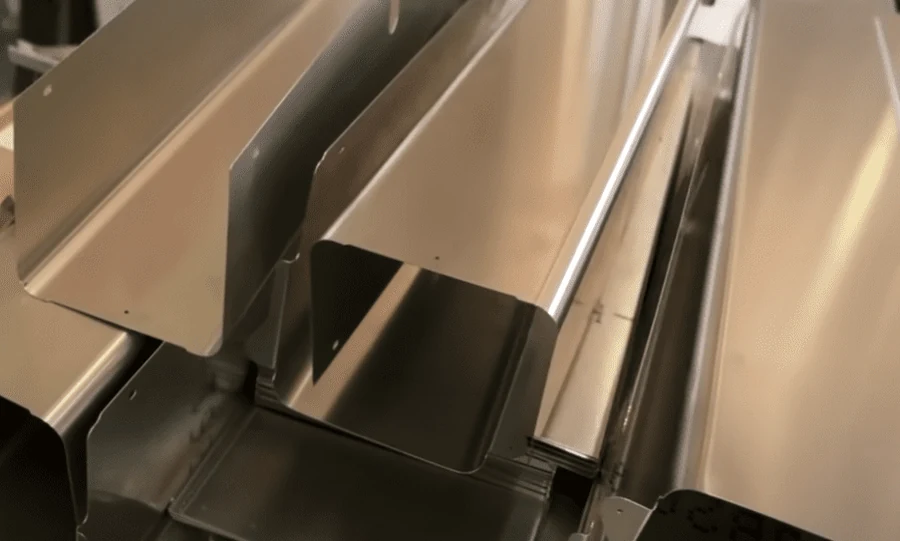
Finish is a separate operation, not a by-product of rolling: the same coil can leave as 2B or as a brushed sheet.
Finishing and Cutting to Size
Finishing is where a mill order becomes a deliverable. Coils are slitted to width, sheets are cut to length, bar is cut and, where the drawing asks for it, ground or peeled. Edges are trimmed, burrs removed and the material protected for transport — usually with an interleaving film or paper that has to be specified for the destination climate, because the wrong interleaf can stain a polished surface in a container.
Two details decide more complaints than the grade itself. The first is flatness: a coil that is not properly tension-levelled will show a wave after cutting into sheets. The second is edge condition on slit coil, where a poor slit leaves a burr that shows up as a scratch on the customer's press.
What the Paperwork Should Show
A stainless delivery is only as good as the certificate that travels with it. The mill certificate should name the standard and the grade, the heat number, the chemistry, the mechanical results and the condition — annealed, cold worked, hardened and tempered, or as-rolled. For a 3.1 certificate the mill declares its own test results; for a 3.2 certificate an independent inspector signs them.
When the material is critical, three checks are worth adding: product analysis on the delivered piece rather than the heat, a positive material identification scan to confirm the grade, and an intergranular corrosion test where the part will be welded or used in an aggressive environment. We supply sheet, bar and tube against the standard named on the order, with the certificate and heat number on the packing list; the materials page lists what is normally stocked, and machining can be quoted on the same order where the part is made here.
Comment
0 comments
Got thoughts or experiences to share? We’d love to hear from you!