

Two Answers Decide the Process
This comparison can be settled from the drawing, before anyone quotes it, and two answers carry most of the decision: how tight the tolerances have to be, and how many parts are being ordered. Everything else follows from those two, including the price that finally lands on the order.
That matters because the two processes are not better and worse versions of each other. Investment casting spends its money up front on accuracy and then spends less per part; sand casting spends very little up front and then spends more per part, mostly at the machine shop. Reading a comparison as a scoreboard — which process is “better” — is how the wrong one gets chosen on a part that only ever needed one of the two.
Investment vs Sand Casting at a Glance
Part weight, wall thickness and tolerance settle most projects, because a part that fails any of the three is out of one of the processes regardless of what the quote says.
| Factor | Investment casting | Sand casting |
|---|---|---|
| Typical part weight | Small to medium, up to tens of kg | Tens of kg up to several tonnes |
| Minimum wall thickness | 1–2 mm | 3–5 mm |
| As-cast tolerance | ±0.1–0.3 mm typical | ±0.5–1.0 mm typical, tighter grades at extra cost |
| As-cast surface | Ra 1.6–6.3 µm, smooth | Ra 12.5–25 µm, visible grain and parting line |
| Geometry limits | Undercuts, internal passages, thin walls | Draft required, usually 1–3° |
| Tooling | Higher: a precision wax die | Lower: a pattern |
| Machining after casting | Light, on critical faces only | Heavy on the functional faces |
| First-part lead time | 4–8 weeks | 2–4 weeks |
| Volume fit | Medium to high | Low volume, or very large simple parts |
| Common materials | Stainless, alloy steel, tool steel, superalloys | Cast iron, ductile iron, aluminium, carbon steel |
Read the table by column rather than by row. The investment column trades higher tooling for accuracy and less machining; the sand column trades the other way, and the two trades are the whole argument.
How the Two Molds Are Made
Both processes pour molten metal into a cavity, so the difference is in the mould itself: what it is made of, and how many times it can be used. That single difference is what sets the cost structure each process carries.
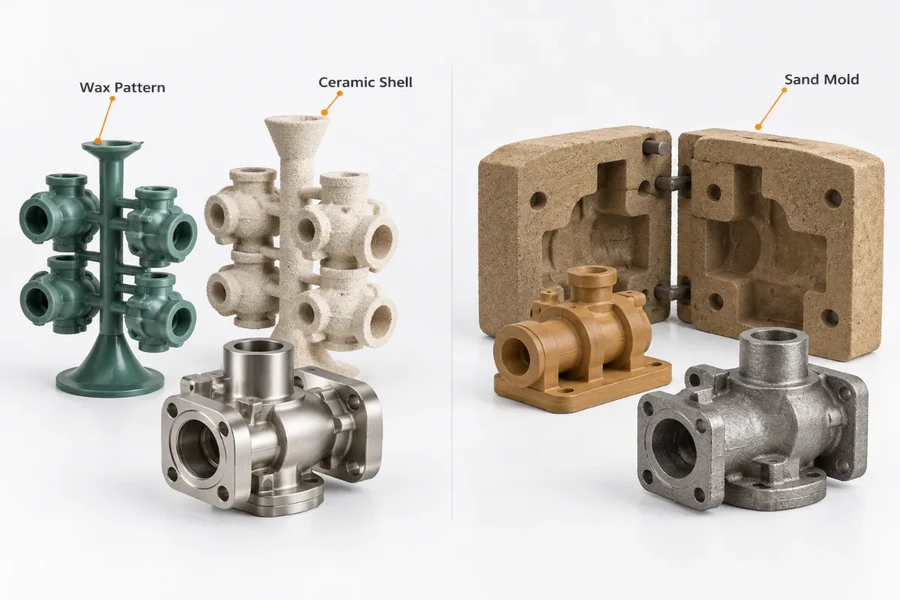
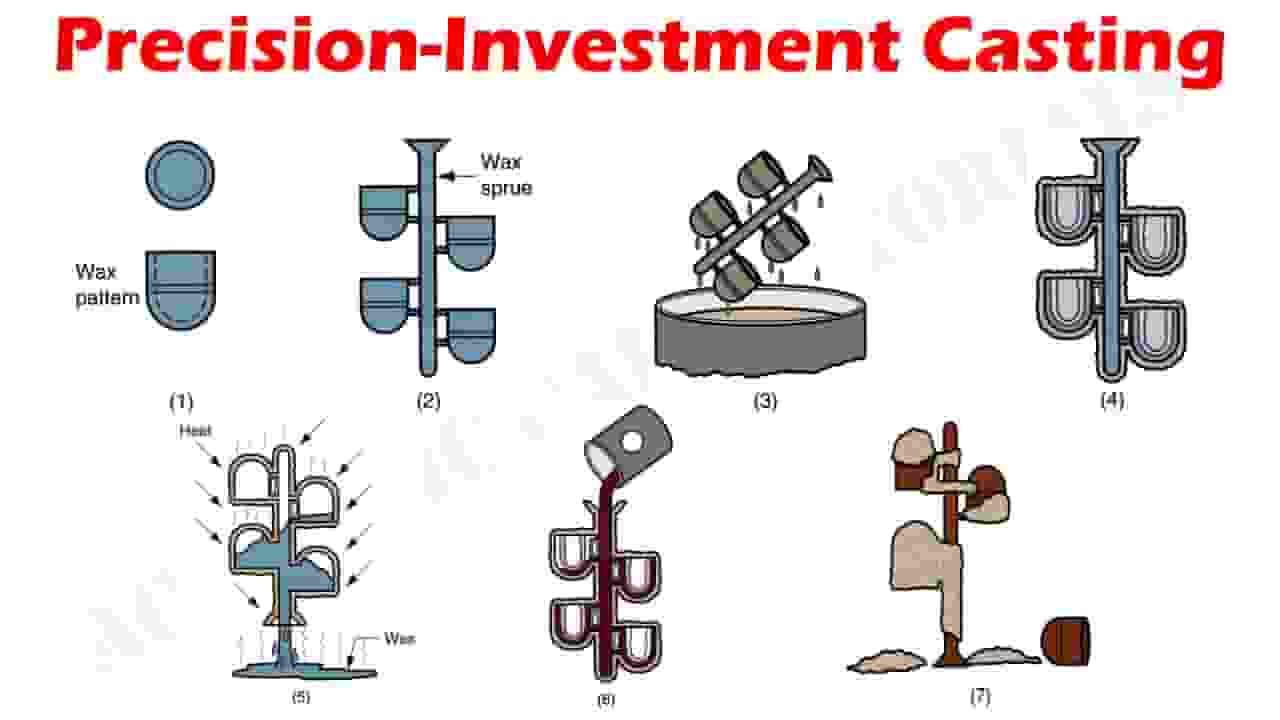
The two molds side by side: the wax tree and ceramic shell that are consumed with every run, and the sand mould that is broken away while the pattern survives.
Investment casting starts with a wax pattern injected for every single part. The patterns are attached to a tree — dozens of identical parts on one runner — and the tree is dipped in ceramic slurry and dried repeatedly until a shell has built up around it. The wax is melted back out, metal goes into the empty shell, and breaking the shell away releases the castings, which are then cut off the tree and finished. The wax die is the only reusable item in the whole chain, and it is precision work: everything after it is consumed with every run.
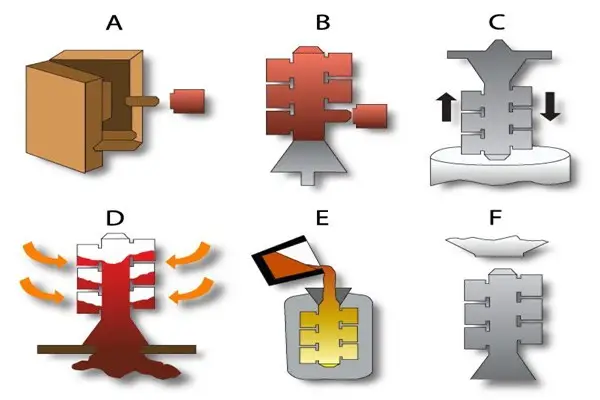
Sand casting works the other way round. A pattern is packed into bonded sand to form a cavity, the pattern is withdrawn, and the two mould halves are closed and poured. When the metal has cooled the sand is broken away and the casting cleaned. The mould is destroyed on every pour while the pattern survives, so tooling stays cheap — and the price for that is dimensional, because sand shifts slightly as it is packed and poured, which is exactly where the wider tolerance bands come from.
Size and Material Come First
Part size leads the checks because it can end the discussion before cost is ever raised. Sand moulds scale far beyond ceramic shells: a sand foundry covers parts from a few kilograms up to several tonnes, which is why pump housings, machine bases and counterweights are still poured in sand. The investment route stays in the small and medium band, where a shell holds the metal on its own and the pattern keeps its shape while it is handled and dipped.
Weight is the hardest filter to work around, because no tolerance requirement makes a ceramic shell hold a part it was never sized for. It is worth confirming the weight band before any other comparison gets made.
Materials then split along a different line. Grey and ductile iron belong to the sand side: they pour well at the temperatures and section thicknesses sand handles, and the surface those parts need is rarely demanding. Investment casting holds the alloys that are expensive to cut: nickel-based superalloys, tool steels and 17-4 PH stainless among them. Because the part arrives near net, an expensive alloy does not turn into expensive chips — and stainless, which oxidises more in a sand mould and needs extra cleaning, tends to be pushed toward a ceramic shell for that reason as much as for accuracy.
Draft, Cores and Undercuts
Geometry is where the two moulds diverge most, and it comes down to whether the tool has to be pulled out or broken away.
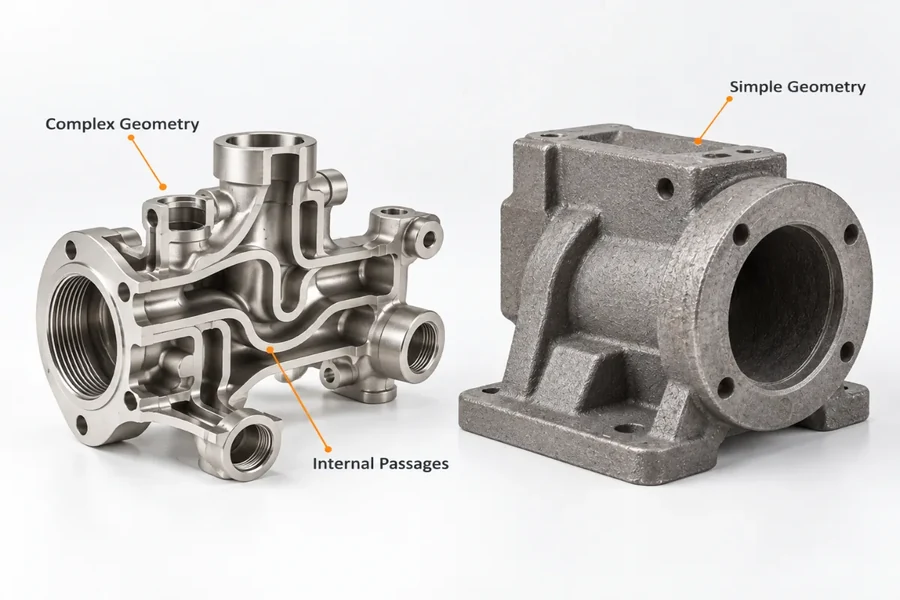
Draft and pull direction set the sand side; a shell broken away instead of pulled can cast internal passages and undercuts directly, which is where geometry decides the process.
A sand pattern has to be withdrawn from the mould, which imposes two limits. Every surface in the pull direction needs draft, typically one to three degrees, and any feature that would trap the pattern needs a core or a redesign. An investment shell has no such constraint, because it is broken away rather than pulled: undercuts and internal passages can be cast directly with no core to position, and several parts that would otherwise be machined and assembled can be merged into one casting. If the design calls for an internal channel that only works as one piece, that detail on its own settles which process to use.
As-Cast Accuracy and Surface
As-cast means straight out of the mould, with no machining, and the two processes are an order of magnitude apart on it. Investment casting holds roughly plus or minus 0.1 to 0.3 mm on as-cast features. Sand practice normally finishes between plus or minus 0.5 and 1.0 mm; holding anything tighter than that is possible, and is charged for. The difference sits in the mould itself: a ceramic shell is rigid and holds its dimensions, whereas packed sand can move as the metal goes into it.
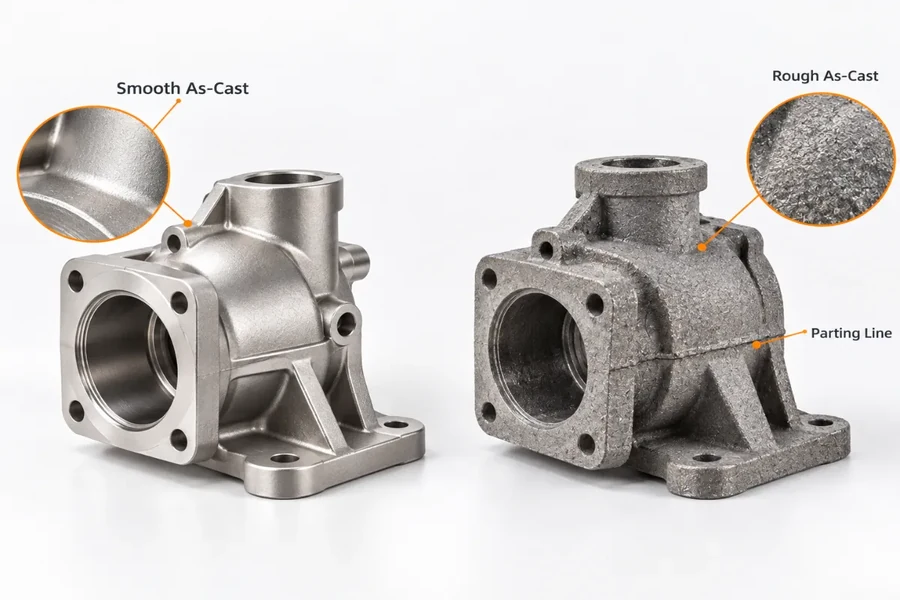
As-cast surface decides how much of the part reaches the grinder: a fine shell finish against a grainy sand surface with a visible parting line.
The useful question is not which process is more accurate overall, but which features have to be accurate as-cast. Any dimension that will be machined either way can be cast loose and cut to size later, which is where a lot of unnecessary tooling money gets spent.
Surface behaves the same way. An investment casting leaves the shell at roughly Ra 1.6 to 6.3 µm, fine enough that many non-functional faces go straight to assembly or coating. Sand casting arrives nearer Ra 12.5 to 25 µm with a grainy texture and a visible parting line. That difference decides how much of the part has to be ground or machined — a cost that rarely appears on the casting quote itself and then arrives with the finishing invoice. Our surface finish reference covers what each finish costs to achieve.
Cost per Finished Part, and Lead Time
Cost comparisons between these two go wrong most often because the processes spend money in different places. Three terms decide it.
| Term | How it is built | Who carries the weight |
|---|---|---|
| Cost per finished part | (tooling ÷ quantity) + casting cost + machining cost + scrap allowance | Tooling dominates at low volume, machining at high volume |
| Break-even quantity | Tooling difference ÷ saving per finished part | The quantity above which investment casting wins |
| Machining cost | Stock allowance × machined area | Paid at the machine shop, not the foundry |
Sand casting starts with the smallest first term and the largest third; investment casting reverses both. Under the break-even quantity the tooling line is the one you feel; over it, the machining line decides the price. The machining line is the one that gets overlooked, since it is invoiced by the machine shop rather than the foundry, and it scales with the stock left sitting on a functional face. A sand casting with generous allowances can therefore finish dearer per part than the investment casting it was being compared with.
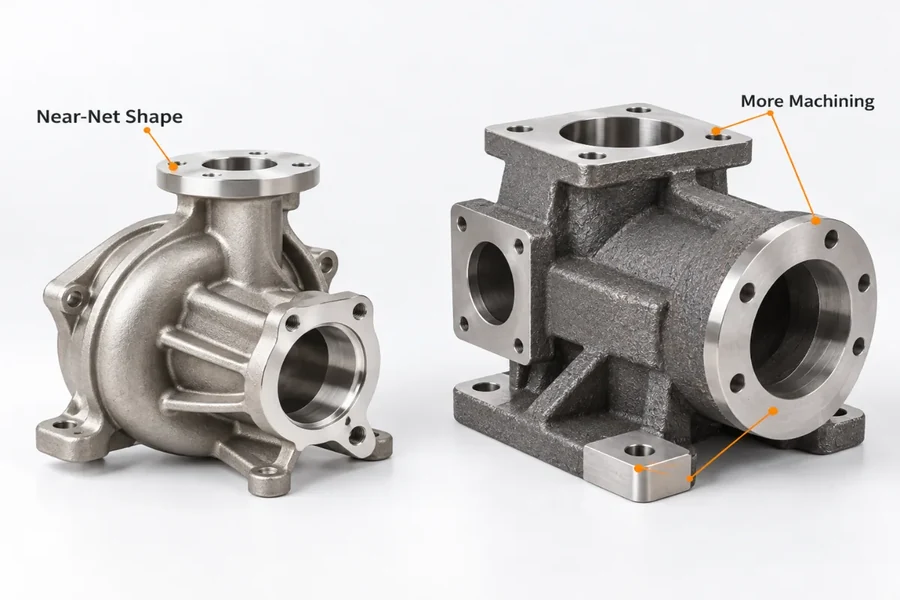
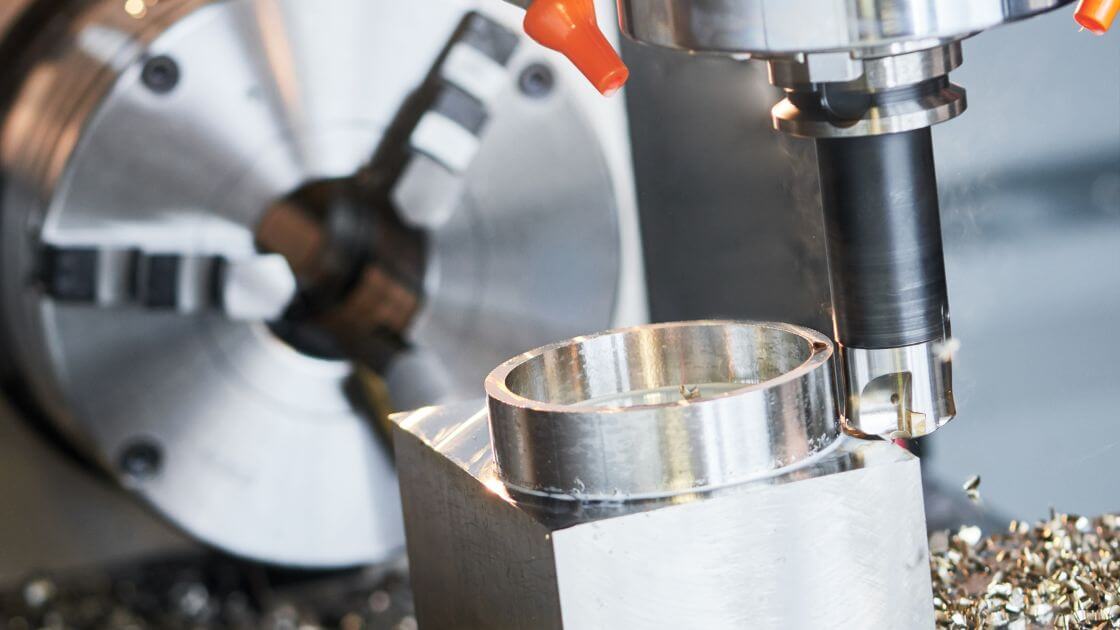
The third cost term in one picture: near-net shape with light finishing against heavy stock on every functional face, paid for at the machine shop rather than the foundry.
Which means the number worth comparing is the finished part, not the casting. A supplier who quotes the machining next to the casting is quoting the part; a casting price on its own is only half of it.
Lead time follows the tooling. Sand casting usually delivers a first article in two to four weeks; an investment casting takes four to eight weeks before the first part exists, and most of that extra time sits in the wax die and the shell process rather than in pouring metal. The gap narrows once both routes are running, but the cost of being wrong early does not narrow at all: a pattern is cheap to change and a wax die is not. That asymmetry is why programmes expecting changes after the first batch usually begin in sand.
Running the Four Checks
The choice sorts itself out when the checks run in order, because each answer can eliminate a process before the next one matters:
- Size and weight, which rules out a process the mould cannot hold.
- Material grade, which sends each alloy to the mould it suits.
- Geometry and tolerance, where a shape one route cannot produce, or cannot hold to size, drops out.
- Volume and total cost, which decides between whatever survives the first three.
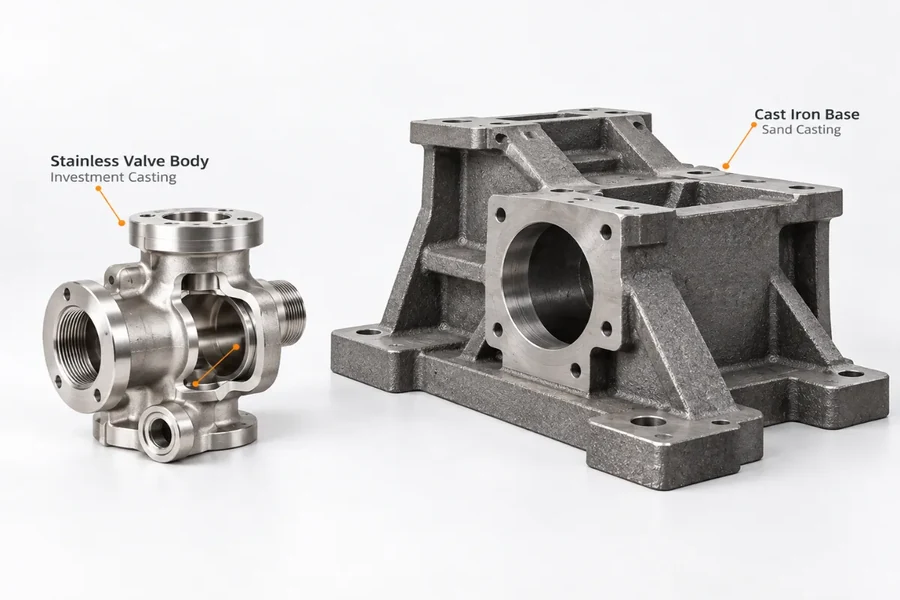
The worked example: a stainless valve body with an internal passage that decides the process, and a cast iron base that is fully machined anyway.
Investment casting earns its tooling when the part carries features sand cannot hold: internal passages and undercuts that would otherwise need cores, walls in the 1 to 2 mm range that sand cannot fill reliably, and surfaces that have to look finished as-cast with no second operation. The material reinforces it, because superalloys and hard stainless are expensive to cut. The clearest signal of all is a component that would otherwise be assembled from several machined pieces: casting it whole removes the joints, the fasteners and the seal faces they need.
Sand casting wins when the part is large, simple and tolerant: machine bases, housings, brackets and counterweights in iron, where nothing beyond the casting is needed. It also wins on parts that will be fully machined anyway, because the accuracy of a shell would be paid for twice, and on low volume without a growth path, where a pattern is cheaper to make and cheaper to change than a wax die.
Two parts on the same shop floor show the order working. The first is a valve body in stainless, roughly 4 kg, carrying an internal passage and a sealing face that must hold without being machined. Weight would clear either route and the alloy points to investment, but the passage settles it: producing it in sand means a core sitting through a wall that has to seal. The second is a cast iron base of about 35 kg with generous tolerances and every mounting face due for machining: size, material and the machining plan all point to sand, and the tooling difference never gets a chance to matter.
Before the drawing goes out, two things belong on it, because both change with the process: which surfaces stay as-cast and which get machined — the as-cast faces set the datum for everything measured afterwards — and the allowance left on the faces to be cut, since a sand foundry and an investment foundry will not leave the same amount. Leave both off the drawing and the job gets quoted twice, with no way to compare the two prices.
Casting and the Machining After It
Both routes run here, and both are quoted as a finished part rather than as a casting. Investment casting for the parts that need as-cast accuracy, internal passages or a single-piece consolidation — see investment casting — and sand casting for the larger, simpler sections, including ductile iron work, through sand casting and the wider metal casting range. Where a programme belongs on a different casting route altogether, we will say so instead of quoting around it: investment casting against die casting and casting against machining cover two of the alternatives, and die casting covers the third.
The part that decides most projects is the second operation. As-cast faces set the datum; the faces that mate get cut on CNC machining centres to the tolerance the assembly actually needs, which is why we quote the casting and the machining together. Send the drawing with the as-cast and machined faces marked, the allowance you expect on each cut face, alloy and quantity, and the prototype and production volumes separately. Our quality system is ISO 9001:2015; where a programme requires IATF 16949 or ISO 13485, raise it at the RFQ stage and we will confirm whether the route fits rather than implying a certificate we do not hold. Start at the quote form, or read how investment casting works first.
FAQs
Is investment casting more expensive than sand casting?
Not per finished part, and not always per casting either. The tooling costs more because a wax die is precision work, and the machining costs less because the part arrives near net. Because the two processes spend their money in opposite places, the answer flips somewhere in the hundreds of parts: below that the tooling term dominates and sand is usually cheaper on a finished-part basis, above it the machining term takes over. The only reliable answer comes from modelling both, machining step included.
Can sand casting hold tight tolerances?
Tighter than its standard band, at a price. Standard practice lands around plus or minus 0.5 to 1.0 mm, and a foundry working carefully on moulding and inspection can go below that, but the extra shows up in price and often in schedule as well. That is why a feature needing real accuracy is normally cast with stock on it and machined to size afterwards rather than being asked of the mould.
Can investment casting handle very large parts?
It can, but the economics change quickly as size grows. The ceramic shell gets heavy and awkward to handle, the wax pattern has to stay rigid enough to hold its shape, and both push the process toward small and medium work. Once a part is into the tens of kilograms, the conversation normally starts at sand casting instead.
Which process suits low-volume production?
Sand casting, for most parts, because the pattern is simple to make and cheap to change. It is worth asking a second question at that stage, though: low volume is also where casting itself may be premature. If the design is still moving, a small batch made by machining or printing answers the same fit and function questions without committing to a pattern at all, and the pattern can be cut once the design settles.
Can a part start in sand casting and move to investment casting later?
Usually yes, but not without rework. Draft, datums and allowance are all chosen to suit the process, so geometry laid out around a sand pattern usually needs rework before a wax die is worth cutting. Where volume is expected to cross the break-even point soon, starting on investment casting can be cheaper than paying for tooling twice.
How many parts does investment casting need to pay off?
The break-even is the tooling difference divided by the saving per finished part, and where that lands depends almost entirely on how much machining the sand route would need. On a part with several functional faces, the machining saving is large and the break-even arrives in the low hundreds of parts. On a part that would be machined either way, it may never arrive, because the accuracy a ceramic shell buys is being paid for twice.
Which materials belong to which process?
Sand casting owns the cast irons: grey and ductile iron pour well into sand at thick sections, and surface quality is rarely the point on those parts. Aluminium and carbon steel run on both. Investment casting holds the alloys that are expensive to cut: 17-4 PH and other stainless grades, tool steels, alloy steels and nickel-based superalloys. Stainless also reacts more with a sand mould and needs more cleaning afterwards, another reason the same alloy leans to a ceramic shell.
What should the drawing state before it goes out for quote?
Two things, because they change with the process. First, which surfaces stay as-cast and which will be machined — the as-cast faces set the datum for everything measured afterwards. Second, the allowance left on the faces that will be cut, since a sand foundry and an investment foundry will not leave the same amount. Without both, the same part comes back as two quotes that cannot be compared.
Summary
Run the checks in order and the choice usually makes itself: size and weight first, then material, then geometry and tolerance, and only then volume and total cost. Sand casting carries size and simplicity at low tooling cost, with wider as-cast tolerances and more machining on the functional faces. Investment casting buys as-cast accuracy, finer surfaces and single-piece consolidation up front, and repays that tooling through less machining and less assembly.
The number to compare is the finished part, not the casting: tooling divided by quantity, plus casting, plus machining, plus scrap. A cheap casting with heavy allowances can lose that comparison. If you have a drawing in this range, send it over with the as-cast and machined faces marked and we will say which route it belongs on, and what the second operation will take.
Comment
0 comments
Got thoughts or experiences to share? We’d love to hear from you!