

A titanium thin-wall part does not fail in the press because the die is worn or the operator was careless. It fails because the material has almost nowhere to move. Grade 5 (Ti-6Al-4V) sheet between roughly 0.5 mm and 1.5 mm thick cracks at the radius, springs back more than steel at the same geometry, and wears the die while it does it — which is why the three problems that define a titanium stamping programme are cracking, springback and tooling cost, in that order.
This guide takes them in the order they appear on the shop floor: what the crystal structure does to a forming radius, what a warm die changes and why the temperature has to be controlled rather than merely reached, how springback is compensated rather than tolerated, what coatings do to die life, and what a small titanium batch costs when the tooling is modular.
What drives the result
- Three slip systems. At room temperature the hexagonal lattice of Grade 5 cannot distribute strain the way cubic metals do, so stress piles up at the formed radius.
- A warm window. Between 200 °C and 350 °C the active slip systems roughly triple and elongation doubles, which is the difference between tearing and forming.
- Die temperature, controlled. A closed-loop die holds the forming zone within a few degrees and logs every cycle, so the first part and the ten-thousandth see the same conditions.
- Compensation, not tolerance. Springback is predicted in FEA, designed out of the die face, and held under load at the dead point while the stress relaxes.
Why Grade 5 Cracks Before the Die Is Full
Forming is a question of how many ways a metal can deform. Titanium in its alpha phase is hexagonal close-packed, and at room temperature that structure offers only three independent slip systems; the body-centred cubic steels a press shop runs every day offer twelve. With a quarter of the deformation paths available, strain cannot spread evenly through the grains and concentrates instead where the geometry forces it — the formed radius, where stress intensity runs three to five times the level on the flat wall next to it.
Two more properties close the window. Grade 5 has a yield-to-tensile ratio of roughly 0.85–0.93, which leaves very little plastic range between yielding and fracture, and it work-hardens fast: strength rises by two to three per cent for every one per cent of plastic strain, so the radius gets harder as it is formed, exactly where more ductility would be useful. Ram speed feeds the same problem, because the alloy is strain-rate sensitive — elongation to failure falls by more than fifteen per cent once the punch is moving faster than about 0.5 m/s.
The usual shop-floor answers treat symptoms. More lubricant postpones the point at which the surface tears, and at die temperature it also burns off into fume that has to be extracted; slowing the ram reduces the strain rate and costs cycle time on every part. Neither changes the number of slip systems, which is why cold forming campaigns on hard-to-form titanium parts keep returning the same defect at the same radius.
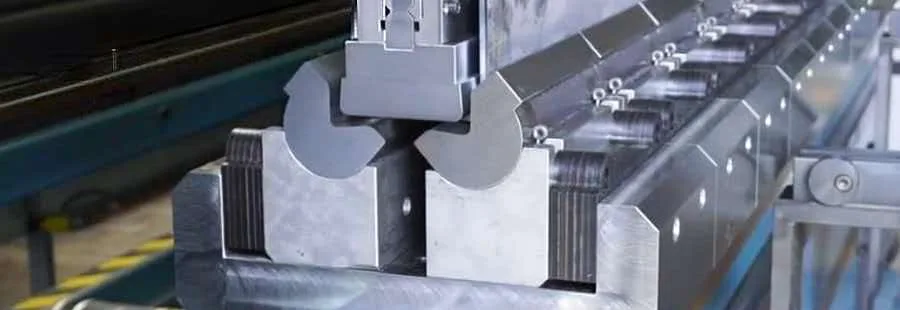
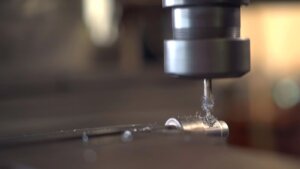
Warm stamping in the press: the forming zone is heated to 200–350 °C so the blank reaches the radius with eight slip systems instead of three.
The Warm Forming Window: 200–350 °C
Heating the blank is what changes the lattice. The activation energy available at 200–350 °C brings additional slip systems into play — around eight at 240 °C, up from three — and elongation roughly doubles. The effect on the process window is easier to read than the metallurgy: the same die that tore at 1.2 mm of draw depth can now form 3.5 mm, the minimum bend radius drops from 1.5 times the sheet thickness to 0.8, and the tolerance the die holds tightens by an order of magnitude.
| Process | Forming temperature | Elongation | Max draw depth | Min bend radius | Forming tolerance |
|---|---|---|---|---|---|
| Cold stamping | ~25 °C | 18–22% | 1.2 mm | 1.5 × thickness | ±0.20 mm |
| Low temperature | 150–200 °C | 25–30% | 2.0 mm | 1.2 × thickness | ±0.15 mm |
| Warm forming | 200–350 °C | 38–45% | 3.5 mm | 0.8 × thickness | ±0.05 mm |
| Hot forming | 600–800 °C | 50–60% | 5.0 mm | 0.5 × thickness | ±0.10 mm |
Read the last two rows together: hot forming buys the most elongation and gives tolerance back, because at 600 °C and above the tooling, the lubrication and the cooling contraction all move. The warm band is the compromise a production programme usually wants — enough ductility to form the geometry, close enough control to hold a precision band. It is also where heat has to be applied selectively: heating the whole blank wastes energy and distorts what is not being formed, so a warm die heats the forming zone and leaves the rest of the strip alone.
Controlling Die Temperature, Not Just the Part
A heated die is only useful if it is a controlled one. The working arrangement is induction heating built into the die with a closed loop: the temperature is measured at the forming zone and the power is modulated to hold it, rather than running a heater at a fixed output and hoping. The numbers that matter in production are the control band, the response time and the record.
- Control band around ±5 °C. Ductility changes with temperature, so a band that wide keeps the forming condition the same part to part.
- Heat-up in about ten seconds. The die reaches working temperature quickly after a stoppage instead of scrapping the first parts of every restart.
- Local heating only. Heating the forming zone rather than the whole die cuts energy use and keeps the surrounding tooling at a stable size.
- A log for every cycle. Storing the temperature of each stroke turns the process into something a quality engineer can review, which is what any capability study on a warm process needs.
That last point is the one buyers underestimate. A warm forming process that reaches temperature but cannot show what temperature each part was formed at is a process you cannot audit; the recorded condition is what makes a controlled parameter, and it is also what tells you why one batch behaved differently from the last.
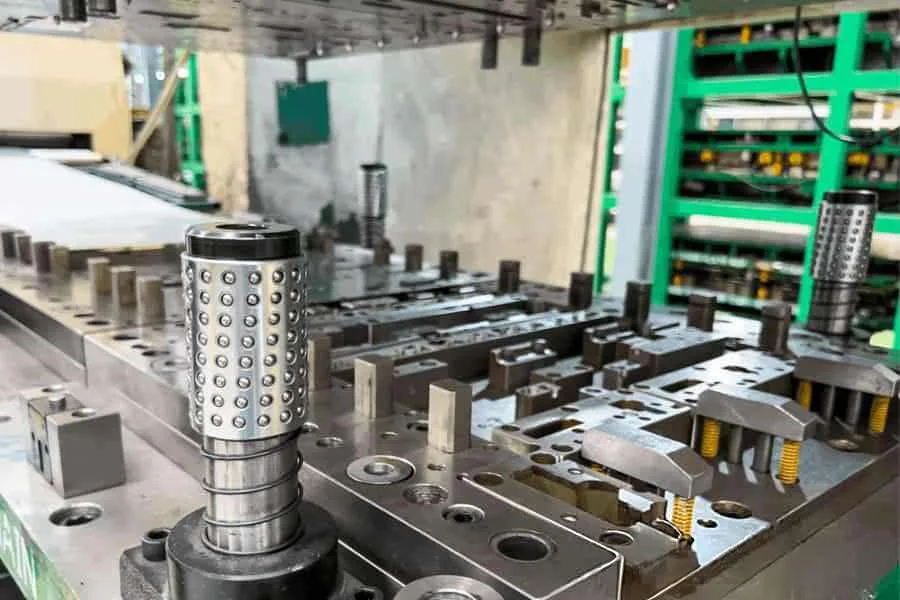
A die with ball-cage guide pillars: alignment is what keeps the heated forming zone where the drawing put it, stroke after stroke.
Springback and How It Is Compensated
Warm forming reduces springback; it does not remove it. Titanium still returns elastically when the load comes off, and the return is larger than steel at the same radius, which matters most on exactly the parts this process is chosen for: thin walls with a formed corner that has to sit flat against something else.
The compensation is geometric. The springback for the specific radius, thickness and material condition is predicted first, typically with an FEA model that tracks the elastic recovery through the stroke, and the die face is then cut over-bent by that amount so the part lands on nominal after it springs. This is reverse deformation rather than a trim allowance: the tool is wrong on purpose, by a calculated amount, to make the formed part right.
On the press the second half of the fix is time. A dead-point hold of 1.5–3.0 seconds keeps the part loaded at the bottom of the stroke and at temperature long enough for the stress to relax rather than snap back the instant the ram reverses. The pair is then verified on the first-off parts and corrected — a compensation model is a starting point, and the parts decide whether it was right.
Coatings, Galling and Die Life
Titanium is chemically eager. Its oxide layer is stable, hard and abrasive, and when it slides against tool steel under pressure the two surfaces pick up and tear at each other — galling — which is what actually ends a titanium die's life, long before the steel wears out. A lubricant film helps and is not a fix, because the load at the radius breaks the film.
A surface coating is the fix. A nano-PVD coating in the HV 3300 range with a low-friction top layer keeps the blank from welding to the working face, and combined with a die held at a stable warm temperature it moves die life from the 5,000–10,000 hits an uncoated cold die manages on Grade 5 to 40,000+. The temperature discipline matters as much as the coating: a die that cycles hot and cold between strokes fatigues its own surface, and no coating compensates for that.
| Indicator | Cold stamping, typical | Warm forming, process window | What it buys |
|---|---|---|---|
| Crack rate at the radius | 25–45% | Approaching zero on a controlled die | Rework and replacement parts fall out of the batch |
| Forming tolerance | ±0.20 mm | ±0.03–0.05 mm | The part can be used in a precision assembly |
| Elongation | 18–22% | 38–45% | Complex radii and deeper draws become formable |
| Die life | 5,000–10,000 hits | 40,000+ hits | The tooling is amortised over more parts |
| Tooling for a short run | 100% of a dedicated die | Around 50% with a modular insert | A 100–500 piece batch becomes viable |
The crack-rate figure deserves a qualification. It is the target of a controlled warm process, not a promise that any heated die will produce it: the number a buyer should ask for is the scrap rate measured on their own run, first-off and at the end of the batch, on a die whose temperature log they can see.
Small Batches Without Full Die Cost
Titanium projects are usually low volume and high value — an implant housing, a bracket for an instrument, a luxury part where the surface is the product. That profile is what kills a conventional die budget: a dedicated tool for 300 pieces carries the same design and manufacturing cost as one for 300,000.
The way around it is modular tooling. The heated forming insert is built as a quick-change element that seats in a shared, already-proven base, so a short run pays for the working geometry rather than the whole die. Tooling cost for a 100–500 piece programme typically lands near half of a single-purpose die, and the same base can take the next part number without being rebuilt. Where the geometry supports it, a progressive arrangement makes the same economics work at higher volume by combining operations in one pass.
Below a certain volume the comparison changes and machining wins. A single millimetre wall with one or two formed features is usually cheaper cut from plate than tooled, which is why the honest answer to “stamp or machine?” depends on the feature count: send the drawing and the answer can be priced both ways.
What to Specify and How It Is Checked
A warm-formed titanium part can hold a band of roughly ±0.03 to ±0.05 mm on the features the die controls, against ±0.20 mm for the same geometry cold. The features that move are the formed radius and the wall; the flat areas between them are as stable as the die face. Unlabelled dimensions take the general tolerances of ISO 2768-1, so there is no need to put a tight band on a clearance slot that will never touch another part.
Inspection follows the same logic. The first-off parts and a sample from the batch go to a CMM on a fixture that holds the part on its assembly datums, because a springback measurement taken on a free-standing part measures the wrong thing. Measure after the part has cooled to room temperature as well: warm forming ends with a thermal contraction that is small per part and systematic across the batch, and a measurement taken hot will hide it.
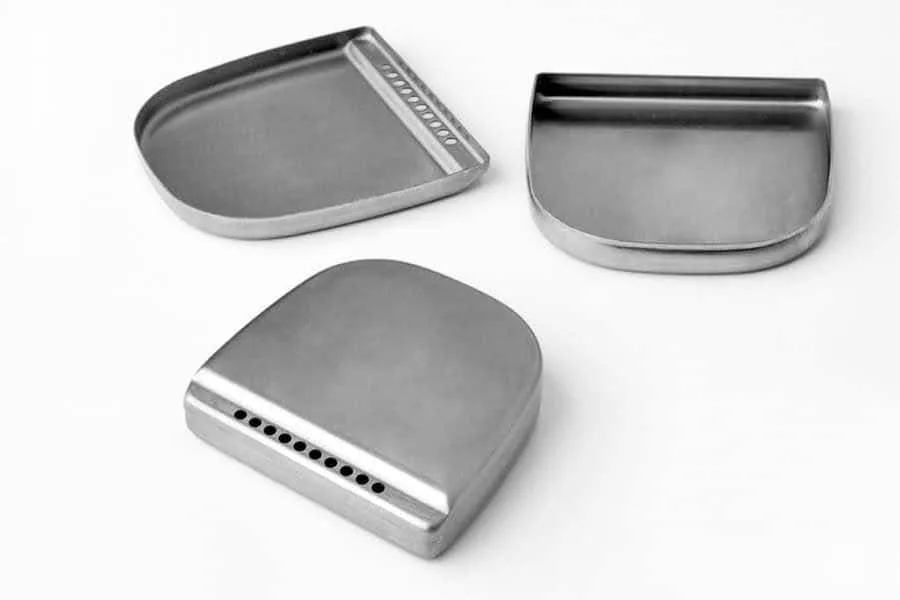
Drawn titanium shells — the wall and the formed radius are the features a CMM checks first, and the ones springback compensation is aimed at.
Titanium and Precision Stamping at SHBD Metal
We have been making parts since 1994 and run stamping, forming and machining under one roof, so a titanium programme can be quoted as a stamped part or as a machined one without either answer being distorted by what the shop prefers to sell. The plant works to an ISO 9001:2015 quality system with 150+ staff, more than a hundred machines and seven inspectors, and the forming processes described here — warm stamping, precision metal stamping and progressive die work — sit alongside metal stamping as the standard routes. Where a titanium geometry is better cut than formed, we will say so and quote titanium machining instead.
What we do not claim is a certification we do not hold. If a programme requires a certified automotive quality system from the production supplier — rather than IATF 16949 being mentioned as a nice-to-have — tell us at RFQ stage and we will say plainly whether we fit. Otherwise the useful first step is the drawing: we review the radii, the wall and the tooling route, and come back with the forming plan and the price together.
Send the Drawing for a Forming Review
FAQs
Why does Grade 5 titanium crack when it is formed cold?
The alloy's hexagonal close-packed lattice offers only three independent slip systems at room temperature, against twelve in the cubic metals most press shops are used to. Deformation cannot spread through the grains, so it concentrates: stress at a formed radius runs three to five times the level on the flat wall beside it. On top of that, Grade 5 holds a yield-to-tensile ratio around 0.85–0.93, so there is very little plastic reserve once it yields, and it work-hardens by two to three per cent for every one per cent of strain — the radius gets stronger and more brittle as it forms. Ram speed makes it worse: elongation to failure drops by more than fifteen per cent once the punch passes roughly 0.5 m/s.
What does heating the blank to 200–350 °C actually change?
It opens the lattice. At around 240 °C the number of active slip systems rises from three to about eight, and elongation roughly doubles, from 18–22% to 38–45%. In press terms that widens the process window: maximum draw depth goes from about 1.2 mm to 3.5 mm, the minimum bend radius falls from 1.5 times the sheet thickness to 0.8, and the tolerance band the die can hold tightens from roughly ±0.20 mm to ±0.03–0.05 mm. Above that window the tooling and lubrication regime changes again, and hot forming near 600–800 °C buys more elongation but gives some of the tolerance back.
How is springback dealt with on a titanium part?
By compensating the die rather than fighting the material. The springback is predicted first, usually with an FEA model of the actual radius and wall thickness, and the die face is then cut over-bent by the predicted amount — a reverse deformation of the geometry rather than a trim allowance. On the press, a dead-point hold of about 1.5–3.0 seconds keeps the part under load at temperature long enough for the stress to relax instead of releasing on impact. Both are then checked on the first-off parts and corrected, because a springback of 0.05 mm is a tolerance failure on a one millimetre wall.
What die life should a titanium stamping programme expect?
It depends on the coating and the temperature control more than on the tonnage. An uncoated tool steel die forming Grade 5 typically manages 5,000–10,000 hits before it needs reconditioning, because titanium's active oxide layer galls and tears the working surface. A nano-PVD coating in the HV 3300 range with a low-friction top layer changes that behaviour, and a die kept at a stable warm temperature rather than cycling hot and cold reaches 40,000+ hits. The coating is not decoration: on titanium it is what keeps the material from welding itself to the die.
Is a 100–500 piece titanium run economical?
It can be, if the tooling is modular. A quick-change insert system lets the heated forming insert sit in a shared base, so a small programme pays for the working geometry rather than a complete dedicated die; tooling cost for a short run typically lands near half of a single-purpose die. Below that, machining the part from plate is often the cheaper route, particularly for a wall under a millimetre or a geometry with several formed features. Send the drawing and we will say which of the two the part actually wants.
Summary
Titanium stamping is a materials problem before it is a tooling one. Grade 5 has three slip systems at room temperature and an unhelpful yield ratio, so cold forming concentrates stress at the radius and cracks. Warming the forming zone to 200–350 °C roughly triples the available slip systems and doubles elongation, which widens the draw depth, the minimum radius and the tolerance the die can hold. What remains is process discipline: a die temperature that is controlled and logged rather than merely hot, a die face compensated for springback and held at the dead point while the stress relaxes, a coating that stops titanium galling the tool, and modular tooling so a short run does not pay for a long-run die.

Comment
0 comments
Got thoughts or experiences to share? We’d love to hear from you!