

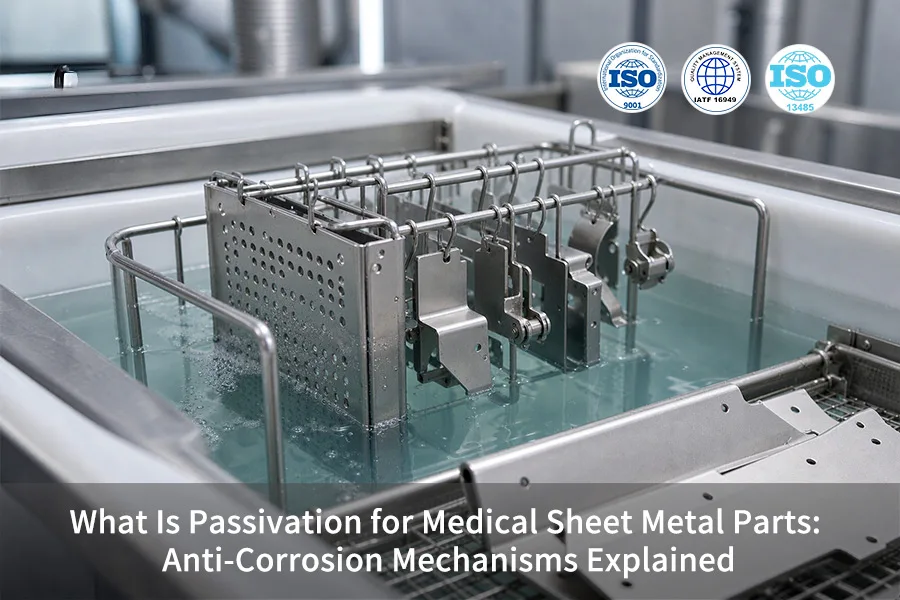
A rack of formed 316L parts entering the acid bath. Passivation runs after forming, welding and deburring, never before.
Rust on a stainless medical component is usually read as the wrong material arriving on site. It rarely is. Forming, shearing and welding all transfer free iron onto the surface of the sheet, and that contamination — not the alloy — is what corrodes. Medical sheet metal passivation is the immersion step that removes it after fabrication, so the alloy can rebuild the protective film it was always capable of growing.
This guide walks through what the bath actually does, why the chromium-to-iron ratio at the surface matters more than the grade number on the certificate, how citric and nitric routes differ, where passivation runs fail, and what documentation to ask for on a medical batch.
What this guide covers
- A chemical step, not a coating. The acid dissolves surface iron and the chromium oxide film rebuilds from the substrate — a layer measured in nanometres that cannot chip or peel because nothing was added to the part.
- Dimensions survive intact. The reaction strips less than 0.001 mm of stock, so formed tolerances stay valid after immersion, unlike electroplating which changes the profile and needs an allowance.
- Chemistry follows the alloy. Citric chelation removes free iron and leaves nickel and chromium alone; nitric oxidation cleans more aggressively but spends more metal.
- Failures usually happen before the tank. Oil films, saturated baths and carbon-steel tooling account for most rejected batches, not the acid chosen.
What Passivation Does to a Formed Stainless Surface
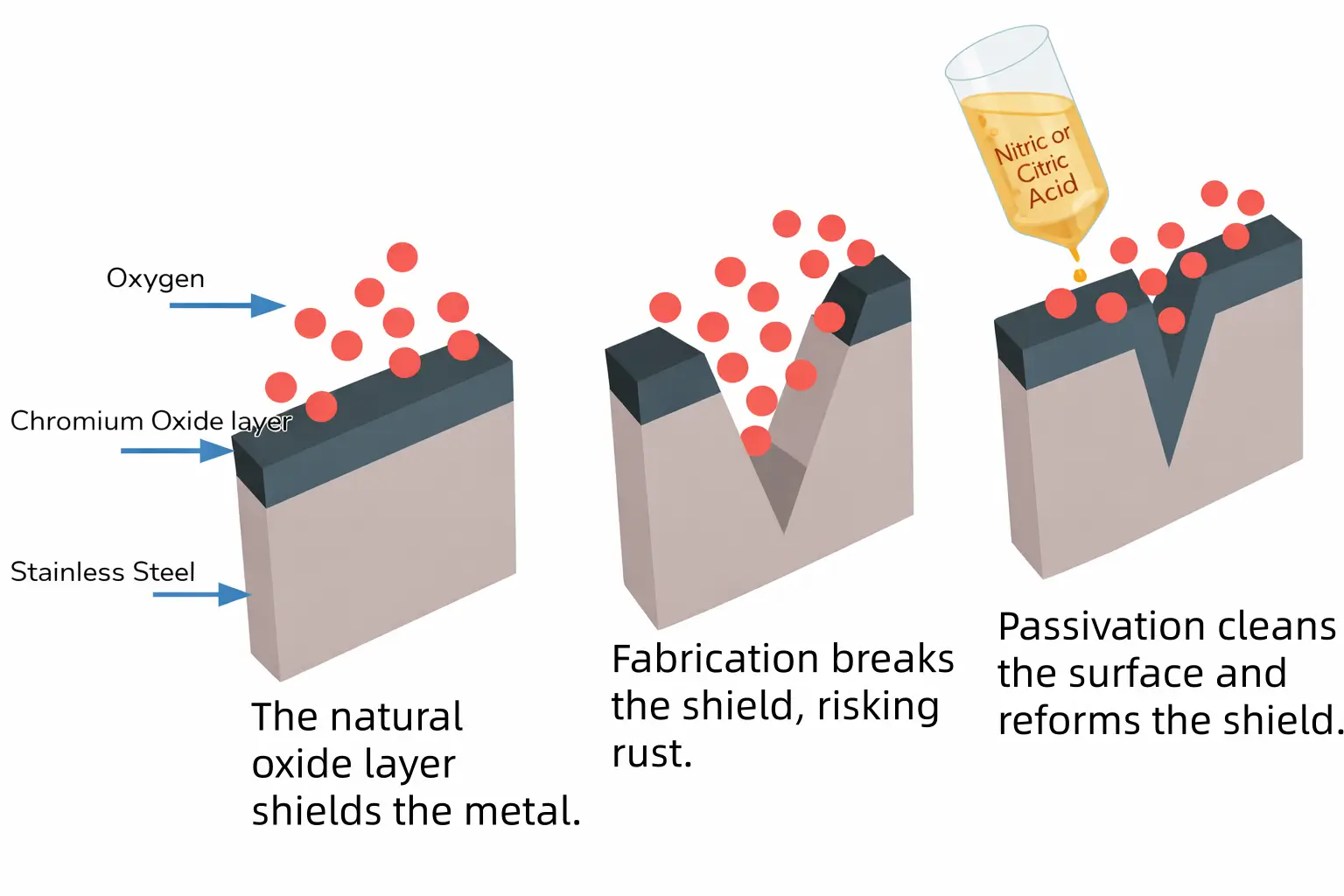
Passivation is a post-fabrication acid immersion that dissolves free iron from a stainless surface and lets the alloy re-form its own chromium oxide skin. It is not plating and it is not a conversion coating: nothing is deposited, nothing is added to the wall thickness, and the film that results grew out of the metal itself.
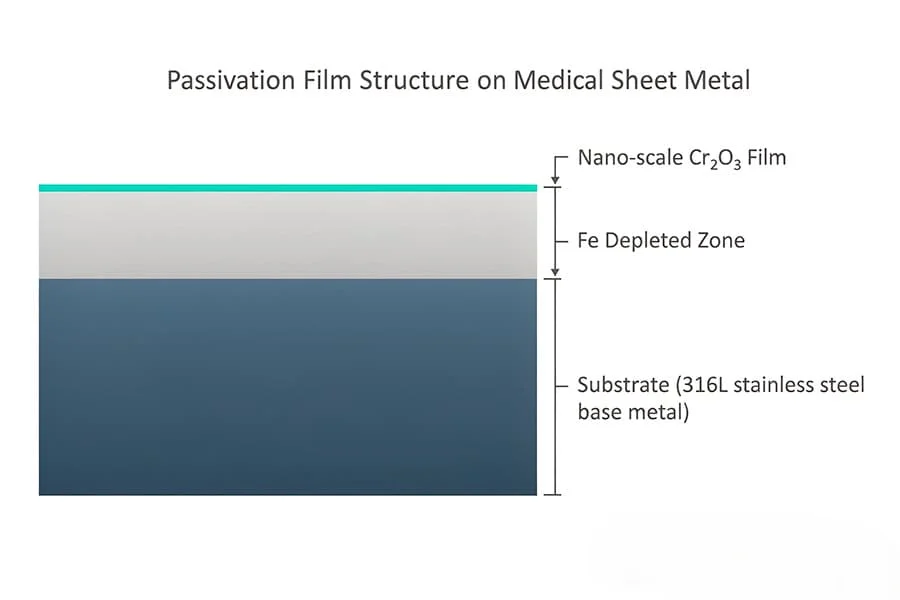
The passive film, in three layers: 316L substrate, an iron-depleted zone left by the bath, and a chromium oxide film of roughly 1.5–3.0 nm.
The thickness is the part most engineers misread. Surface treatments for stainless parts are specified in ASTM A967/A967M, and the film it describes sits between 1.5 nm and 3.0 nm — three orders of magnitude below any tolerance band on a formed part. Electroplating, by contrast, adds a measurable layer that has to be designed for, and that layer meets a hard edge where it can flake.
Where the free iron comes from is worth knowing, because the answer decides whether a batch passes:
| Source of contamination | What transfers iron | Where it hides |
|---|---|---|
| Blank and trim | Shear blades and punch faces running carbon steel against the sheet | Cut edges, hole perimeters |
| Laser cutting | Spatter and dross redepositing on the cut face | Kerf walls, tight vent slots |
| Press brake forming | V-die and punch contact, tool wear on high-volume runs | Bend radii, outer tensile faces |
| Welding | Heat tint and filler pick-up along the seam | Heat-affected zone, crevices at lap joints |
| Handling | Unpainted racks, carbon-steel benches, shared bins | Whatever the part rests on |
A copper sulphate swab turns dark within seconds where free iron is still present, which is why it is the field test of choice. Stainless that fails it was never defective; it was contaminated, and a bath run to the right chemistry removes the contamination without touching the structure underneath.
How the Bath Stops Corrosion: Galvanic Cells and Cr/Fe
Corrosion on passivated stainless starts as a small galvanic cell. A free iron particle sitting on the surface acts as the anode, the chromium-rich alloy around it acts as the cathode, and a film of moisture closes the circuit. The iron dissolves, a pit opens where the particle sat, and chloride from cleaning chemistry keeps the pit growing.
That mechanism explains why the Cr/Fe ratio at the surface is a better predictor of corrosion performance than the grade stamped on the material certificate. As-received 316L typically measures a surface ratio of roughly 0.5–0.7, below the bulk value, because machining, forming and welding all leave the outer few nanometres iron-enriched. Once the bath strips that iron, chromium dominates the surface again and the passive film can close over it.
Film continuity decides sterilization endurance
A film only protects where it is unbroken. Heat tint from welding, an unground seam or a crevice that holds fluid gives chloride a path to the substrate, and autoclave cycles — hot, wet, chloride-bearing — will find it. That is why seams are ground and dressed before immersion rather than after.
The same reasoning caps how long a part should stay in the tank. Adding time does not thicken the film: the reaction is self-limiting, and an over-long dwell starts attacking chromium-poor grain boundaries instead. Bath control, not bath duration, is what carries a part through repeated sterilization.
Holding Formed Tolerances Through the Bath
A medical passivation line is a sequence of stages, and each one exists to protect the stage after it:
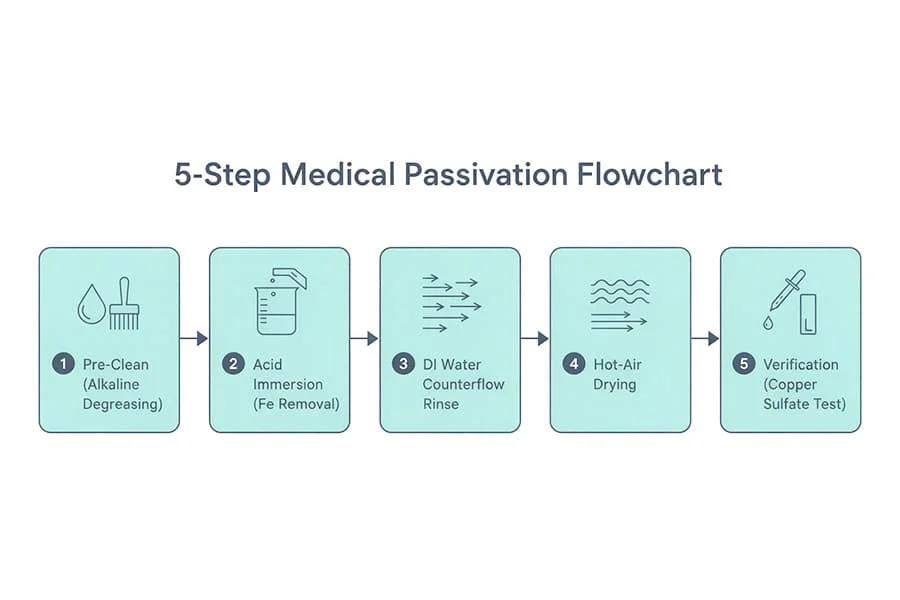
Five stages, in order: alkaline pre-clean, acid immersion, deionised counterflow rinse, hot-air drying and verification. Skipping the first stage is the most common way to fail the last one.
- Alkaline pre-clean. Ultrasonic degreasing lifts drawing oil, fingerprints and machining residue, so the acid meets bare metal rather than an oil film.
- Acid immersion. A citric bath held between 45 °C and 65 °C de-irons 316L medical work at a controlled rate. Cooler baths work slowly; hotter ones start on the grain boundaries.
- Deionised counterflow rinse. Conductivity is monitored so rinse water carries no acid into the next stage and no ions back onto the part.
- Hot-air drying. Drying closes the sequence before the film is fully formed, and trapped moisture is what leaves water marks and flash rust.
- Verification. Copper sulphate swabbing confirms de-ironing, and gauged features are re-measured against the pre-bath record.
One expectation is worth killing early: the bath cannot rescue a dimension. Acid removes iron selectively rather than uniformly, so an oversize boss stays oversize and an out-of-band hole stays out of band. Pre-bath and post-bath gauge readings should be identical, and if they are not, the fix belongs at the press or the mill, not in the tank. Tolerance stability is a forming property that passivation preserves.
Citric or Nitric Acid: Choosing the Chemistry
The two acids reach the same destination by different roads. Citric acid chelates iron — it binds the free iron and carries it into solution while leaving the alloying elements in place. Nitric acid oxidises the whole surface, which is faster on heavily contaminated or sulfide-bearing stock but also spends nickel and chromium along with the iron.
Both are permitted by ASTM A967/A967M for medical parts, and both are self-limiting: the film stops growing once the surface is covered, so salt spray comparison of coupons from each bath tends to land close together. Where they diverge is on everything around the part:
| Surface treatment | How it acts | Bath and conditions | Dimensional effect | Typical medical use |
|---|---|---|---|---|
| Citric acid passivation | Chelation lifts free iron only | 4–10% solution, 45–65 °C | Under 0.001 mm removed; profile essentially unchanged | Instrument handles, endoscope housings, enclosure panels |
| Nitric acid passivation | Oxidation cleans the whole surface layer | Higher concentration, lower bath temperature | Under 0.001 mm removed, but more alloy spent | Washer chambers, analyser frames, surgical trays |
| Electropolishing | Anodic dissolution smooths micro-peaks | Phosphoric/sulphuric electrolyte with a DC field | 5–15 µm removed, and unevenly | Implants and catheter connectors where stock removal is allowed |
| Conversion coating | Builds a synthetic oxide or chromate layer | Alkaline or oxidising salt bath | Adds a micrometre-scale film | Aluminium analyser panels and brackets |
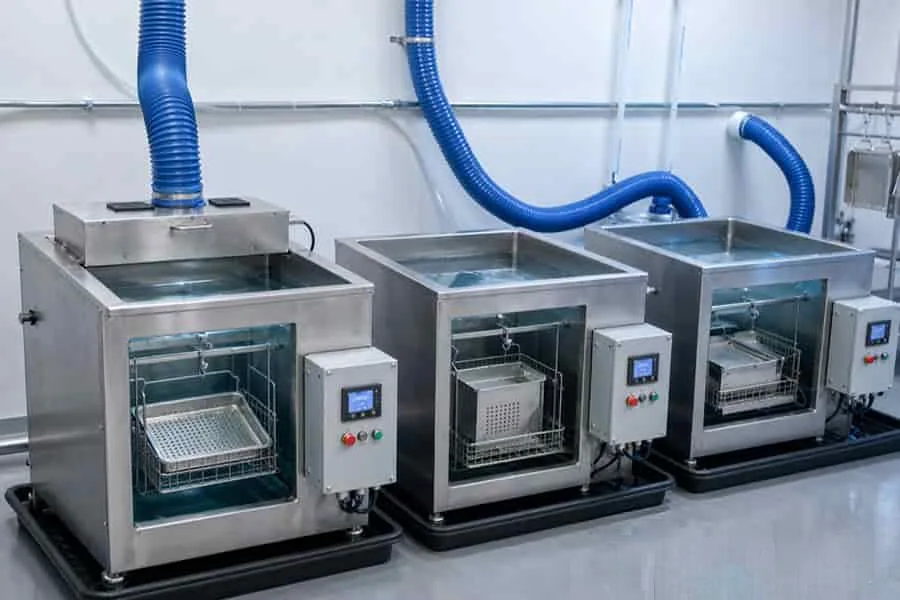
Bath stations under extraction: temperature and concentration are logged per run, which is what makes a treatment record auditable rather than anecdotal.
Two practical differences decide most medical selections. Nitric acid releases fumes that need scrubbing hardware and permits, while citric acid does not — so the regulatory burden sits on one side of the choice. And citric acid introduces no hydrogen, which matters on spring-tempered clips and martensitic parts where hydrogen embrittlement causes delayed fractures. Nitric acid carries that risk, and austenitic grades tolerate the exposure far better than martensitic ones.
Why a Passivation Run Fails Anyway
Most rejected batches trace back to conditions created before the part reached the tank. Four causes cover the majority:
An oil film that shields the metal. Drawing lubricant resists a weak alkaline soak. Where it survives, the acid only reaches the patches around it, so the film grows patchily and chloride finds the gaps. Alkaline degreasing followed by a water-break test — water should sheet evenly rather than bead — tells you the surface is ready.
An aged bath that gives iron back. Once a bath approaches saturation, dissolved iron precipitates onto the parts leaving the tank as a smut layer. Fresh rinse water will not remove it, and parts can come out dirtier than they went in. Bath life needs monitoring against a loading limit, not against a calendar.
Iron applied after the treatment. Carbon-steel press brake dies, blasting media and unpainted handling racks all transfer iron back onto a treated surface. A salt spray failure on passivated parts is often read as bad bath chemistry when the actual cause is a second forming or blast step that happened afterwards.
Liquid trapped in a crevice. Rinse water or acid held in a lap joint dries down to chloride-rich deposits that pit under steam sterilization. Drainage paths, seam dressing and a documented drying stage are what keep joints clean, and no chemistry substitutes for them.
In Practice: A Surgical Fluid-Handling Enclosure
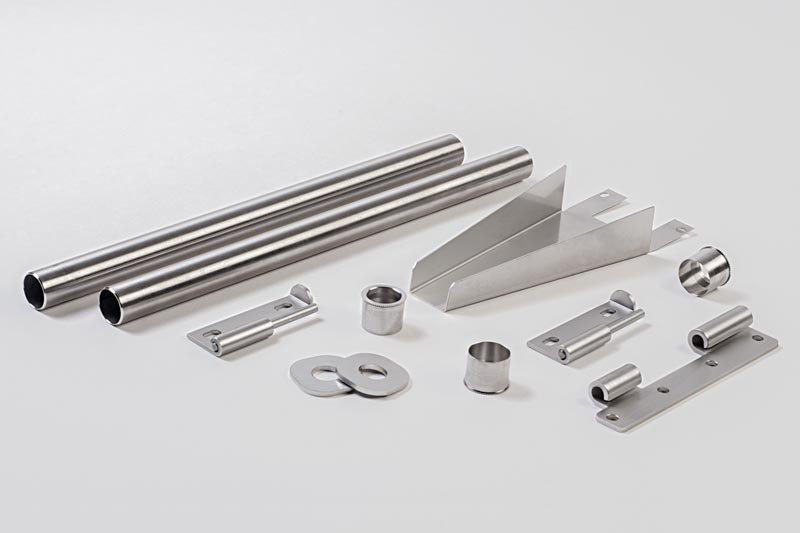
A representative job is a fluid-handling enclosure whose stamped 316L brackets sit inside peristaltic pump channels. The brackets locate the pump head, so the drawing carries a tight positional tolerance and states plainly that no coating is acceptable — a plated or painted film would change the profile the pump was designed around.
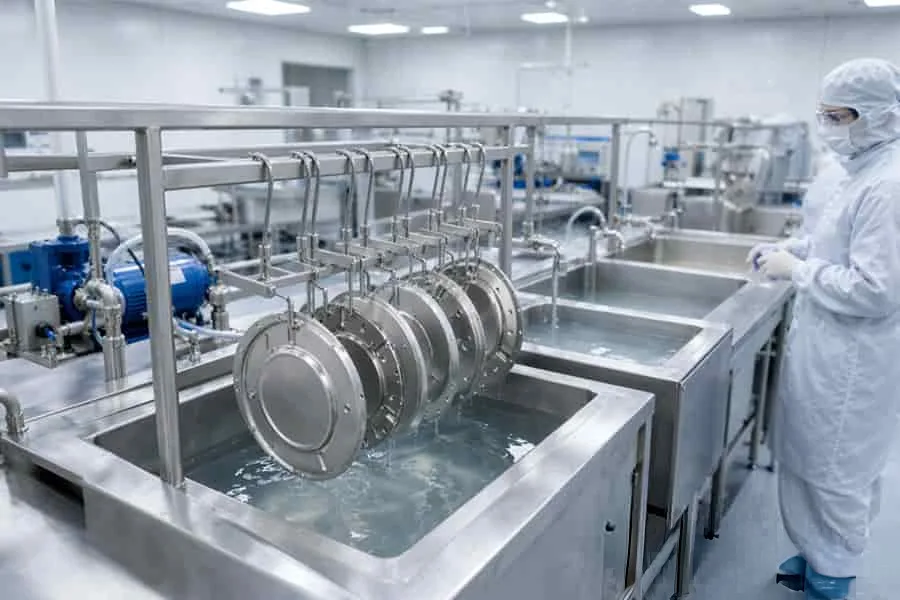
Small brackets are jigged, not piled: every face sees the bath, and every part drains on the way out.
The route that follows is the one described above: ultrasonic alkaline cleaning to remove the drawing oil, citric immersion held inside 4–10% and the mid-point of the temperature window, a deionised counterflow rinse, hot-air drying, and then copper sulphate swabbing plus measurement on the gauged faces. Two process notes carry most of the quality:
- The bath temperature has an upper bound for a reason. Cold-rolled 316L has chromium-poor grain boundaries; run the bath hot and the acid attacks those boundaries before it finishes the de-ironing work, which shows up later as intergranular attack rather than a clean surface.
- Extra dwell time buys nothing. The reaction stops when the surface is covered. Holding parts longer to be safe is the fastest way to roughen them.
Where a batch does go wrong, the cause is usually visible in the record before it is visible on the part: a degreasing stage that ran cold, a bath past its iron loading, or parts moved with bare carbon-steel tongs after treatment. None of those are acid-selection problems.
Medical Passivation at SHBD Metal
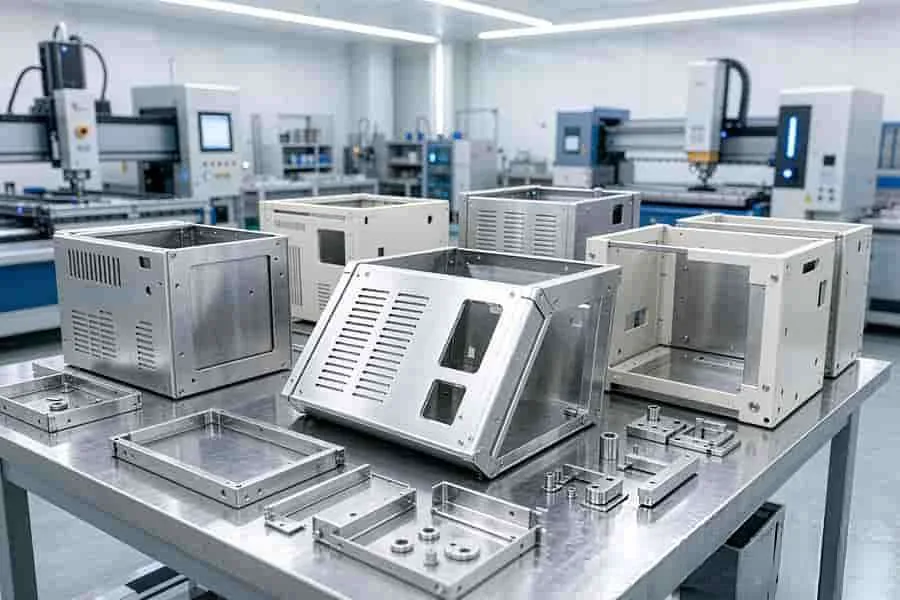
Passivation runs in-house as part of our sheet metal fabrication service, alongside fiber laser cutting, CNC press brake forming, hardware insertion and TIG welding. Because the sequence stays under one roof, the tolerance chain never leaves our control between forming and the bath, and the treatment record is written by the same team that formed the part.
We have been manufacturing since 1994, with 150+ staff, more than a hundred machines and a seven-person quality team working to an ISO 9001:2015 quality system. Medical and laboratory work is a standing part of the workload; the alloys we run are listed in the materials library, and finishes beyond passivation — anodising, powder coating, laser marking — are set out under surface finishing. Parts that need machined interfaces move to our CNC machining department instead of being pressed to a tighter band than sheet can hold.
Send the 3D model or the 2D drawing with its tolerance bands, the cleaning protocol the part will see and any standard the print names. You get back a quotation, the fabrication and passivation route we intend to run, and any drawing change we would make before cutting metal.
Have stainless parts that need passivating?
Upload Your CAD FilesFAQs
Does the acid bath change the dimensions of formed stainless parts?
No — the reaction works on surface iron, not on the alloy underneath. The bath consumes less than 0.001 mm of stock and the film it leaves rebuilds from the substrate at roughly 1.5–3.0 nm. Profiles formed to ±0.1 mm, and critical features machined to ±0.01 mm, come out of the tank where the press and the mill left them, which is why gauged features are measured before and after immersion.
Why does passivated stainless steel still rust?
Because the rust is a surface-chemistry problem rather than an alloy problem. Press brake tooling, shear blades, laser cutting and welding all transfer free iron onto the sheet, and that iron becomes a micro-anode that pits where moisture collects. Removing the iron lets the chromium-rich oxide film re-form, which is exactly what the bath does.
Citric or nitric acid for a medical part?
ASTM A967/A967M allows both routes and both finish with a comparable chromium-rich film. Citric acid chelates free iron and leaves nickel and chromium untouched, with no fume scrubbing to manage; nitric acid oxidises the whole surface, spends more metal and carries a hydrogen-embrittlement risk on spring-tempered or martensitic parts. Medical work runs citric unless the customer print names nitric.
Which standards govern medical passivation?
ASTM A967/A967M covers the chemistry and the free-iron tests for both acids, ASTM A380 covers cleaning, descaling and passivation practice, ASTM F86 covers surface preparation for metallic surgical implants, AMS 2700 is the aerospace equivalent and ASTM B117 salt spray is how two baths are compared. The quality system a shop holds decides the paperwork, not the bath.
How do I know a batch was actually passivated?
Not by looking at it. Ask for three things with the parts: the treatment record with chemistry, concentration, temperature and dwell; the copper sulphate swab result, where free iron shows up as a dark stain within seconds; and before/after measurement on any gauged feature. Those three travel with the batch whether the part is a bracket or an enclosure.
Will passivation hide a weld crack or a crevice?
No. Acid removes surface iron and nothing else, so a seam that traps rinse water still fails a hygiene review after treatment. Welds are dressed and seams are drained before immersion precisely so the oxide film can run continuously across the joint.
Summary
Passivation removes the iron that forming left behind and lets the chromium oxide film rebuild from the substrate, which is why a passivated stainless part resists chloride pitting that a freshly machined one will not. Keep three things straight and the rest follows: the bath changes surface chemistry rather than dimensions, citric acid suits medical work because it saves the alloy and carries no fume burden, and most failures are decided upstream — by degreasing, bath life and whatever touched the part after treatment.
Comment
0 comments
Got thoughts or experiences to share? We’d love to hear from you!