

Some engineering-friendly metals, like stainless steel and titanium, form a natural oxide layer that acts as a protective barrier against inconveniences like contaminants and free iron. This oxide film forms a thin but effective shield that helps isolate the base metal from the environment. But what if you could restore and stabilize that natural oxide coating without significantly altering the geometry of the metal part?
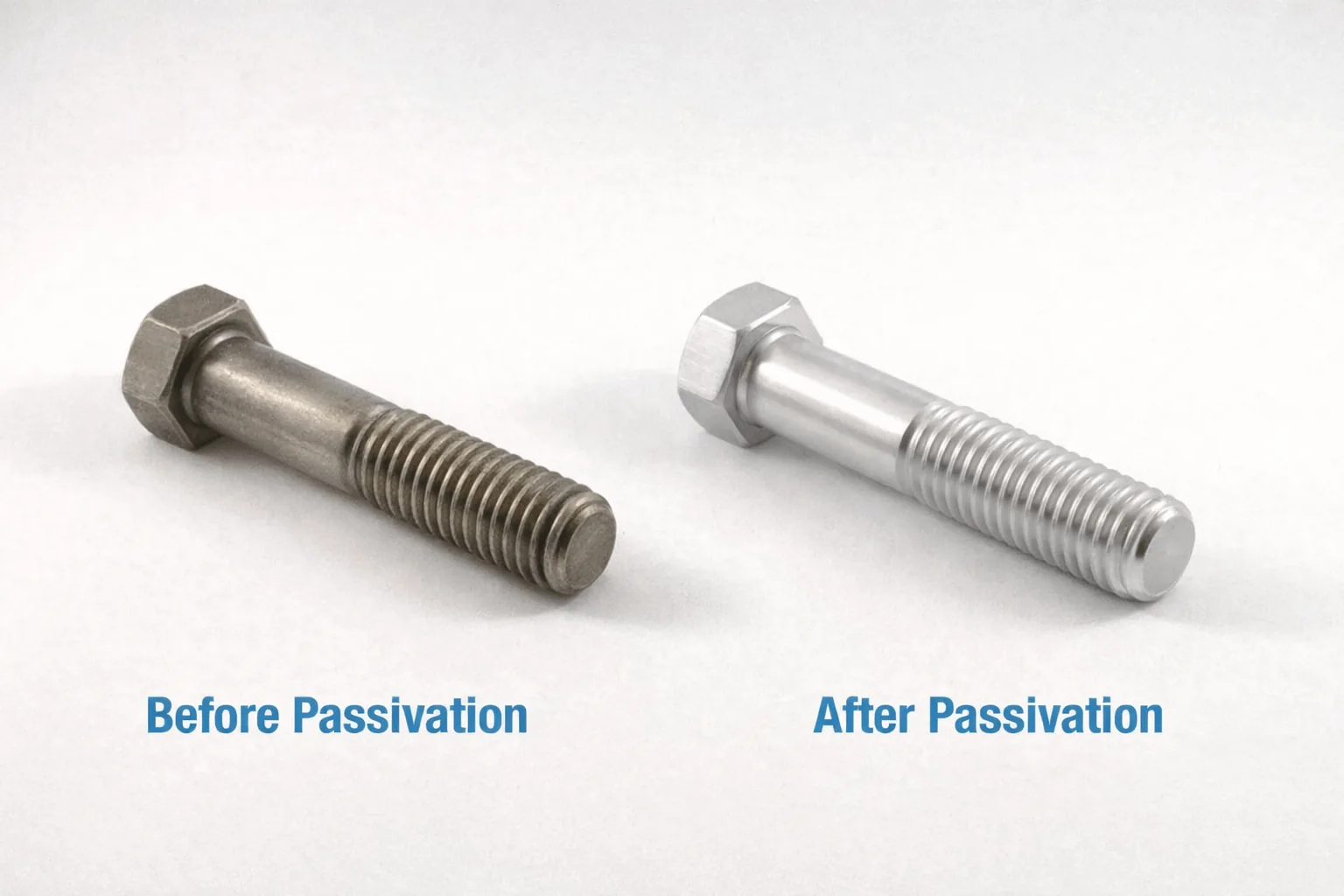
The process of passivation does just that, enhancing the corrosion resistance of metals like stainless steel.
This article goes over the basics of passivation, looking at how it works, its key advantages, and its main subtypes. In the article, we draw on SHBD Metal’s many years of experience applying surface finishing treatments to metal parts, discussing passivation as well as comparable treatments like anodizing.
What is Passivation?
Passivation is a surface finishing treatment used to improve the corrosion resistance of stainless steel and other metal parts.
The ASTM A967 standard defines passivation as “the chemical treatment of a stainless steel with a mild oxidant, such as a nitric acid solution, for the purpose of acid to remove free iron or other foreign matter, but which is generally not effective in removal of heat tint or oxide scale on stainless steel.”
However, in general use, the passivation meaning can also encompass other metals besides stainless steel.
How Passivation Works
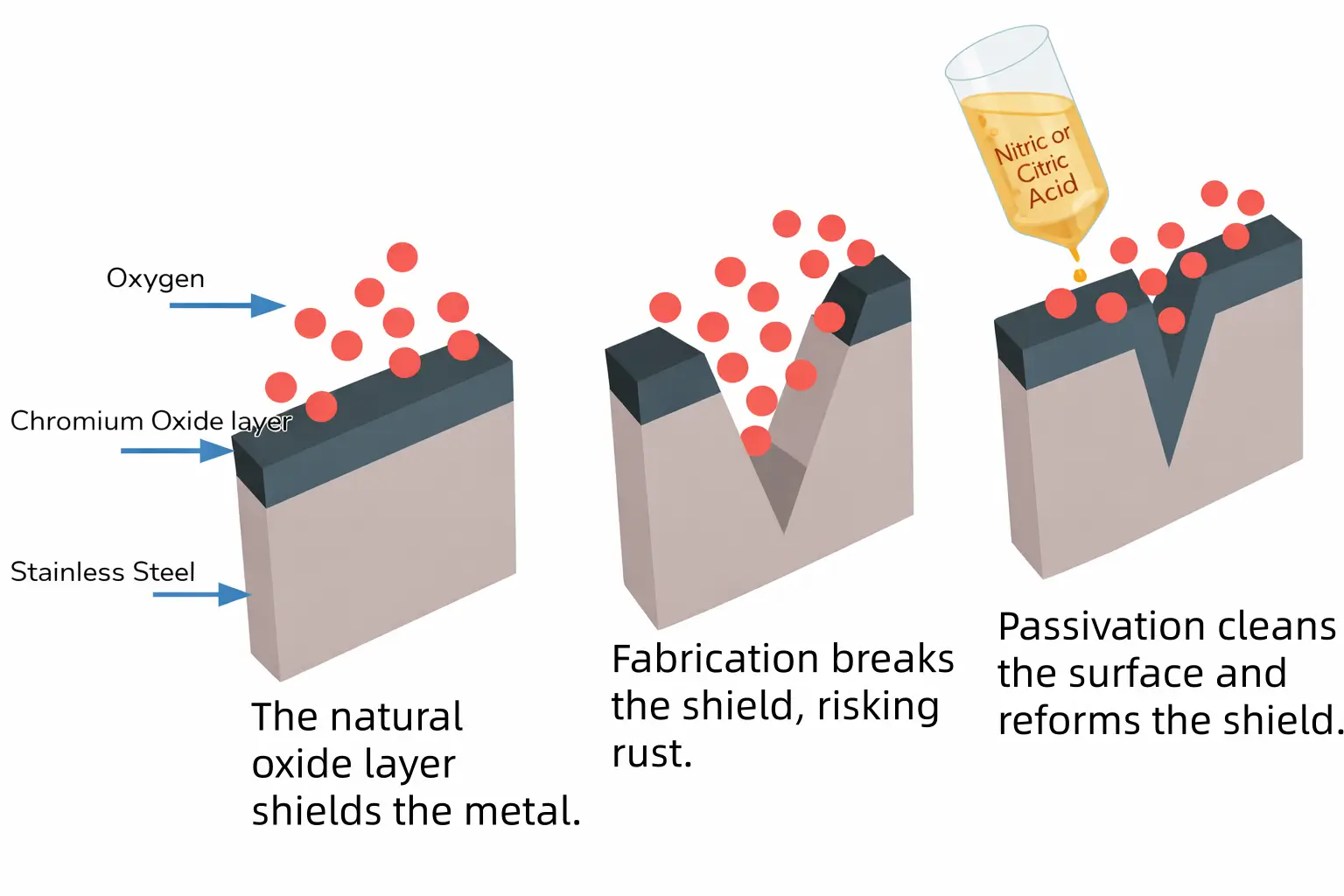
Passivation is the chemical treatment of a material to make it more corrosion resistant. During passivation, the stability of the material’s protective oxide film is improved by oxidation from the surrounding air.
During passivation, a substance like nitric acid or citric acid is used to remove surface contaminants like free iron from a metal and to stabilize the material’s outer protective layer. Once the acid is rinsed away, the surface of the decontaminated metal reacts with oxygen to form a chromium oxide layer. This layer is “passive,” meaning it is less chemically reactive and less likely to corrode, giving the material excellent corrosion resistant properties.
The difference is atomic. Since the passivating acid dissolves more iron than chromium, the top few atomic layers become enriched in chromium, increasing the chromium-to-iron ratio. The protective layer is typically a few nanometers thick.
Other surface treatments that resemble passivation include anodization, which uses an electrolytic bath instead of chemicals, and chromate conversion coating, which is a related corrosion protection treatment.
Why Passivate? Key Benefits for Manufacturers
Why passivate stainless steel and other metals? Surprisingly, passivation benefits go beyond corrosion resistance, helping to keep parts spotlessly clean and prolong their lifespan. Some of the main benefits of passivation include:
Corrosion Resistance: The primary reason for the process. By creating a strong passive layer, passivation prevents rust and oxidation, even in harsh conditions.
Improved Cleanliness: Essential for safety-critical industries. The removal of contaminants like free iron makes parts safer for use in sensitive industries like food and healthcare.
Longer Part Lifespan: Protection against oxidation makes parts less likely to degrade or break, protecting the customer’s investment.
Tight Tolerance: The ultra-thin passivation film is created by the base material; it does not add a significant extra layer of thickness like a paint coating.
Appearance: The spotless look of a newly passivated surface gives the impression of high material quality, although the appearance of the metal does not change in other ways.
Passivation Chemicals: Citric Acid vs. Nitric Acid
Passivation broadly involves the use of two different passivation agents: citric acid and nitric acid. Historically, nitric acid has been the more popular choice, but proponents of citric acid passivation (when specific conditions are met) include organizations like NASA.
Both chemicals can suffer from an issue known as “flash attack” when passivating stainless steels. This is a problem in which the acid bath aggressively etches the surface of the metal.
Nitric Acid Passivation
Nitric acid is the traditional industrial standard for passivation. Its use as a passivation agent dates back to the 18th century, when Russian polymath Mikhail Lomonosov discovered that iron does not react with it.
Because it is the more established method, it may be considered the more reliable. It is highly effective but requires strict safety and environmental controls, especially when using concentrated nitric acid. The use of sodium dichromate can reduce the likelihood of flash attack, though this presents major waste handling issues.
Key nitric acid passivation advantages include:
- Established process
- Stronger oxidizer than citric acid
- Range of variants
The ASTM A967 standard governs the passivation process and outlines different nitric acid methods, shown in the table below.
| Method | Nitric acid (vol %) | Sodium dichromate | Min time | Temperature range |
|---|---|---|---|---|
| Nitric 1 | 20–25% | 2.5 ± 0.5 wt% | 20 min | 120–130°F (49–54°C) |
| Nitric 2 | 20–45% | None | 30 min | 70–90°F (21–32°C) |
| Nitric 3 | 20–25% | None | 20 min | 120–140°F (49–60°C) |
| Nitric 4 | 45–55% | None | 30 min | 120–130°F (49–54°C) |
| Nitric 5 | Not fixed | Optional (incl. accelerants/ inhibitors) |
Not fixed | Not fixed |
Comment
0 comments
Got thoughts or experiences to share? We’d love to hear from you!