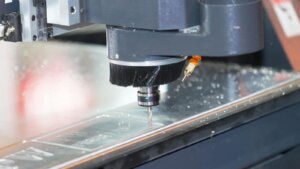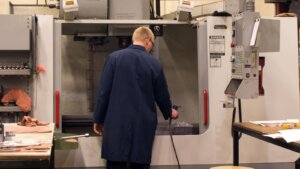

If you have ever ordered a precision metal part, a prototype bracket, or a custom enclosure, there is a good chance it was produced on a CNC milling machine. These computer-controlled machine tools are the workhorses of modern manufacturing: they cut, drill, slot, and contour blocks of raw material into finished components with tolerances measured in thousandths of a millimeter. But what exactly is a CNC milling machine, how does it work, and what should you look for when choosing a manufacturer?
This guide answers those questions in practical terms. Whether you are a procurement manager evaluating suppliers or a design engineer preparing parts for production, understanding the fundamentals of CNC milling will help you communicate requirements clearly, estimate costs realistically, and avoid the rework loops that come from mismatched expectations.
At SHBD Metal, our CNC machining services are built around in-house 3-axis, 4-axis, and 5-axis CNC milling centers, so the capabilities described here are exactly what we apply to every customer project.
What Is a CNC Milling Machine?
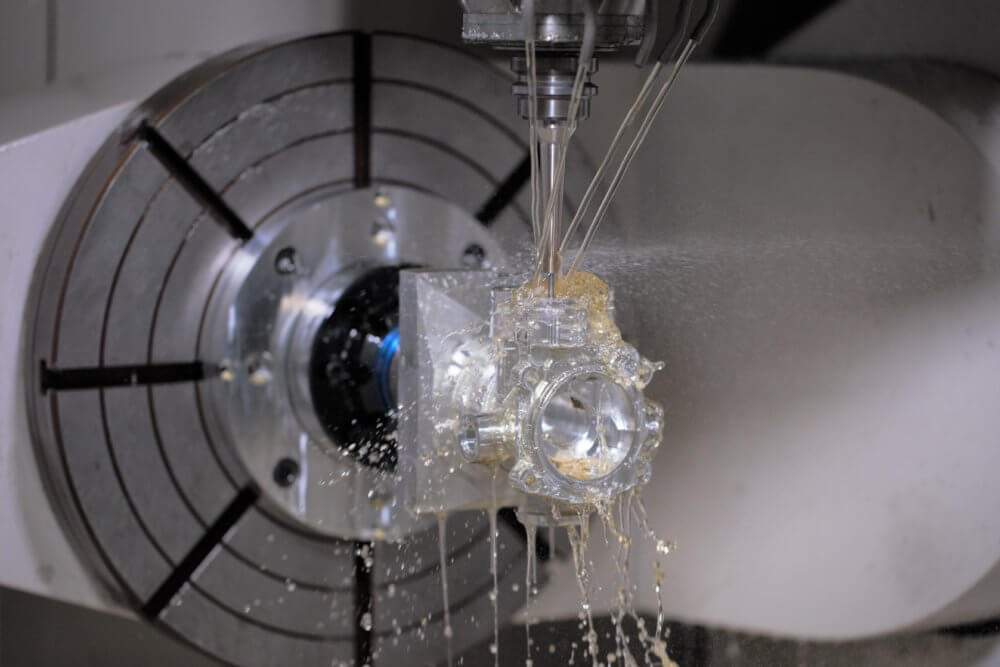
A CNC milling machine is a computer numerically controlled machine tool that removes material from a workpiece using rotating multi-point cutting tools. The term CNC stands for Computer Numerical Control: a computer reads a part program — usually G-code generated from a CAD model — and translates it into precise movements of the spindle, the table, and the cutting tool. Because every motion is executed from code rather than by hand, a CNC milling machine can reproduce the same part thousands of times with virtually identical dimensions.
Milling belongs to the subtractive manufacturing family. Instead of building a part up layer by layer like 3D printing, it starts with a solid block of metal or plastic and systematically removes the material that does not belong. The result is a part with the mechanical properties of the original stock material, which is one of the main reasons milling remains the default choice for structural, load-bearing, and tightly toleranced components.
How Does a CNC Milling Machine Work?
The workflow follows a predictable sequence used by every machine shop:
- Design: The part is modeled in CAD software as a 3D solid or surface model.
- Programming: CAM software converts the model into tool paths and generates the G-code program that tells the machine how to move.
- Setup: The operator mounts the workpiece on the machine table, installs the correct cutting tools, and sets the program zero point.
- Machining: The machine executes the program, advancing the cutter through the material in a series of roughing and finishing passes.
- Inspection: The finished part is measured against the drawing to confirm that dimensions and surface finish meet specification.
Modern machines add a layer of automation: automatic tool changers swap tools mid-cycle, probes locate the workpiece before cutting, and monitoring systems track spindle load in real time. This is what allows a CNC milling machine to run lights-out — unattended shifts that cut the cost per part at higher volumes.
Key Components of a CNC Milling Machine
Every CNC milling machine is built from the same core systems:
- Spindle: The motor-driven shaft that holds the cutting tool and rotates it at speeds ranging from a few hundred to tens of thousands of RPM.
- Machine table: The work surface where the workpiece is clamped, usually with a T-slot pattern or a workholding fixture such as a vise or pallet.
- Linear axes: Precision guideways and ball screws that move the spindle and table along the X, Y, and Z axes.
- Controller: The computer brain that interprets G-code and coordinates axis motion, spindle speed, and coolant flow.
- Tooling: End mills, face mills, drills, reamers, and taps — the interchangeable cutting tools that actually shape the material.
- Coolant system: Flood or mist coolant that removes heat and flushes chips away from the cutting zone.
The interaction between these systems determines what a machine can achieve: rigidity translates into surface quality, and controller capability into machining complexity.
Types of CNC Milling Machines
CNC milling machines come in several configurations, and the differences matter for both capability and cost.
Vertical vs Horizontal Milling Machines
On a vertical milling machine, the spindle is oriented vertically, and the cutter approaches the workpiece from above. This is the most common configuration in job shops because it offers excellent visibility, simple fixturing, and versatility across a wide range of part sizes. On a horizontal milling machine, the spindle lies horizontally, and the cutter is mounted on an arbor. Horizontal machines excel at heavy stock removal, deep slots, and production runs of prismatic parts, since chips fall away from the cutting zone naturally and multiple sides can be machined in one setup.
Milling Machines by Axis Count
Machines are also classified by how many axes they can move along. A 3-axis machine positions the cutter in X, Y, and Z, which covers the majority of everyday milling work. A 4-axis machine adds a rotary axis, typically allowing the workpiece to rotate so features can be cut on multiple faces without re-fixturing. A 5-axis machine adds two rotary axes and lets the tool approach the part from virtually any angle in a single setup — the configuration of choice for impellers, turbine blades, medical implants, and complex mold cavities, where accuracy would be lost if the part had to be repositioned several times.
Common CNC Milling Operations
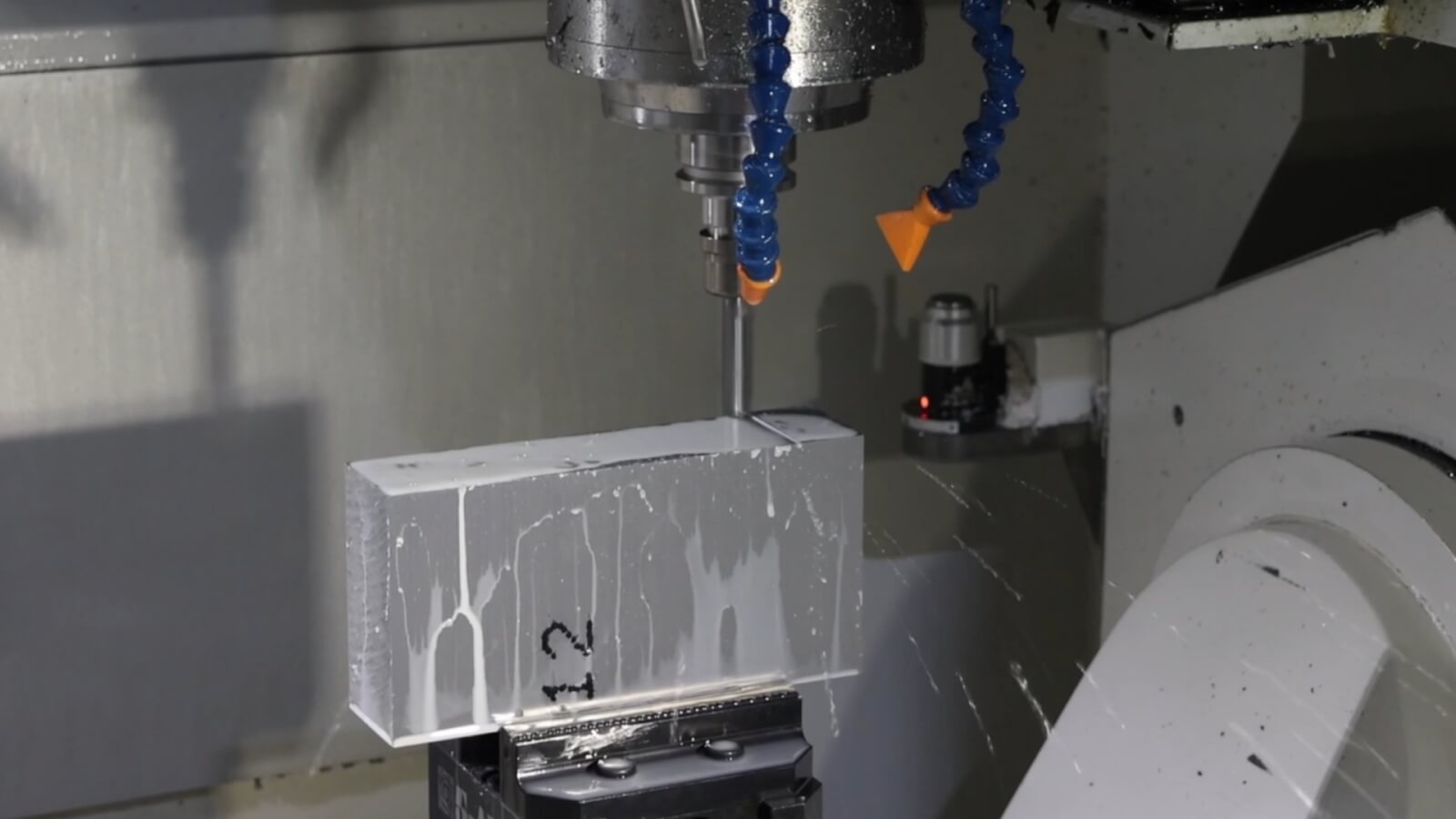
A CNC milling machine performs a broad family of operations with different tool geometries:
- Face milling: Flattening and squaring large surfaces with a face mill.
- Plain milling: Cutting slots and keyways along the surface of the workpiece.
- End milling: Profiling, pocketing, and contouring with an end mill.
- Drilling and boring: Creating and accurately sizing holes.
- Tapping: Cutting internal threads.
- Contouring: Following complex 2D and 3D profiles defined by the CAD geometry.
Materials Suitable for CNC Milling
One of the great strengths of CNC milling is material versatility. Aluminum alloys such as 6061 and 7075 machine quickly and deliver an excellent strength-to-weight ratio; stainless steels like 304 and 316 offer corrosion resistance; and steels, brass, bronze, copper, titanium, and magnesium each bring their own mechanical properties. Engineering plastics — including PEEK, Delrin (acetal), nylon, and ABS — are also milled routinely for electrical insulators, wear components, and prototypes.
The machinability of a material affects tool selection, cutting speeds, cycle time, and ultimately cost. Our materials guide compares the mechanical properties of the most commonly specified metals and plastics so you can match the right material to your application before requesting a quote.
Advantages and Limitations of CNC Milling
The advantages of CNC milling are well established. It delivers high repeatability across production runs, tight tolerances down to ±0.005 mm on the best equipment, excellent surface finishes, and the ability to machine virtually any solid engineering material. It is equally suited to one-off prototypes and high-volume production, and modern 5-axis machines consolidate complex geometry into a single setup.
The limitations matter too. Milling is subtractive, so it wastes material — especially with expensive alloys. Deep cavities and sharp internal corners are constrained by tool reach and radius. And while per-part cost falls with volume, it never matches the speed of forming processes like die casting or injection molding at very large quantities.
Choosing a CNC Milling Manufacturer
The capabilities of the machine are only half the story — the shop operating it is the other half. When evaluating a CNC milling partner, look for evidence of in-house capability rather than outsourced subcontracting, ask about axis configurations and maximum part sizes, and verify that inspection is performed with calibrated equipment such as CMMs. A supplier that documents its quality assurance process and provides inspection reports with every shipment is far less likely to surprise you with out-of-tolerance parts.
Frequently Asked Questions
What is the difference between a CNC milling machine and a CNC lathe?
A CNC milling machine holds the workpiece stationary on a table and moves a rotating cutting tool across it. A CNC lathe does the opposite: the workpiece rotates while a stationary tool cuts it. Milling produces prismatic parts such as housings and brackets; turning produces cylindrical parts such as shafts, bushings, and fittings.
How accurate is a CNC milling machine?
Standard CNC milling holds tolerances of ±0.025 mm to ±0.05 mm, while precision machining on well-maintained machines can hold ±0.005 mm. Actual achievable accuracy depends on the machine, the material, the part geometry, and the inspection method used to verify it.
What materials can a CNC milling machine cut?
Aluminum, steel, stainless steel, brass, bronze, copper, titanium, magnesium, and most engineering plastics, including PEEK, Delrin, and nylon. Material hardness and machinability influence tooling and cycle time but rarely rule out milling altogether.
How much does CNC milling cost?
Cost is driven by material, part complexity, tolerance requirements, quantity, and surface finish. Setup and programming are amortized across the order quantity, so per-part prices drop as volume increases. Uploading a CAD file is the fastest way to get an accurate, itemized quote.
Get Your CNC Milling Quote
At SHBD Metal, our CNC milling centers — from compact 3-axis machines to full 5-axis systems — handle prototypes and production runs in aluminum, steel, stainless steel, titanium, and engineering plastics. Every order is backed by in-house inspection, documented quality reports, and an engineering team that reviews your design for manufacturability before the first tool path is cut.
Upload your CAD files today and receive a detailed quote within hours. Whether you need a single functional prototype or a production run of thousands, we are ready to help you bring your design to life.