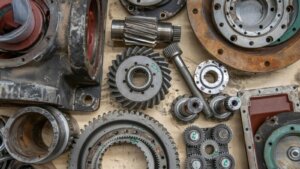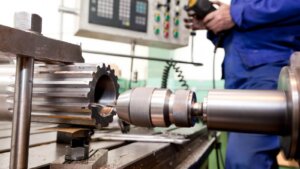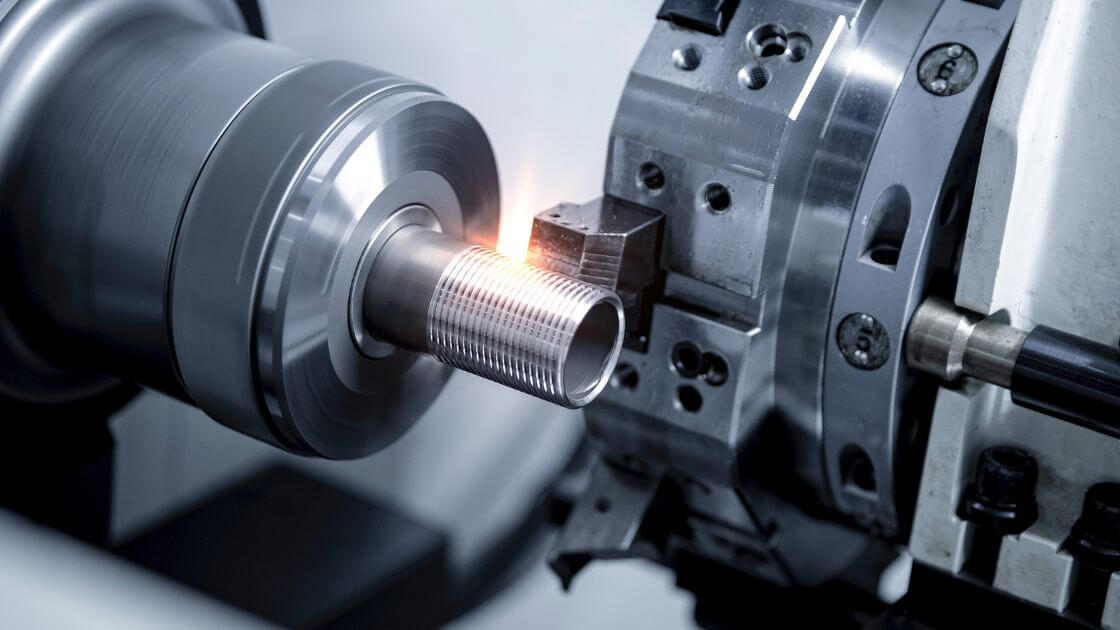

Ask ten engineers what their parts are made with and most will answer the same way: CNC machining, and specifically CNC milling. The two terms are so closely related that they are often used interchangeably — but they are not quite the same thing, and understanding the relationship between them is the foundation of smart sourcing in precision manufacturing.
In short, CNC machining is the umbrella category: every computer-controlled subtractive process that cuts material from a block. CNC milling is the most important member of that family — the rotating-cutter process that produces housings, brackets, plates, and complex 3D geometries. If you are comparing suppliers, quoting parts, or designing components for production, this distinction shapes everything from the machines used to the tolerances you can expect.
This guide explains what CNC machining and milling are, how they compare with related processes, which operations and materials they cover, and what drives cost — so you can make confident decisions for your next project. SHBD Metal's CNC machining services cover the full range of milling, turning, and finishing described here.
CNC Machining and Milling: An Overview
Think of CNC machining as the process family and CNC milling as one specific process within it. Machining encompasses milling, turning, drilling, boring, grinding, and EDM; milling is the process in which a rotating multi-point cutter moves across a stationary workpiece to remove material. The two are frequently paired in a single part: a cylindrical section turned on a lathe, then milled flat with holes and pockets added by a machining center.
For a manufacturer, the practical implication is capability breadth: a shop that only turns cannot mill, and a shop that only mills cannot economically produce long shafts. Full-service suppliers combine both — plus finishing and inspection — so tolerances never get lost in vendor hand-offs.
What Is CNC Machining?
CNC machining is a subtractive manufacturing process in which pre-programmed computer software controls the movement of machine tools. The machine removes material from a solid block of metal or plastic until the part matches the CAD model. Because execution is code-driven, CNC machining delivers exceptional repeatability: the thousandth part matches the first within microns.
The core operations of CNC machining include milling (rotating cutters), turning (rotating workpiece), drilling and tapping (hole making), and grinding (abrasive finishing). Each uses a different machine configuration and tool geometry, but all rely on the same principle: controlled removal of stock to achieve precise dimensions, tolerances, and surface quality. For an in-depth walkthrough of the full sequence, see our guide to how CNC machining works.
What Is CNC Milling?
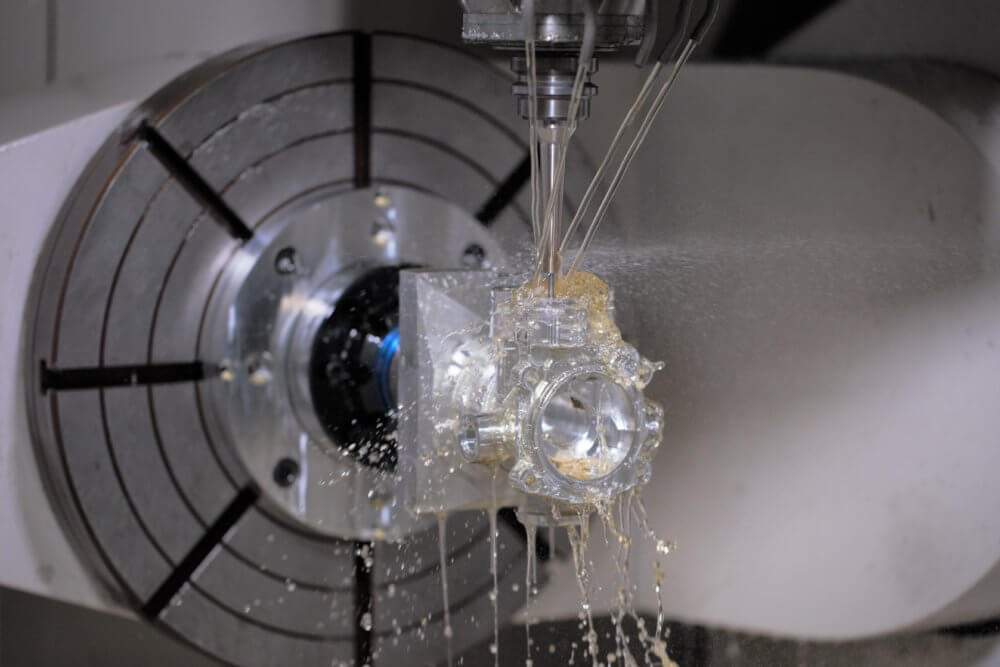
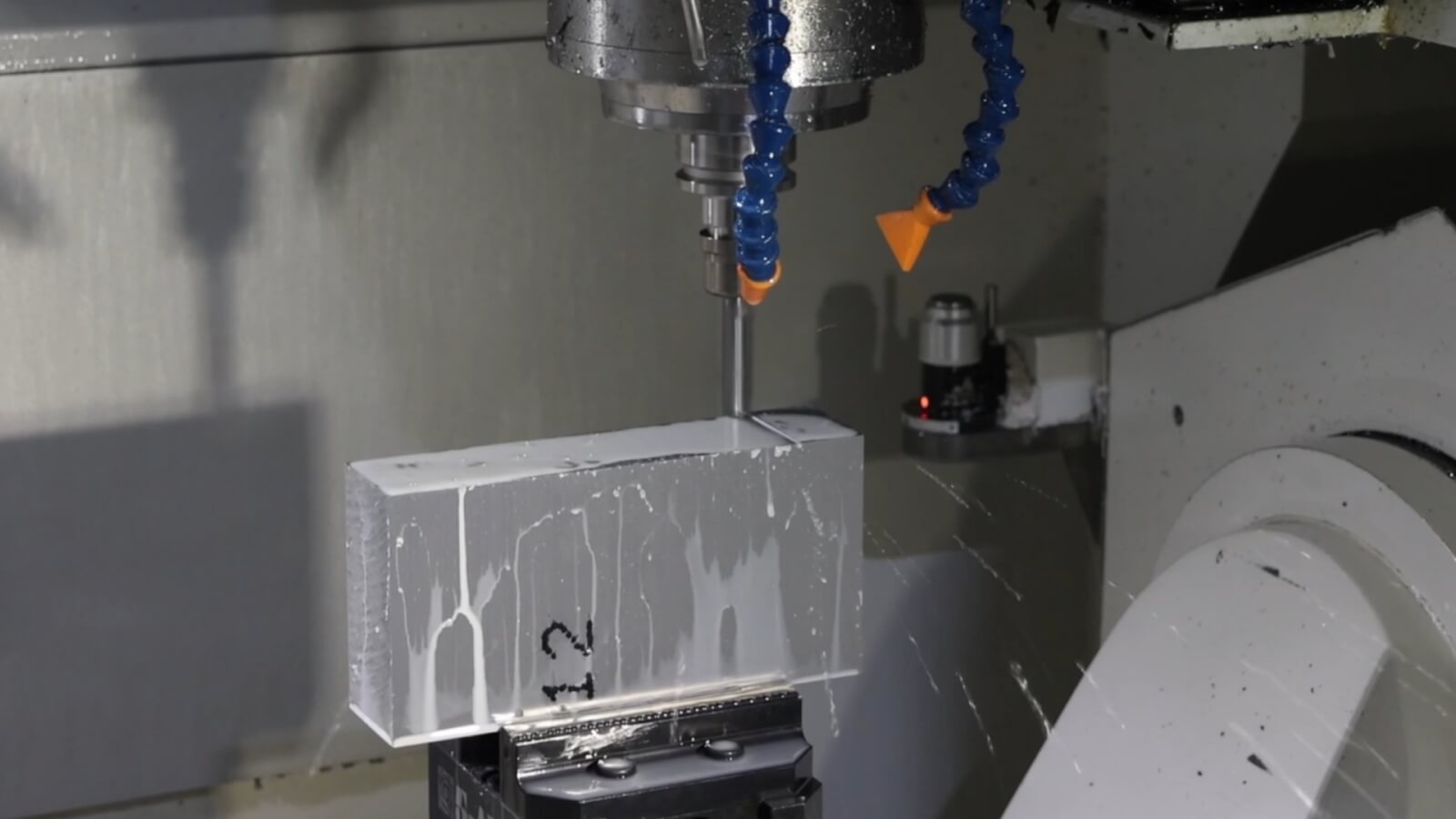
CNC milling is the CNC machining operation in which a rotating cutting tool — typically an end mill or face mill — removes material from the surface of a workpiece held on a machine table. The spindle moves the cutter along multiple axes (X, Y, and Z on a 3-axis machine; plus two rotational axes on a 5-axis machine), allowing everything from simple flat faces to fully contoured 3D surfaces to be produced.
Milling is the most versatile of all machining operations. It handles large flat surfaces, deep slots, pockets, holes, threads, and sculpted forms, across part sizes from jewelry-scale components to large structural plates. On modern machining centers, a single setup can complete an entire part: drilling, tapping, facing, contouring, and finishing in one program with one automatic tool change after another.
CNC Milling vs CNC Turning
Milling and turning are the two pillars of CNC machining, and they solve different geometry problems:
- Milling — the workpiece is stationary, the tool rotates. Best for prismatic parts: housings, brackets, plates, enclosures, and components with flats, slots, pockets, and drilled hole patterns.
- Turning — the workpiece rotates, the tool is stationary. Best for axi-symmetric parts: shafts, bushings, pulleys, fittings, and anything with a cylindrical profile.
Many parts blend both. A motor housing might be turned on its outer diameter, then milled for mounting flats and threaded holes. Choosing a supplier with both capabilities — like SHBD Metal, which pairs CNC milling centers with CNC lathes and Swiss-type machines — avoids the cost and lead time of splitting a part between vendors.
Common CNC Milling Operations
Within CNC milling, engineers specify a set of standard operations that every machinist recognizes:
- Face milling — producing a flat, smooth surface, usually to establish a datum.
- End milling — profiling, pocketing, and slotting with an end mill.
- Drilling — creating holes to standard or custom diameters.
- Boring — enlarging and precisely sizing existing holes.
- Tapping — cutting internal threads.
- Contouring — machining complex 2D or 3D profiles, including sculpted surfaces on 5-axis machines.
Each operation has a preferred tool geometry and cutting strategy. A well-structured milling program sequences roughing passes first — removing bulk material fast — then finishing passes that bring surfaces to final dimension and finish. The result is a balance of speed and quality that directly affects quoted cost.
Materials for CNC Machining and Milling
CNC machining and milling accept virtually every engineering material. Aluminum alloys (6061, 7075, 2024) combine light weight with excellent machinability; stainless steels (304, 316, 17-4 PH) add corrosion resistance; and carbon steels, brass, bronze, copper, titanium, and magnesium each serve specific mechanical needs. On the plastic side, PEEK, Delrin (acetal), nylon, ABS, and PTFE are milled for insulators, wear parts, and food-contact components.
Material choice drives more than function — it drives machining strategy. Soft alloys cut fast with high spindle speeds; hardened steels demand tougher tooling and slower feeds; gummy materials like copper need aggressive chip control. Our materials guide compares properties and machinability ratings across the most common grades to support your selection.
Surface Finishes for Machined Parts
Machining gets a part to the right shape; finishing gives it the right surface behavior. As-machined surfaces (Ra 1.6–3.2 µm) suit most internal and functional areas, while precision finishing passes reach Ra 0.4 µm or better. Beyond roughness, secondary finishes add performance: anodizing protects aluminum and adds color, plating improves conductivity or wear resistance, powder coating provides durable color, and bead blasting creates a uniform matte texture.
Finish specification interacts with tolerances, so it belongs in the design review. Plating and anodizing add material in the micron range, which can shift tight dimensions unless allowances are planned. A supplier that coordinates machining and finishing in-house manages these interactions in one place.
Cost Factors in CNC Machining and Milling
Quoted prices for CNC machining and milling are driven by five variables:
- Material — cost and machinability of the chosen grade.
- Complexity — number of setups, tool changes, and tight features.
- Tolerances — tighter tolerances mean slower passes, more inspection, and more scrap risk.
- Quantity — setup and programming are amortized over the order, so per-part cost falls steeply with volume.
- Finishing — secondary processes add labor and handling time.
Design choices that reduce cost include standardizing hole sizes, keeping walls uniform, avoiding deep pockets with small radii, and specifying only the tolerances that function requires — all DFM conversations your partner should have with you before quoting, not after.
Frequently Asked Questions
Is CNC milling the same as CNC machining?
Not exactly. CNC machining is the umbrella term for all computer-controlled subtractive processes, including milling, turning, drilling, and grinding. CNC milling is one specific process within that family — rotating multi-point cutters against a stationary workpiece — and its most widely used member.
When should I choose milling over turning?
Choose milling for prismatic parts — anything with flat surfaces, pockets, slots, or drilled hole patterns. Choose turning for cylindrical parts like shafts and bushings. Many parts use both, and a full-service CNC machining supplier handles the combination in-house.
What tolerances can CNC milling hold?
Standard CNC milling holds ±0.025 mm to ±0.05 mm; precision milling reaches ±0.005 mm on critical features. Tolerance capability depends on the machine, material, and feature geometry, and it should always be confirmed with your supplier's quality team.
Can CNC machining and milling handle low-volume production?
Yes. CNC is ideal for prototyping and low-to-medium volume production because there are no tooling investments like injection molds. It is also perfectly scalable — the same program runs for 1 part or 10,000, which makes it a low-risk bridge to high-volume processes.
How do I get a quote for CNC machining and milling?
Upload your CAD file — STEP or native format — along with a drawing of tolerances and finishes if available. A manufacturer like SHBD Metal will review the design for manufacturability and return an itemized quote with lead time, usually within hours.
Get Your CNC Machining and Milling Quote
At SHBD Metal, CNC machining and milling are what we do every day: 3-axis, 4-axis, and 5-axis milling centers, CNC turning, Swiss-type machining, and a full menu of secondary finishes — all under one roof with documented quality reports. Our engineering team reviews every design for manufacturability before a single chip is cut, so the part you receive fits, functions, and arrives on schedule.
Upload your CAD files today and receive a detailed quote within hours. Whether you need a single prototype or a production run of thousands, we are ready to help you bring your design to life.