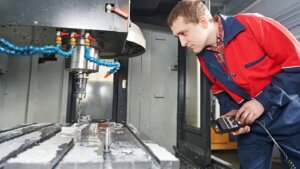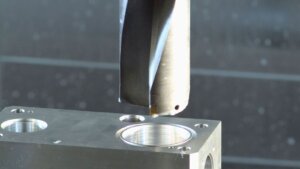

The aerospace industry sets some of the most demanding standards in modern manufacturing: parts must be precise enough to fly, light enough to save fuel, and reliable enough to protect lives over decades of service. CNC (Computer Numerical Control) machining has become the backbone of aerospace production precisely because it can deliver on all three fronts. In this article, we break down the top 10 reasons aerospace manufacturers choose CNC machining — and why it remains essential from prototyping to full-rate production.
At SHBD Metal, our CNC machining services support aerospace programs with 3-axis, 4-axis, and 5-axis machining, tight tolerances, and full material traceability.
Why Does the Aerospace Industry Use CNC Machining?
The aerospace industry relies on CNC machining because the process combines precision, efficiency, and the ability to produce complex geometries that other methods struggle to match. CNC machines hold tight tolerances on safety-critical parts, which directly supports the reliability of aircraft and spacecraft. Because the process is automated, it also shortens production cycles and lowers unit costs — both critical in an industry where lead times and budgets are tightly managed.
What Are the Typical Applications of CNC Machining in Aerospace?
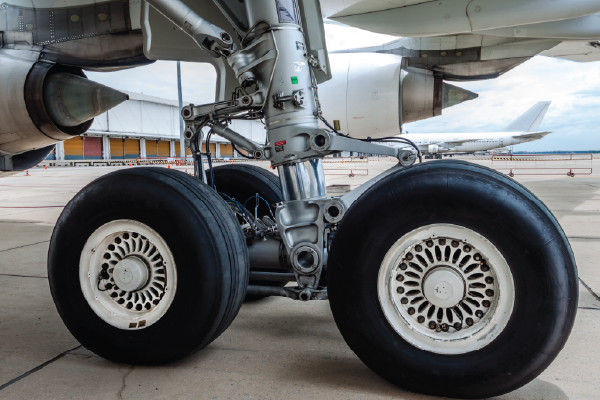
CNC-machined aerospace components range from structural brackets and housings to turbine blades, engine mounts, landing gear parts, and avionics enclosures. What unites them is the need for dimensional accuracy, repeatability, and the use of high-performance materials such as titanium, aluminum alloys, and superalloys. The ten benefits below explain why CNC machining is the process of choice for these applications.
The Top 10 Benefits of CNC Machining for Aerospace
1. Unparalleled Precision
Precision is the foundation of aerospace manufacturing. Components such as turbine blades and engine parts must fit and perform within extremely tight tolerances because they operate under extreme heat, pressure, and stress. CNC machining delivers the repeatable accuracy required to keep those parts within specification — and to keep the aircraft they belong to safe.
2. Capability to Handle Complex Geometries
Modern multi-axis CNC machines can machine intricate shapes that are common in aerospace design, including thin walls, curved airfoils, and internal channels. Five-axis machining in particular allows a tool to approach the part from almost any angle, so complex geometry can be produced in a single setup — reducing fixturing errors and improving structural integrity.
3. Enhanced Material Versatility
Aerospace parts are machined from titanium, aluminum alloys, stainless steel, and composite materials, each with different hardness, heat tolerance, and machinability. CNC machining is flexible enough to handle this full range, allowing manufacturers to match material to application — whether the priority is strength-to-weight ratio, corrosion resistance, or heat resistance.
4. High Repeatability and Consistency
In aerospace, even a small variation between parts can affect performance and safety. CNC machines follow the same program on every cycle, producing parts with minimal variation from the first piece to the thousandth. This consistency is essential for interchangeable components and for maintaining quality across large production runs.
5. Faster Production Times
CNC machines run automatically and can operate around the clock, dramatically compressing production schedules. Faster turnaround matters in aerospace, where program deadlines, flight-test schedules, and fleet delivery commitments depend on parts arriving on time.
6. Cost Efficiency
Although CNC equipment requires a significant upfront investment, it lowers the cost per part over time. Automation reduces manual labor, and precise cutting minimizes material waste — both of which improve overall cost efficiency, particularly at higher volumes.
7. Energy Efficiency
CNC machining consumes considerably less energy than many conventional manufacturing processes — research cited in the industry points to roughly one-seventh of the energy of traditional machining. For manufacturers under increasing sustainability pressure, this makes CNC machining a responsible choice that also reduces operating costs.
8. Improved Safety
Automation removes operators from direct contact with cutting tools, reducing the risk of workplace accidents. Machine operators set up and monitor production from a safe distance, and modern machines are equipped with protective enclosures and safety interlocks as standard.
9. Scalability for Prototyping and Mass Production
CNC machining scales smoothly from single prototype parts to full production volumes. Aerospace teams use CNC-machined prototypes to validate designs, test fit and function, and qualify manufacturing processes before committing to production tooling and long runs.
10. Innovation in Design and Manufacturing
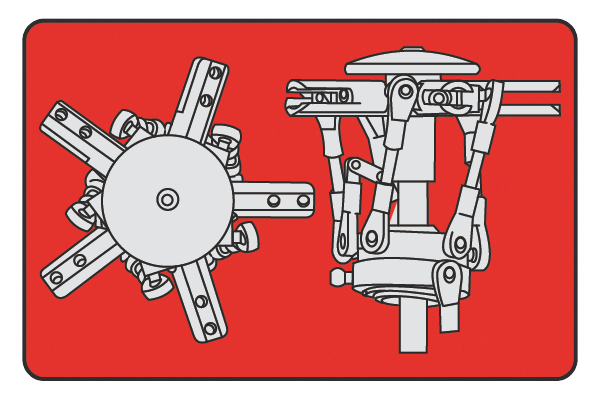
Because CNC machining can cut advanced materials into complex shapes with high precision, it gives engineers the freedom to innovate. Lightweight structural designs, optimized brackets, and next-generation engine components all become manufacturable, supporting the aerospace industry's push toward lighter, more efficient aircraft.
Why Use CNC Machining for Your Aerospace Components?
CNC machining has transformed aerospace manufacturing by combining precision, efficiency, and versatility in a single process family. It handles complex geometries, shortens production times, and controls costs, while meeting the strict certification and quality requirements of the industry. As demand grows for lighter, higher-performance aircraft, CNC machining will remain central to aerospace innovation. Whether you need one prototype or a production run of thousands, working with a partner that understands aerospace tolerances and materials — like SHBD Metal's materials expertise and quality assurance system — is the first step to a successful program.
Ready to start your aerospace project? Upload your CAD files for an instant quote and free manufacturability feedback.
FAQs
What should you look for in a CNC machine shop for aerospace components?
Look for demonstrated precision, rigorous quality control, aerospace-relevant certifications, and experienced machinists. Certifications such as AS9100D, along with material traceability and inspection documentation, are strong indicators that a supplier can meet aerospace requirements.
What kinds of aerospace components can be CNC machined?
CNC machining is used for a wide range of precision aerospace parts, including brackets, housings, engine components, landing gear parts, and structural fittings — anything that demands tight tolerances and high-strength materials.
What materials are commonly machined for aerospace?
Aluminum alloys, titanium, and stainless steel are the most common choices, selected for their strength-to-weight ratios and durability. Superalloys and engineering composites are also machined for specialized high-temperature applications.