

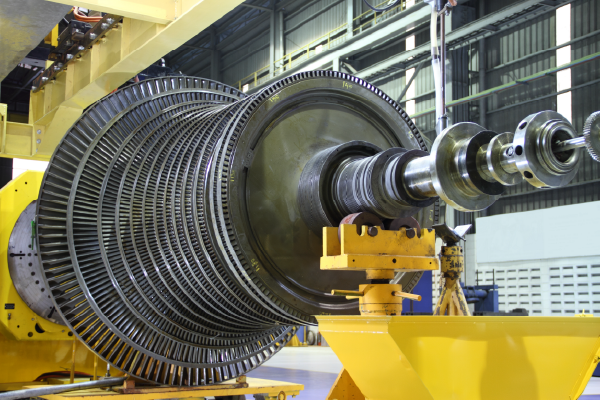
Inconel earns its reputation where engineers worry most: combustion chambers that glow orange, sour-gas wellheads, reactor coolant loops and turbocharger housings. It belongs to the austenitic nickel-chromium superalloy family, and it was created for service conditions that make ordinary stainless steel look fragile.
This guide covers what Inconel actually is, how the alloy family is composed, how it is produced, which properties matter in practice, and the industries that specify it — plus what has to be understood when the part will be machined rather than cast.
What Is Inconel?
Inconel is the family name for a group of austenitic superalloys built on a nickel-chromium base. On top of those two elements, individual grades add molybdenum, niobium, aluminium and other constituents to tune strength and corrosion behaviour for a given service condition.
The mechanism behind its heat resistance is a protective oxide skin. Exposed to high temperature, the alloy develops a dense passivating layer that shields the metal underneath from further attack. Unlike aluminium or carbon steel, it keeps its load-bearing capacity as the temperature climbs and holds out against creep — the slow, permanent stretching driven by thermally generated crystal vacancies.
How Inconel Alloys Are Composed
Nickel is the dominant constituent of every grade, accounting for well over half the mass, which is what places these alloys in the high-temperature nickel superalloy class. Chromium, iron, molybdenum, niobium, cobalt and aluminium appear in varying proportions according to the designation and the property balance being targeted.
Three grades account for a large share of industrial demand:
| Alloy | Strengthening mechanism | Key elements | Notable properties | Typical applications |
|---|---|---|---|---|
| Inconel 600 | Solid solution | Ni, Cr, Fe | Oxidation and corrosion resistance; stable when hot | Furnaces; chemical processing |
| Inconel 625 | Solid solution | Ni, Cr, Mo, Nb | Corrosion resistance; weldability; strength | Marine; chemical; aerospace |
| Inconel 718 | Precipitation hardening | Ni, Cr, Fe, Nb, Mo, Al, Ti | High strength; creep and fatigue resistance | Jet engines; turbines; fasteners |
Picking between them is rarely a question of taking the strongest option. Grade 625 tends to be specified where welds must survive chloride exposure, while 718 comes into play when a component sees cyclic loading and has to hold tolerance while hot.
Inconel's History and How It Is Made
The family was trademarked in the United States in 1932, the work of the International Nickel Company, as an answer to industrial demand for metals that would not give way in severe environments.
Aviation gave the material its first high-profile role. Frank Whittle, a British Royal Air Force officer and engineer, built the first turbojet engine during the Second World War, and Inconel components went into that engine. The alloy performed far beyond the assumptions behind its original designations, and the family grew into specialised grades including 600, 625 and 718.
Production begins with melting. Nickel, chromium, iron, molybdenum, niobium, cobalt and aluminium are charged into high-temperature furnaces, and the melt is refined until impurities are down to specification before being cast into ingots or billets. Hot rolling, forging and other forming operations then convert that stock into the blank shapes a machine shop can work with. A manufacturer such as SHBD Metal receives those forms and finishes them into the components an application requires.
Additive manufacturing has opened a second route: aerospace programmes increasingly print complex, consolidated Inconel parts that conventional forming struggles to deliver. Work continues on composition, processing and sustainability.
Mechanical Properties of Inconel
Values shift from grade to grade with the alloying additions, but the family shares one profile: strength that survives heat, firm resistance to corrosion and oxidation, and mechanical behaviour that stays predictable in extreme service.
Elevated-Temperature Strength
Keeping useful strength when hot was the goal from the outset, because conventional metals — aluminium and carbon steel among them — soften, oxidise or fail under the same conditions. That is why Inconel appears in engine hot sections, chemical reactors and power generation turbines, where heat is both intense and continuous. Under those conditions the alloys still return good tensile, yield and fatigue values.
They also hold shape under steady load, which is what makes them creep-resistant and suitable for parts expected to remain in service for years.
Oxidation and Corrosion Resistance
The alloys tolerate a broad range of aggressive media — process chemicals, acids and saline atmospheres — that would degrade most alternatives. Chemical processing, marine and oil and gas applications follow directly from this behaviour. At high temperature the same passivating oxide layer forms and slows further oxidation.
Thermal Stability Across a Wide Temperature Range
Thermal expansion is lower than in many competing metals, so dimensions move less as the temperature swings. Mechanical and physical properties stay consistent at both ends of the range, which matters in assemblies built with tight clearances.
Load and Stress Resistance
Under combined tensile and shear loading at elevated temperature, Inconel outclasses many stainless steel grades. Its fatigue performance counts wherever a part sees repeated cycles, as in aircraft and industrial machinery.
Dependability in Demanding Service
Because the material resists wear, corrosion and heat without degrading, it keeps working in punishing conditions. The longer service life that results translates into fewer maintenance interventions and better operating efficiency.
Strengthening Mechanisms
- Solid solution strengthening: elements such as chromium, molybdenum and nickel distort the crystal lattice and impede the movement of dislocations through the metal.
- Precipitation strengthening: in grades such as 718, fine gamma-prime and gamma double-prime particles form inside the nickel matrix. Those precipitates pin dislocations in place and lift strength considerably.
Industries That Use Inconel
Aerospace Engine Hardware
Exhaust systems, engine hardware and turbine blades all lean on Inconel where reliability cannot be traded away. Grade 718 in particular goes into combustion casings, shafts, spools and turbine discs — components that must stay strong and resist oxidation in the hottest part of an engine.
Oil and Gas Equipment
Downhole tools, drill collars, gas turbine combustors, rotor blades and valves are often specified in Inconel because they work under high pressure, high temperature and corrosive produced fluids. Material stability of this kind underpins both safety and uptime.
Chemical Processing Hardware
Reaction vessels, valves and heat exchangers handling aggressive chemistries at elevated temperature are natural Inconel applications. One example is grade 693 in thermowell assemblies for ammonia synthesis reactors, where dependable temperature measurement is essential to the process.
Nuclear and Power Generation
Reactor internals and heat exchangers call for materials whose integrity directly affects safety and efficiency. Grades 600, 690 and 625 combine resistance to radiation, heat and corrosion with high strength, and appear in coolant piping, fuel rod cladding, core components and steam generator tubing.
Automotive Applications
Turbocharger rotors and exhaust systems use Inconel for its heat tolerance and performance under sustained load.
Marine Environments
Salt water is one of the harshest environments a metal can face, and Inconel handles it well. Offshore platforms, propeller blades and sheathing for undersea communication cable are typical applications.
Machining and Fabricating Inconel at SHBD Metal
Supplying the alloy is only part of the job; turning it into a finished part is where process control decides the outcome. Inconel work-hardens quickly, carries heat away poorly and loads cutting tools heavily, so it calls for sharp tooling, conservative parameters and a strategy that avoids dwelling in the cut.
SHBD Metal machines Inconel on CNC turning and milling equipment, with grade and heat treatment selected against the drawing and the service environment. The material sits alongside other high-performance alloys in our materials library, and the full capability set is described on the CNC machining service page. Every batch passes dimensional inspection under our quality system, so tolerance and traceability are confirmed before parts ship.
If the design is still open, we can review geometry, tolerancing and tool access before any metal is cut — early feedback on an Inconel part is far cheaper than rework on a finished one.
Ready to Machine Your Inconel Parts?
Get Instant QuoteFAQs
What exactly is Inconel?
It is a family of nickel-chromium superalloys engineered for extreme service, valued above all for heat resistance and corrosion performance.
Which elements go into these alloys?
Nickel forms the base, with chromium and iron present in every common grade and smaller additions such as molybdenum, copper and titanium adjusted to suit the designation.
Does Inconel respond to a magnet?
No — the alloy is non-magnetic, and it pairs that behaviour with strong corrosion resistance.
Where is Inconel most commonly used?
Aerospace, chemical processing and other duties involving sustained high temperature account for the bulk of demand.
Can Inconel be welded?
Yes. With the right procedure and filler selection, sound and durable joints can be produced.
Who can machine Inconel parts to tolerance?
SHBD Metal machines the alloy on CNC turning and milling equipment, with dimensional inspection and documentation built into every batch.


