

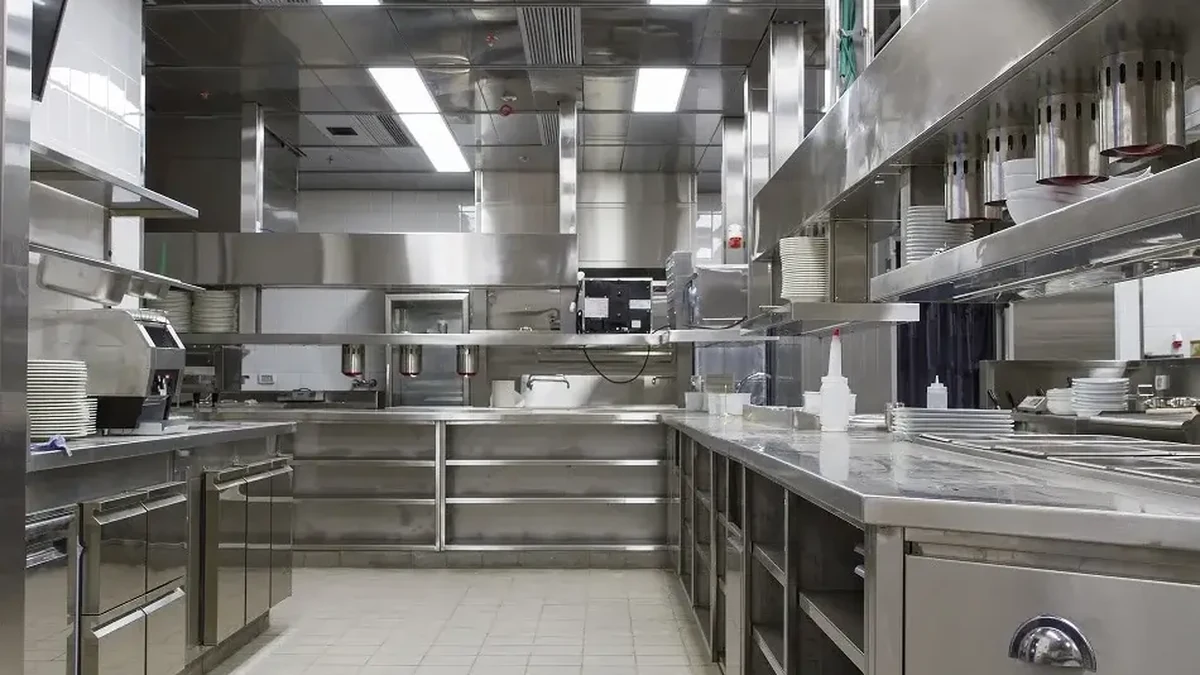
The kitchen is where most people meet stainless first, and food equipment is still one of its largest applications.
Reading an Application List Properly
Lists of stainless applications tend to read as if the material were interchangeable. It is not. What decides whether a grade works in a given place is the combination of three things: the environment, the mechanical duty and the manufacturing route. A kitchen sink and a marine propeller shaft may both be described as stainless steel applications, but one is a formed sheet in a wet, mildly chlorinated environment and the other is a machined bar under load in salt water.
So the useful way to read any application list is to ask what the place demands. Is it chloride exposure, heat, abrasion, food contact, structural load, or appearance? Once that is named, the grade follows, and the sections below follow the same order.
Kitchens, Cookware and Food Equipment
Food contact is the largest single use most people encounter. Sinks, worktops, splashbacks, extraction hoods, mixing bowls, pans and the process equipment behind a commercial kitchen are usually 304, because the environment is wet but not saline and the material has to be formable, weldable and easy to clean.
Where chlorides appear — brine lines, seafood processing, dairy with chloride-based cleaning chemicals — 316 takes over. The other half of the specification is the finish: a smooth, pit-free surface that can be cleaned, and welds that are ground and passivated rather than left as they came off the bench.
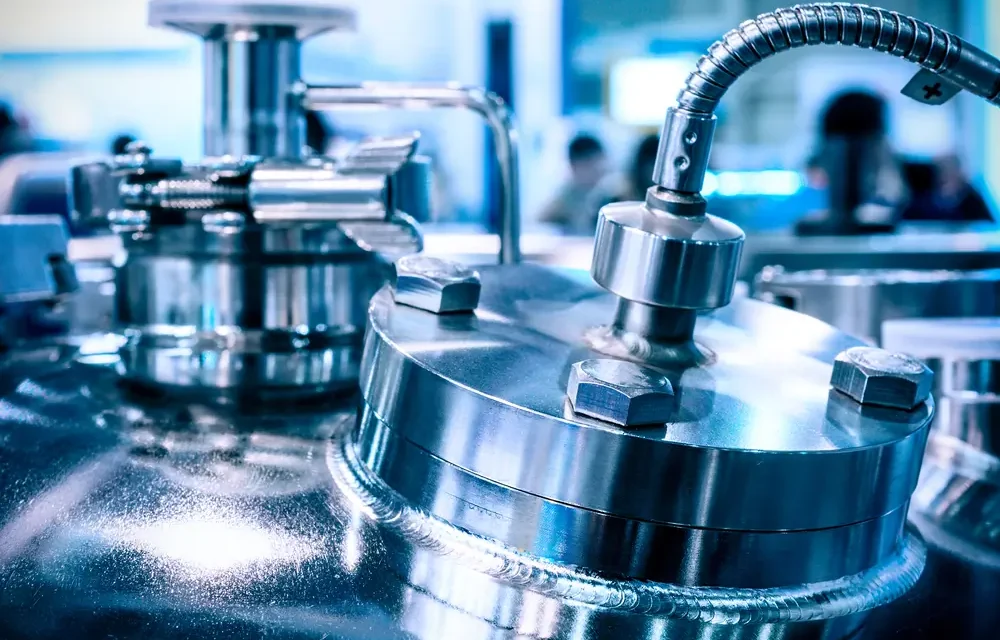
Food and laboratory work share the same requirement: a surface that can be cleaned, not just a grade that resists rust.
Medical Instruments and Devices
Surgical instruments, trays, sterilising containers, dental equipment and the enclosures around diagnostic machines are a natural fit: the material tolerates repeated cleaning and steam sterilisation, and it does not shed a coating. 304 covers trays and furniture; 316L is the usual choice where body contact, saline or aggressive disinfection is involved, and the martensitic grades appear where an edge or a wear surface is needed.
The constraint that catches people out is fabrication, not service. A welded, ground and passivated instrument is a different product from the same instrument with a weld left as-welded, and the cleaning regime in a hospital will find the difference.
Construction and Architecture
Facades, cladding, roofs, balustrades, handrails, fixings and street furniture account for a large share of flat product. 304 is the normal choice for inland and rural exposure; 316 is specified near the coast, on bridges that see de-icing salt, and anywhere the surface will be cleaned with chlorinated products.
Two decisions matter as much as the grade. The finish sets how the surface weathers — a smooth 2B, a brushed hairline or a patterned embossed sheet all age differently, and a rough surface holds dirt and salt. And the fixing detail decides whether the facade stains: dissimilar metals in contact, or a design that traps water, will produce tea-staining that has nothing to do with the steel being wrong.
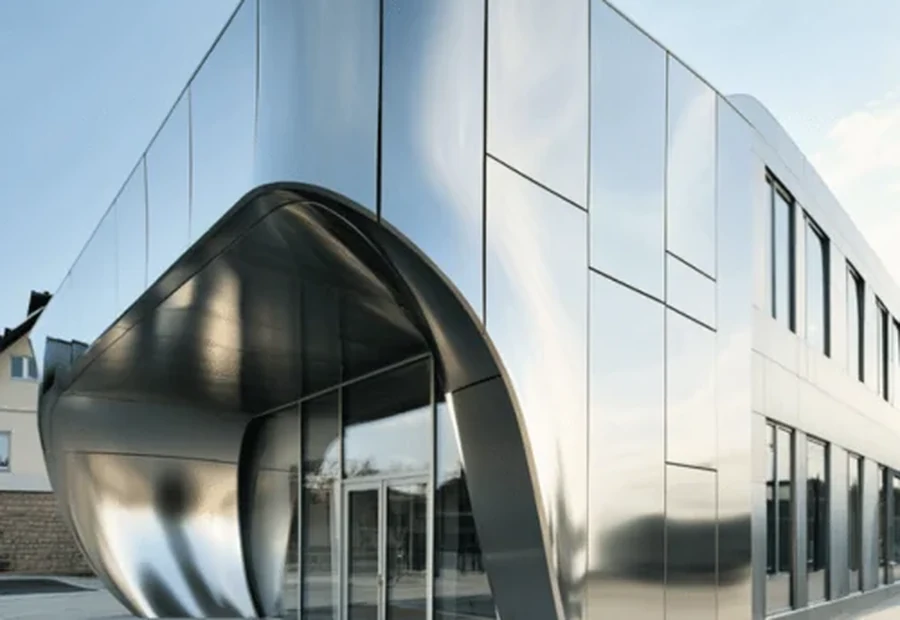
Architectural work is judged on how the surface ages, which is a finish and detailing question before it is a grade question.
Vehicles, Rail and Aerospace
In road vehicles, stainless appears in exhaust systems, fuel tanks, trim and structural parts that need corrosion resistance without a coating. The ferritic grades dominate exhaust work because thermal expansion and cost matter more than formability; the martensitic grades appear in wear parts; 304 and 316 turn up in tankers, food transport and rail interiors.
Rail and aerospace add a fatigue dimension: the material is chosen for a combination of corrosion resistance, strength-to-weight and repairability, and the qualified grade is usually fixed by the specification rather than by preference. In aerospace, 17-4 PH and 15-5 PH precipitation-hardening grades are common where high strength and reasonable corrosion resistance are both required.
Energy, Oil, Gas and Marine
This is where the higher alloys earn their price. Power plant pipework, heat exchangers, flue gas handling and nuclear components use 304, 316 and the stabilised grades; offshore and marine work moves to duplex and super-duplex where chloride stress-corrosion cracking would take out an austenitic grade; and refinery service with acids or high chloride loads reaches for 904L or a 6% molybdenum alloy.
In these sectors the material specification is usually written by an engineering contractor and is not negotiable. What a supplier can add is documentation: the right standard, the heat number, the test results and, where required, third-party inspection.
Water, Plumbing and Process Plant
Potable water, wastewater, pumps, valves, tanks, manifolds and instrumentation lines all use stainless, most of it 304 and 316 in tube, pipe and fitting form. The distinction that matters is chloride level: fresh water at ambient temperature is comfortable for 304, while brackish water, brine circuits and hot chlorinated water push the choice to 316 or to a duplex grade.
Process plant adds cleanability and pressure duty to the same question. Sanitary tubing, dairy and brewery lines and pharmaceutical process pipe are specified by surface finish and weld quality as much as by analysis.
Interiors and Consumer Goods
Appliances, furniture frames, lift interiors, kitchen splashbacks, bathroom fittings, watches, cutlery and decorative screens all rely on the same property: a surface that keeps its appearance. Thin-gauge sheet in 304, polished or brushed, does most of this work; the martensitic grades supply blades and cutting edges; and coloured or patterned finishes extend the material into visible design elements.
Consumer goods are also where cost pressure is strongest, which is why the 200 series appears in some low-duty applications. It is a legitimate choice indoors and dry, and a poor one anywhere chlorides or long outdoor exposure are involved.
Matching the Grade to the Place
The table below is the short version of the sections above: the environment, the grade that normally fits, and the compromise being made.
| Sector | Typical grade | What drives the choice |
|---|---|---|
| Kitchens and food equipment | 304, 316 where brines or chlorides | Cleanability, formability, cost |
| Medical instruments | 304, 316L, 420 for edges | Sterilisation, body contact, edge retention |
| Architecture and facades | 304 inland, 316 coastal | Appearance over decades, chloride exposure |
| Automotive exhaust | 409, 439, 304 | Thermal cycling, cost, oxidation |
| Marine and offshore | 316, duplex 2205, super-duplex | Chloride pitting and stress-corrosion |
| Process and chemical | 316L, 904L, 6% Mo alloys | Acid and chloride resistance, documentation |
| Water and plumbing | 304, 316 | Chloride level, temperature, pressure duty |
| Interiors and appliances | 304, 430, some 200 series | Appearance, cost, dry indoor service |
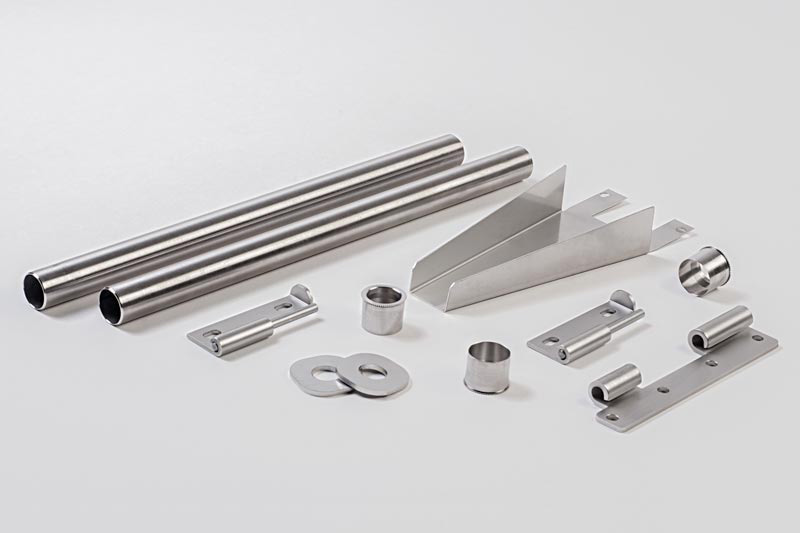
We supply sheet, tube and bar in the grades above against the standard named on the order. If the application is the open question rather than the grade, send the environment, the duty and the fabrication route and we will say which analysis we would put forward. The sheet, tube and bar pages list the stocked sizes, the materials page covers the wider range, and machining can be quoted on the same order.
Comment
0 comments
Got thoughts or experiences to share? We’d love to hear from you!