
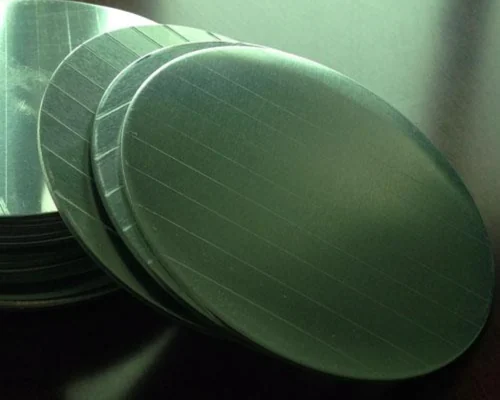
Cookware circles
O-temper circles in 1100 and 3003, sized to the press so the first operation is the draw rather than the blanking.
Pots, pans, pressure cookersRaw Materials · Aluminum Products
A circle is a blank that has already been cut to the diameter a press needs, so the customer's first operation is forming rather than blanking. Thickness, temper and diameter tolerance decide whether the draw goes cleanly.
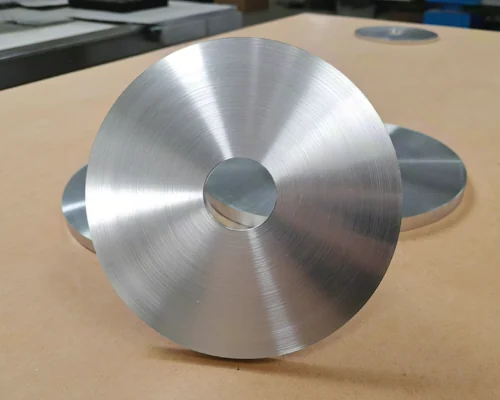
Four routes cover most of what we quote. Each is a different mill or process route, so the size window and the lead time differ even where the grade looks similar.
O-temper circles in 1100 and 3003, sized to the press so the first operation is the draw rather than the blanking.
Pots, pans, pressure cookers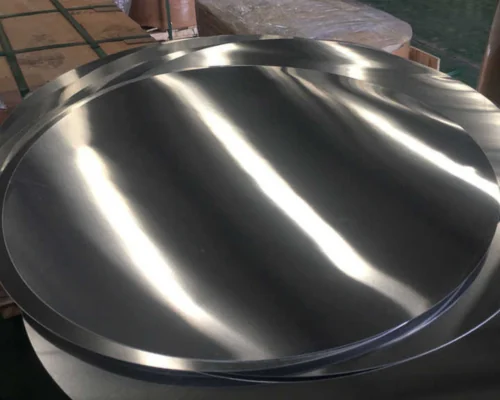
Circles spun or pressed into cones and reflectors, with the thickness and flatness the forming process needs.
Luminaires, reflectors, housings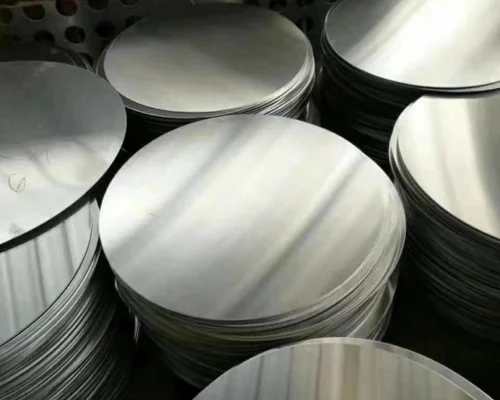
Disks for capacitors, heat sinks and shielding, where conductivity and flatness matter as much as the alloy.
Capacitors, heat sinks, shielding
Standard diameters for plates, badges and general press work, saving a blanking operation on the customer's floor.
Badges, plates, general press workCircles are quoted by alloy, temper, thickness and diameter. The temper and the thickness tolerance are what decide whether the draw succeeds.
Swipe the table sideways for the notes →
| Parameter | Range | What decides it |
|---|---|---|
| Thickness | 0.3 – 4.0 mm | Deep-drawn cookware uses thicker stock than a lighting reflector. |
| Diameter | 100 – 980 mm | The press sets the diameter; the tolerance on it sets the die clearance. |
| Temper | O, H12, H14, H16, H18 | O for deep drawing, H14–H18 where stiffness matters more than forming. |
| Alloys | 1050, 1060, 1100, 3003, 3004, 5052 | 1100 and 3003 for cookware, 5052 where strength and corrosion resistance matter. |
| Surface | Mill, protected film, coated | A protective film prevents press marks on visible cookware surfaces. |
| Packing | Pallets or crates, interleaved | Circles are packed flat and interleaved so edges are not dented in transit. |
Four properties make a circle the right input for a drawing or spinning operation.
Soft temper and consistent thickness let the blank flow into the die without tearing, which is the whole point of buying a circle rather than a square blank.
A thickness variation across the blank turns into a variation in the wall of the drawn part, and the press cannot compensate for it.
Any mark on the blank is stretched by the draw and appears on the finished part, so surface control is part of the specification.
Aluminum circles are used for heat spreaders and electrical components because the substrate conducts as well as forms.
Circle orders are decided by alloy, temper, thickness and diameter. The first two decide whether the part forms at all.
Deep drawing, spinning or blanking change the temper and the thickness tolerance that will work.
1050 and 1100 for cookware draws, 3003 for general work, 5052 where the part needs more strength.
The press and the die clearance set how tight the diameter has to be.
Film for visible surfaces, interleaved packing so the edges arrive undented.
Circles are the input to cookware, lighting and any part that starts life as a round blank.
Pots, pans and pressure-cooker bodies drawn from O temper circles in 1100 or 3003.
Housings and reflector blanks where the circle is spun or pressed into a conical form.
Disks for capacitors, heat sinks and shielding, where conductivity and flatness matter.
Round blanks for plates, badges and general press work where a standard diameter saves a blanking operation.
Need circles quoted by alloy, temper and diameter? Send the specification, quantity and any certification requirement and we will come back with what we can supply.
Get Instant Quote