
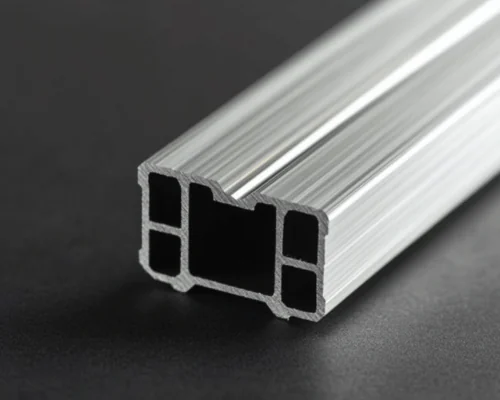
T-slot and V-slot
The frame-building sections: a slot on every face takes a nut anywhere along the length, so a joint can be moved without drilling.
Machine frames, guards, workstationsRaw Materials · Aluminum Products
A standard profile is an extrusion that already has a die, which is why it arrives faster and cheaper than a custom shape. The die number, the alloy and the temper decide what the profile can carry; the finish decides how it looks after five years outdoors.
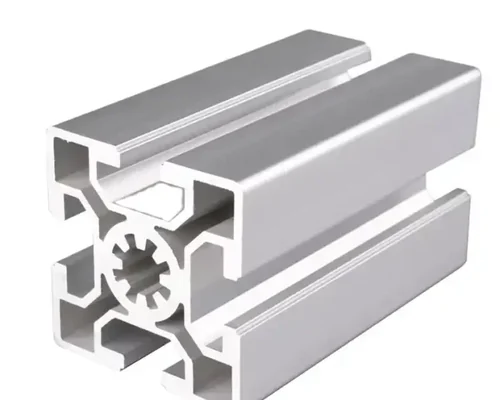
Four routes cover most of what we quote. Each is a different mill or process route, so the size window and the lead time differ even where the grade looks similar.
The frame-building sections: a slot on every face takes a nut anywhere along the length, so a joint can be moved without drilling.
Machine frames, guards, workstations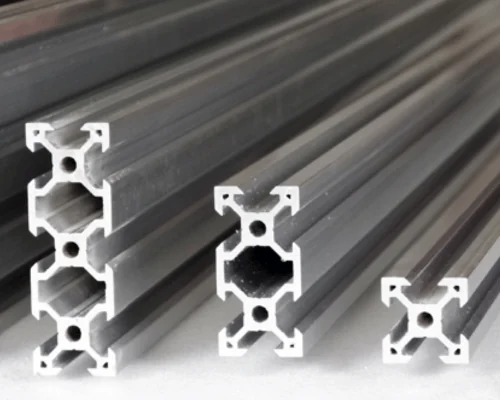
L-section and corner profiles for edges, trims and brackets, in wall thicknesses that suit light trim or loaded corner posts.
Edge trim, brackets, corner joints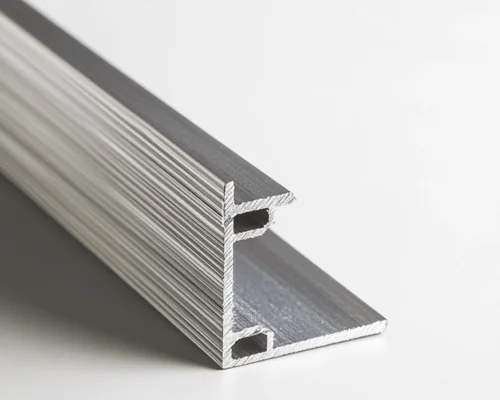
Square, rectangular and round extruded tube plus flat bar, for parts that need a closed section or a flat mounting face.
Rails, spacers, mounting plates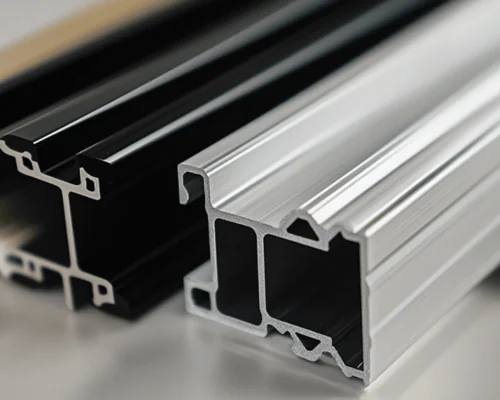
Open sections that guide, cover or carry a panel, with the wall and the internal radius set by the die rather than by a drawing.
Cable covers, guides, panel edgesStandard profiles are quoted by die number plus alloy, temper and length. Where a section has to be load-bearing, the moment of inertia rather than the outside size is what to compare.
Swipe the table sideways for the notes →
| Parameter | Range | What decides it |
|---|---|---|
| Section families | T-slot, V-slot, angle, channel, round and square tube, flat bar | The family narrows the die list; the slot pitch decides which fasteners and nuts fit. |
| Alloys | 6063, 6061, 6082, 6005, 6106, 6060 | 6063 extrudes to the best finish, 6061/6082 give higher strength for structural and machined parts. |
| Temper | T4, T5, T6 | T5 is the usual architectural temper; T6 is for parts that are machined or loaded. |
| Length | Cut to length, typically up to 6 m | Long lengths need a flat bed and a handling plan, not just a longer truck. |
| Finish | Mill, anodized (clear or colour), powder coated | Anodizing is a conversion of the surface; powder coating is a film on top of it. |
| Tolerance | Per EN 755 or the drawing | Wall and twist tolerances decide whether two profiles meet cleanly at a joint. |
Four properties decide whether a standard profile works in a frame or has to become a custom die.
An existing die gives you its section, its wall and its corner radii. Designing around the catalogue is faster than designing around a drawing and waiting for tooling.
Two profiles that look alike can differ by a millimetre of wall. On a loaded beam that difference matters more than the alloy name.
The same 6063 section in T5 and T6 does not carry the same load, and the difference is not visible on the surface.
Anodizing and powder coating add lead time and handling. Specifying the finish after fabrication usually means re-handling the parts.
Standard profile orders are decided by four numbers: die, alloy, temper and length. We confirm all four before quoting, because three of them cannot be changed after extrusion.
Send the die number if you have one, or the section family and the load it has to carry.
6063-T5 for architectural work, 6061-T6 where the profile is structural or machined afterwards.
Cut lengths, hole positions and tapped ends are set before finishing so the anodized surface is not broken by a second operation.
Anodized, powder coated or mill, with protection between profiles so the visible faces arrive unmarked.
Standard profiles are structural and decorative at the same time: the same extrusion becomes a machine frame, a window mullion or a display stand.
T-slot and V-slot profiles with the matching fasteners, cut to a cut list and drilled for the panels.
6063-T5 sections anodized or powder coated, where the finish and the straightness are the visible quality.
Profiles cut, tapped and finished as a kit, so assembly on site is bolting rather than machining.
Higher-strength 6061 or 6082 sections for frames that carry equipment through vibration.
Need a standard section priced by die number and cut length? Send the specification, quantity and any certification requirement and we will come back with what we can supply.
Get Instant Quote