

Imagine your engineering team is preparing to launch a new industrial fluid reservoir with an Estimated Annual Usage (EAU) of 5,000 units. As a New Product Introduction (NPI) sourcing manager or lead mechanical engineer, you face a critical financial fork in the road: Do you authorize a $3,000 capital expenditure (CapEx) for a rotational mold and endure a sluggish 45-minute cycle time? Or do you invest $20,000 upfront in a blow mold to achieve a blazing-fast 60-second cycle time?
When it comes to manufacturing hollow plastic components—ranging from automotive fuel tanks and kayaks to medical waste bottles and playground equipment—the choice between blow molding vs. rotational molding is rarely just a technical preference. It is a strict financial calculation. Selecting the wrong manufacturing process can either burn your upfront tooling budget or destroy your long-term unit economics.
In this comprehensive engineering guide, we bypass the generic definitions and dive straight into the physics, thermodynamics, and financial realities of both processes. By examining tooling CapEx, operational expenses (OpEx), and hard Design for Manufacturability (DFM) constraints, this guide will provide you with the exact framework needed to calculate your manufacturing break-even point.
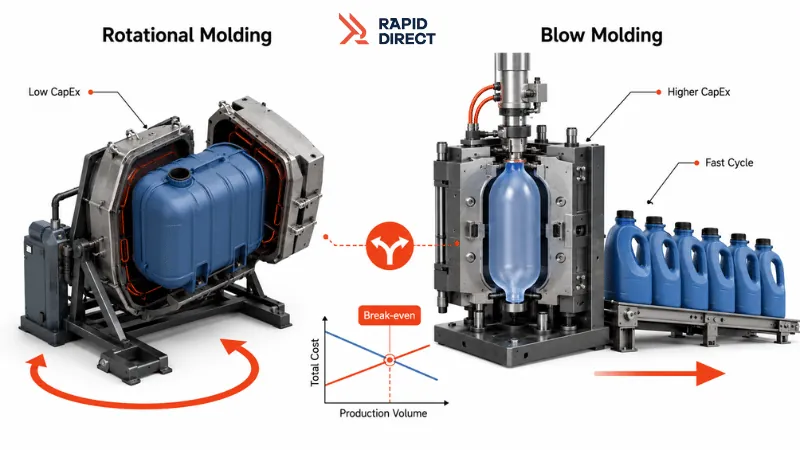
The Physics Behind the Tooling: Why Costs Differ Dramatically
To understand why tooling quotes from your manufacturing partners vary so wildly between these two processes, engineers must look at the underlying physics. Mold costs are not arbitrarily assigned; they are a direct reflection of the internal pressure, thermal dynamics, and mechanical stresses exerted on the tooling during the manufacturing cycle.
Blow Molding: High Pressure, High CapEx
The core mechanics of extrusion blow molding and injection blow molding rely on pneumatic force. During the process, a hollow tube of molten plastic (the parison) is clamped inside the mold. High-pressure air—typically ranging from 50 to 100 PSI—is instantly injected into the parison, violently expanding the plastic until it is pressed tightly against the mold’s interior walls.
To safely contain 100 PSI of internal pressure and withstand the massive clamping tonnages required to keep the mold halves sealed shut, blow molds must be CNC-machined from solid blocks of hardened tool steel (such as P20 or H13) or high-grade aircraft aluminum. Machining deep, complex cavities into hardened steel is an incredibly slow and expensive process, which routinely drives blow molding tooling CapEx into the tens of thousands of dollars.
However, this massive upfront investment yields unparalleled operational efficiency (Low OpEx). Steel molds utilize highly engineered conformal cooling channels that rapidly dissipate heat from the plastic. As a result, the entire molding cycle is extraordinarily fast, usually yielding a finished part every 30 to 60 seconds.
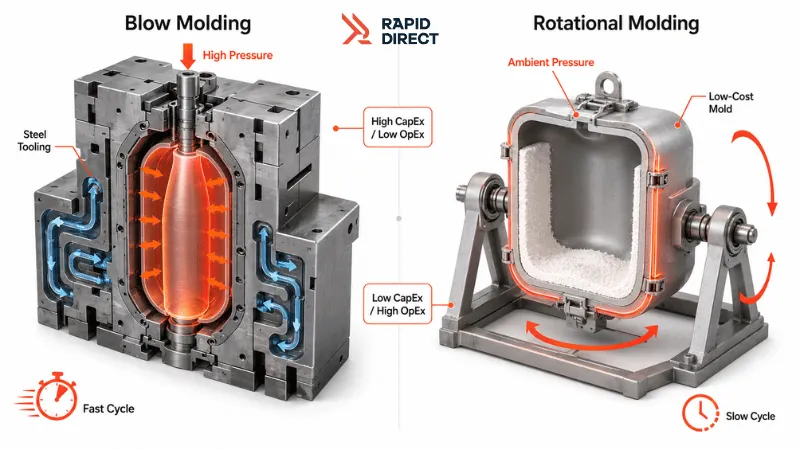
Rotational Molding: Ambient Pressure, Low CapEx
Rotational molding (roto molding) operates in an entirely different thermodynamic environment: ambient pressure. Instead of injecting molten plastic under high force, the roto molding process relies on placing pulverized polymer powder inside a hollow mold. The mold is then moved into a massive industrial oven where it is slowly rotated on two biaxial axes. As the mold heats up, the powder gradually melts and adheres to the inner walls through centrifugal force and gravity.
Because the internal pressure is effectively zero (0 PSI), the mold does not need to withstand high mechanical stress or clamping forces. Consequently, rotational molds are significantly cheaper to manufacture. They are typically fabricated from cast aluminum or formed sheet metal, dropping the tooling CapEx to a mere fraction (often 10% to 20%) of a comparable blow mold.
The trade-off for this cheap tooling is operational inefficiency (High OpEx). Because rotational molding relies on slow, ambient thermal transfer to melt the powder and relies on air/water cooling to solidify the part while still rotating, the cycle times are drastically elongated. A single rotational molding cycle can easily take 30 to 60 minutes to complete.
The Break-Even Matrix: CapEx vs. OpEx Analysis
In the hardware supply chain, the decision between blow molding and rotational molding hinges entirely on your Estimated Annual Usage (EAU). Sourcing directors must calculate the exact intersection where the high tooling cost of blow molding is amortized and eclipsed by its incredibly low piece price.
The Break-Even Matrix: Blow Molding vs. Rotational Molding
| Metric | Blow Molding | Rotational Molding |
| Tooling CapEx ($) | $10,000 – $50,000+ (High) | $2,000 – $10,000 (Very Low) |
| Cycle Time (OpEx Driver) | 30 – 60 Seconds (Extremely Fast) | 30 – 60 Minutes (Extremely Slow) |
| Internal Pressure (PSI) | 50 – 100 PSI | Ambient (0 PSI) |
| Suitable EAU (Volume) | 20,000 – 1,000,000+ Units | 500 – 10,000 Units |
| Key DFM Strength | Thin walls, rapid high-volume output | Molded-in inserts, extreme physical sizes |
Interpreting the Break-Even Point
Let us model a real-world scenario for a 50-liter industrial chemical tank:
- Scenario A: Low Volume (1,000 Units EAU)
If your market demand is only 1,000 tanks per year, rotational molding holds absolute financial superiority. If a blow mold costs $20,000, that capital expenditure adds a $20 tooling amortization burden to every single part in your first year. Even if the blow molded piece price is $2 cheaper due to faster cycle times, the math does not work. Rotational molding allows you to launch the product with a $3,000 mold, drastically lowering your financial risk during the early NPI phases. - Scenario B: High Volume (50,000 Units EAU)
If your volume scales to 50,000 tanks, the equation flips aggressively. The 45-minute cycle time of rotational molding will bottleneck your supply chain, requiring multiple machines and operators, driving your piece price sky-high. Conversely, the high-speed 60-second output of blow molding will slash your unit cost. At this volume, the initial $20,000 steel mold is amortized to just $0.40 per part, generating massive long-term savings and proving blow molding to be the ultimate mass-production solution.
Hard Engineering Constraints: Design for Manufacturability (DFM)
Financial calculations mean nothing if the manufacturing process cannot physically create your geometry. Beyond the CapEx vs. OpEx debate, blow molding and rotational molding possess absolute limitations in Design for Manufacturability (DFM).
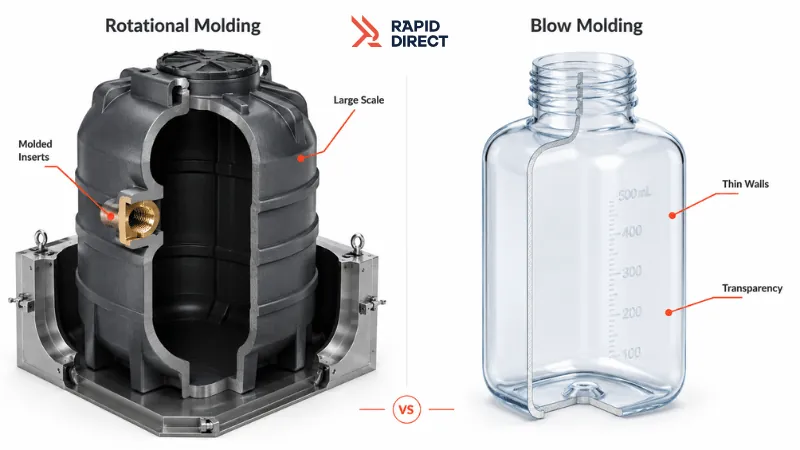
Molded-in Inserts and Extreme Sizes (The Roto Advantage)
If your hollow part is a heavy-duty industrial tank that requires robust threaded connections for valves and hoses, you need molded-in inserts. Rotational molding is the undisputed king of this structural feature. Engineers can manually bolt heavy brass or stainless steel nuts directly into the aluminum mold prior to the cycle. As the polymer powder melts, it flows seamlessly around the metal inserts, creating an indestructible mechanical interlock within the thick plastic wall. Blow molding, due to its rapid inflation process, struggles to encapsulate thick metal inserts effectively.
Furthermore, rotational molding dominates extreme part sizes. If you need to manufacture a 20,000-liter agricultural water reservoir, building a blow mold and an injection press large enough to handle it would cost millions. Large-scale roto-ovens easily accommodate massive geometries.
Thin Walls, Transparency, and PET (The Blow Advantage)
If your application demands lightweight, ultra-thin walls, blow molding is the mandatory choice. The high-pressure pneumatic expansion inherent to blow molding stretches the polymer chains, allowing engineers to produce extremely thin, uniform walls that maximize material efficiency without sacrificing tensile strength.
If your product requires visual transparency (like a medical fluid container or a consumer beverage bottle), blow molding is unparalleled. It is the only viable method for processing optically clear, high-strength packaging geometries at scale.
Material Monopolies: What Can You Actually Mold?
Your choice of polymer resin will frequently dictate your manufacturing pathway, as both processes have distinct material monopolies.
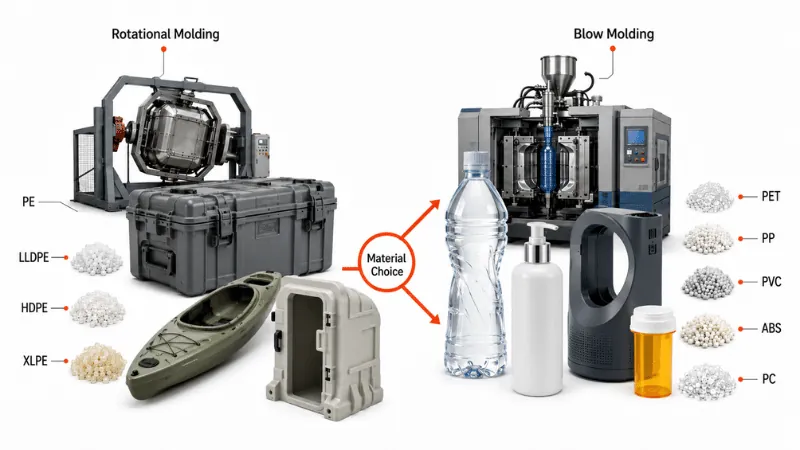
- The Rotational Molding Monopoly (Polyethylene): Roto molding is highly restrictive regarding material science. The process relies heavily on the powder’s ability to flow smoothly and melt gradually without degrading during the long 45-minute bake time. Consequently, the rotational molding industry is heavily monopolized by varying densities of Polyethylene (PE), including LLDPE, HDPE, and Cross-Linked PE (XLPE). While PE is incredibly durable and impact-resistant, if your project requires high-heat deflection or engineering-grade rigidity, roto molding cannot support it.
- The Blow Molding Advantage (PET and Engineering Plastics): Blow molding supports a vastly wider spectrum of thermoplastic resins. It processes Polypropylene (PP), PVC, ABS, and Polycarbonate with ease. Most importantly, PET (Polyethylene Terephthalate) is virtually exclusive to the blow molding process. If you are designing high-strength, transparent packaging, blow molding is your only engineering route.
Sourcing Smart: Get a Dual-Track Cost Analysis
In modern hardware procurement, guessing your manufacturing break-even point leads to disastrous budget overruns. You do not need to choose between CapEx and OpEx in the dark.
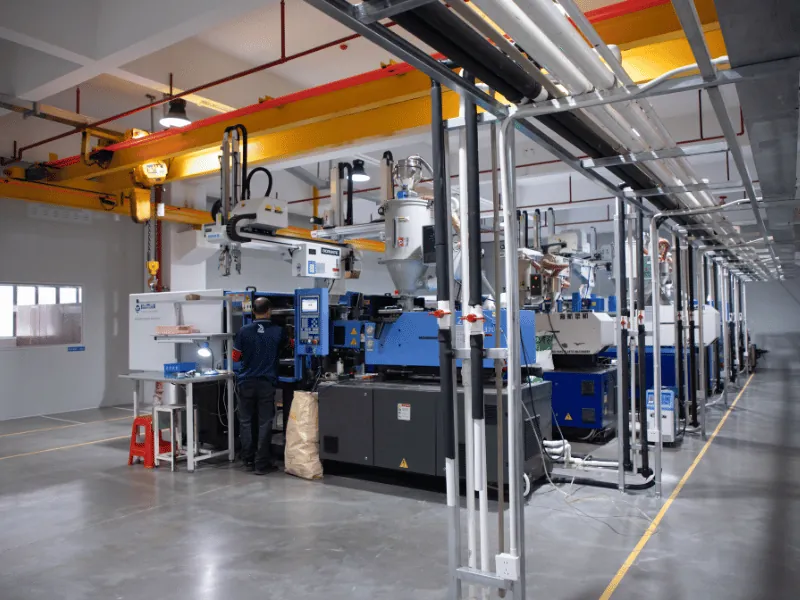
Unsure if your part volume justifies the heavy tooling cost of blow molding? Upload your CAD file to the SHBD Metal platform today. Our specialized tooling engineers will perform a strict DFM review and provide a Dual-Track Cost Analysis. We will mathematically calculate the exact break-even point between blow molding and rotational molding based on your specific geometry and EAU, ensuring you select the most profitable manufacturing strategy for your product lifecycle.
FAQ for Sourcing Managers
For standard-sized hollow components, the financial break-even point typically falls between 10,000 and 20,000 units. Once your Estimated Annual Usage (EAU) crosses this threshold, the blazing-fast cycle time of blow molding (often under 60 seconds) drives the machine hourly rate and labor OpEx down so significantly that it rapidly amortizes and eclipses the expensive upfront cost of the hardened steel tooling.
No. Because rotational molding occurs at ambient pressure and the part cools and shrinks freely inside the mold over a long period, it suffers from wider dimensional variations. Roto molding tolerances typically sit around ±2%. Conversely, blow molding forces the plastic against precision CNC-machined steel walls under 100 PSI, allowing it to hold significantly tighter engineering tolerances. If your hollow part must mate perfectly with complex injection-molded assemblies, blow molding is the safer specification.

Comment
0 comments
Got thoughts or experiences to share? We’d love to hear from you!