
Polypropylene dominates traditional injection molding because it survives millions of bending cycles and resists harsh industrial chemicals. Hardware engineers specify PP plastic 3d printing to validate living hinges and automotive fluid reservoirs directly on the test bench. Because the material’s semi-crystalline structure causes massive thermal shrinkage, attempting to print it on desktop machines usually yields distorted plastic. We manage the intense thermal demands of powder-bed fusion so your team can stop fighting warped prototypes and immediately test functional, stress-relieved components.
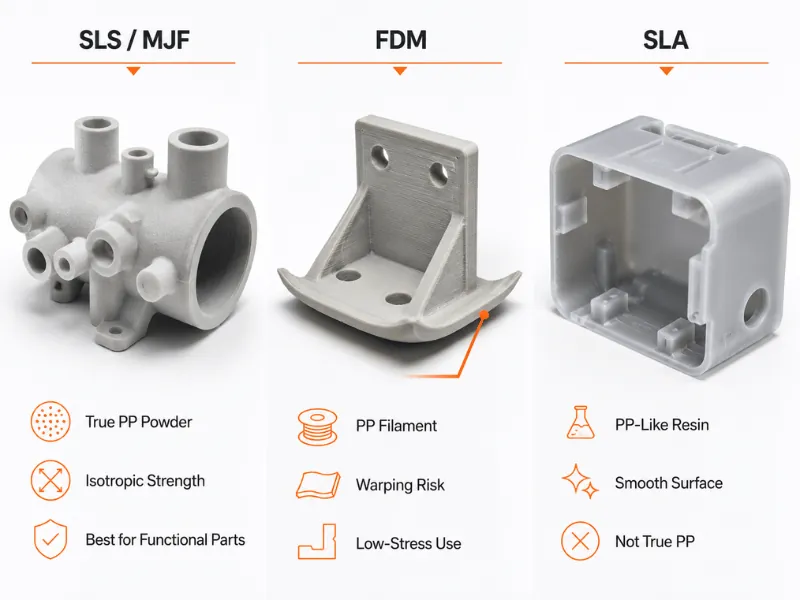
PP 3D Printing Process Selection Matrix
Reference this matrix to align your specific mechanical requirements with the most reliable manufacturing process. This eliminates weeks of material trial and error on the test bench.
| 3D Printing Technology | Base Material Form | Key Advantage for PP | Primary Challenge/Drawback | Ideal Application |
| SLS / MJF | True PP Powder | Excellent isotropic strength, no support structures needed | Slightly porous surface finish | Living hinges, chemical tanks, fluid manifolds |
| FDM | PP Filament | Cheap material, accessible on desktop machines | Extreme warping, poor bed adhesion, anisotropic strength | Basic jigs, low-stress brackets |
| SLA | PP-Like Photopolymer Resin | Exceptional surface finish, high resolution for fine details | Not true PP chemistry, lower thermal/chemical resistance | Cosmetic mockups, high-precision snap-fits |
The Physics of PP Plastic 3D Printing
Polypropylene polymer chains fold into highly organized crystal structures as they cool from a molten state. This chemistry causes extreme thermal shrinkage across the entire part. Attempting to print standard PP filament for 3d printing on a generic desktop machine causes this shrinkage to pull the part completely off the build plate. Your engineering team is left with unusable geometries instead of testable functional prototypes.
The Battle of Technologies: How to Succeed in 3D Printing with PP
Powder Bed Fusion (SLS & MJF): The Industrial Gold Standard
Selective Laser Sintering (SLS) and Multi Jet Fusion (MJF) bypass the bed adhesion nightmare of extrusion methods completely. These industrial powder-bed systems act as the gold standard for 3d printing with PP because the unsintered powder physically supports the part during the intense thermal curing phase.
This precise thermal management prevents differential shrinkage and produces living hinges with true isotropic strength. The powder bed maintains a consistent ambient temperature just below the melting point, ensuring the semi-crystalline structure forms evenly. Automotive NPI teams rely on our industrial SLS machines to print functional fluid reservoirs that bolt directly onto active engine dynamometers without leaking.
FDM 3D Printing: Taming PP Filament
While highly accessible, printing PP filament for 3d printing introduces severe manufacturing headaches. Polypropylene possesses an extremely low surface energy. The melted plastic refuses to stick to standard glass, PEI, or textured build plates.
Operating FDM requires a fully enclosed, actively heated chamber to slow the cooling rate. You must apply specialized PP-specific adhesive sheets or standard polypropylene packaging tape directly to the bed to achieve even marginal first-layer adhesion. Even with perfect adhesion, FDM parts always possess severe Z-axis weakness, making them highly unreliable for stress-tested living hinge applications.
SLA 3D Printing: The “PP-Like” Resin Alternative
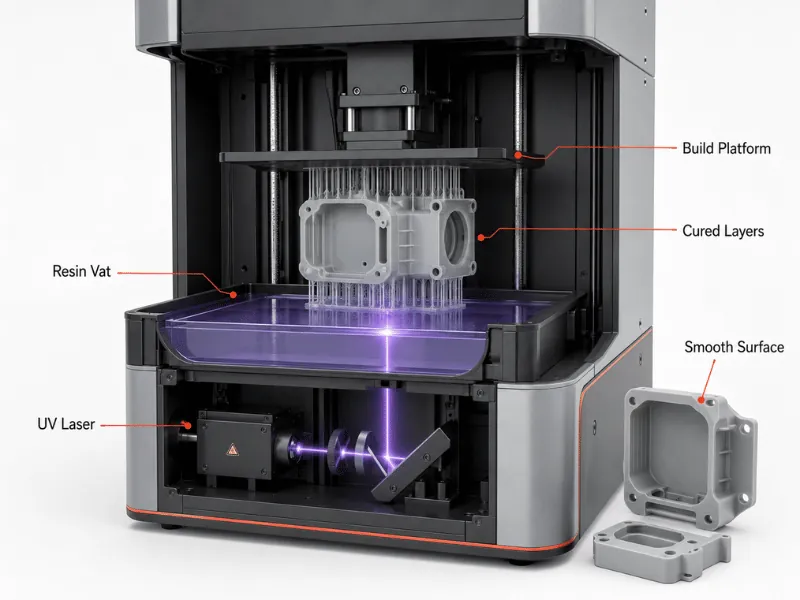
When your design requires injection-molding-level surface finishes—such as an interlocking cosmetic housing—true PP powder presents a slightly porous, rough texture. Printing a “PP-Like” photopolymer resin on an industrial SLA machine offers a highly precise alternative.
These SLA resins mimic the flexibility and Shore hardness of polypropylene perfectly. Because they are light-cured thermosets rather than true thermoplastics, they degrade rapidly if exposed to the harsh chemicals or extreme temperatures that true PP survives. Reserve PP-like SLA resins strictly for form, fit, and aesthetic validation inside a temperature-controlled lab.
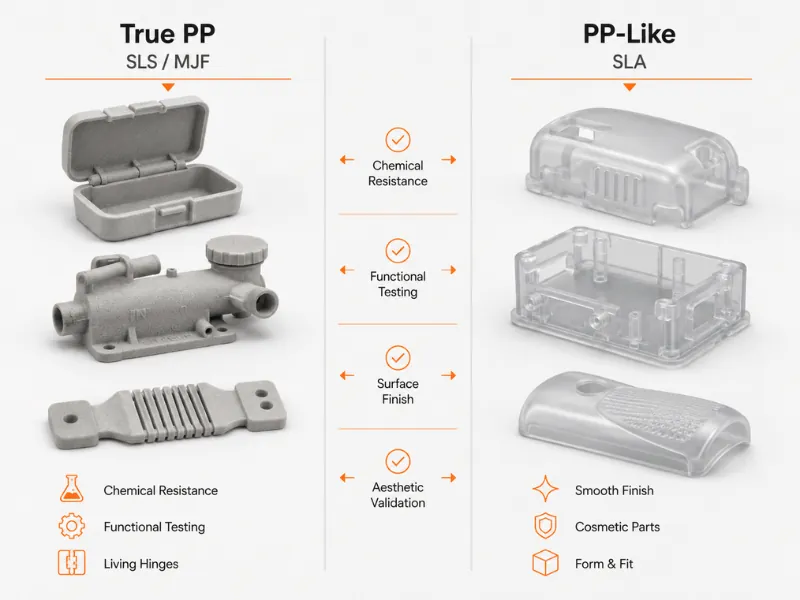
Pro Tip: Unsure if your design requires the chemical resistance of true SLS PP or the smooth finish of an SLA PP-Like resin? Request SHBD Metal’s [Free Material Sample Box] today. Physically bend our printed living hinges to make risk-free decisions for your specific assembly.
Designing for PP 3D Printing: DFM Best Practices
Engineering Functional Living Hinges
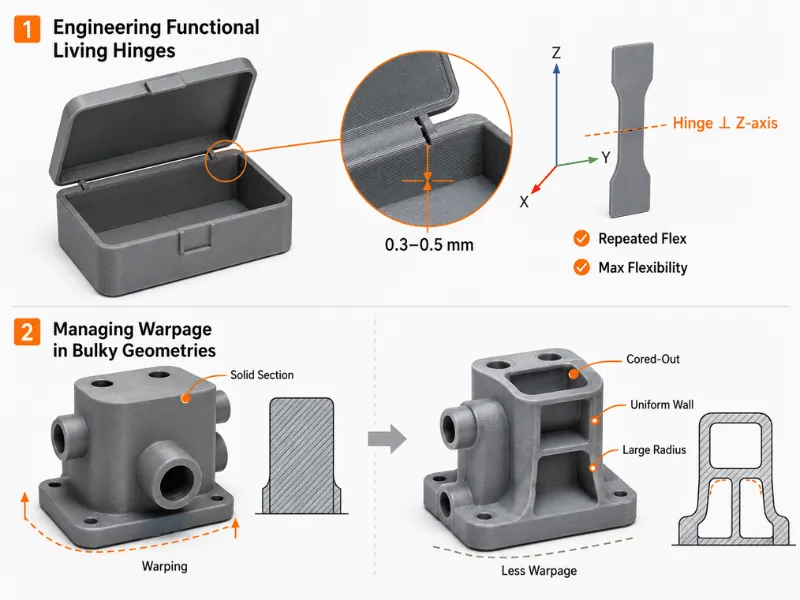
Living hinges printed in PP must flex repeatedly without tearing the polymer chains. Maintain a hinge thickness between 0.3mm and 0.5mm to balance flexibility with tensile strength.
When orienting the part for powder-bed fusion, always align the hinge perpendicular to the Z-axis. This specific orientation ensures maximum flexibility and prevents delamination during the critical first bend.
Managing Warpage in Bulky Geometries
Thick, solid cross-sections cool much more slowly than thin walls. This thermal mismatch induces massive internal stresses that warp the final geometry out of tolerance.
Always core out bulky sections, maintain uniform wall thicknesses, and apply generous radii to all internal corners. Distributing the cooling stress evenly across the part guarantees your printed manifolds and brackets match your precise CAD dimensions.
Accelerate Production with Factory-Direct 3D Printing
Sourcing through digital marketplaces risks breaking your manufacturing traceability. When CAD data is brokered to changing sub-tier facilities, the direct loop between design engineers and machine operators is severed. This structural gap directly increases your risk of dimensional errors.
SHBD Metal restores this pipeline by acting as a direct Tier-1 manufacturer. Within our 20,000㎡ centralized facility, every phase—from raw powder verification to precision post-machining—is controlled under strict internal quality protocols. By removing broker-layer overhead, we deliver transparent pricing that returns a 30% budget efficiency back to your procurement pipeline.
Conclusion
Testing living hinges and fluid enclosures requires real PP material that will not warp on the build plate. Our factory-direct SLS and MJF systems eliminate these thermal shrinkage risks to deliver precise, stress-relieved components. Upload your CAD to our 3D printing service today for an instant DFM quote, and receive your functional PP parts in just 3-5 days.
FAQ
Polypropylene is a semi-crystalline polymer that shrinks drastically as it cools. Combined with its extremely low surface energy, the material refuses to bond with non-PP build plates. This unique chemistry causes massive thermal warping, making FDM printing nearly impossible without a heated chamber and specialized PP adhesive beds.
True polypropylene resin is inherently safe and chemically inert. The layer-by-layer nature of 3D printing creates microscopic surface porosity that traps bacteria. If your component requires direct food contact or medical-grade sterilization, you must use our post-processing vapor smoothing services to fully seal the surface and achieve compliance.
For order volumes between 1 and 500 units, printing true PP powder via industrial SLS or MJF completely avoids the massive capital expense of machining a steel mold. Once your project scales beyond 1,000 units, transitioning to our traditional injection molding service drastically reduces the per-unit cost and becomes the most capital-efficient supply chain strategy.
Comment
0 comments
Got thoughts or experiences to share? We’d love to hear from you!