
For product designers, mechanical engineers, and procurement teams, selecting the right manufacturing process is only half the battle. The true challenge lies in material selection. When transitioning a digital CAD model into a physical prototype, the material must accurately reflect the mechanical, thermal, and cosmetic properties of the final injection-molded part.
When dimensional accuracy, watertight integrity, and injection-mold-like surface finishes are non-negotiable, resin 3d printing stands as the industry standard. However, the landscape of photopolymer resins can be complex. With proprietary names like Accura, Somos, and RPU, engineers often struggle to map these 3D printing materials to the standard thermoplastics they use daily.
This comprehensive B2B guide translates complex photopolymer chemistries into practical engineering categories: ABS-like, Polycarbonate-like, Polypropylene-like, and Elastomers. By understanding these material equivalents and the industrial processes that shape them, you can confidently specify the right resin for your next project and leverage a professional resin 3d printing service to bring it to life.
What is Resin 3D Printing?
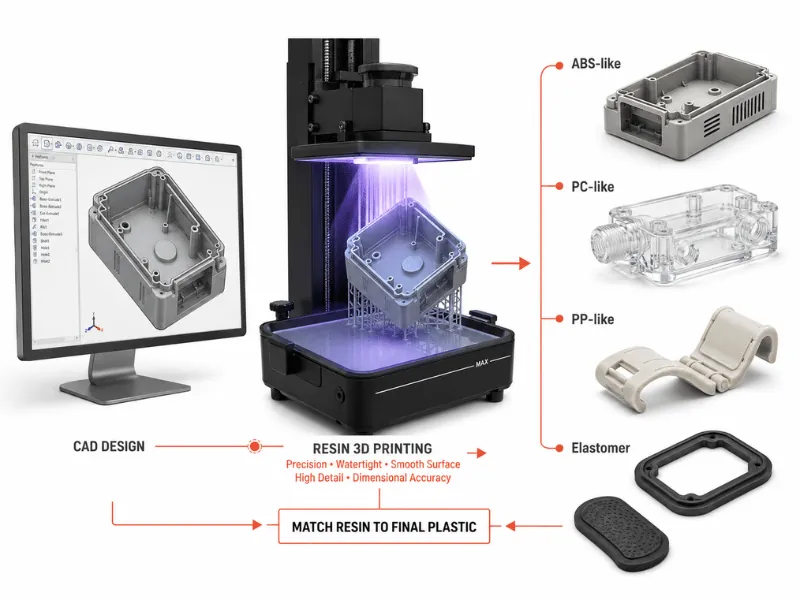
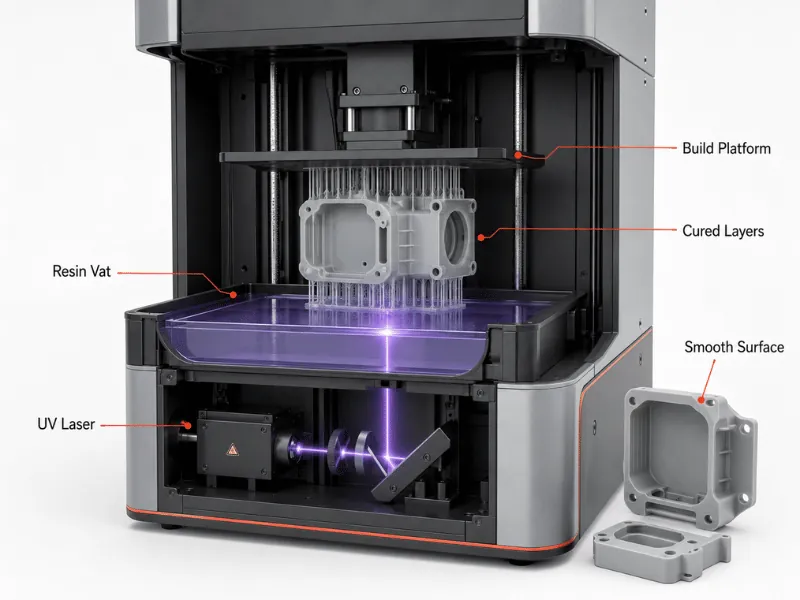
At its core, resin 3d printing relies on a process called photopolymerization. Instead of melting plastic filament (like FDM) or fusing polymer powder (like SLS), resin technologies use targeted ultraviolet (UV) light to selectively cure liquid photopolymer resin layer by layer.
As the UV light hits the liquid, the monomer chains cross-link, instantly solidifying the material into a highly dense, isotropic structure. Because this reaction occurs at a microscopic level, resin printing achieves tolerances, fine feature details, and smooth surface finishes that are completely unattainable by extrusion-based methods. The resulting parts require minimal post-processing to achieve a glass-like finish, making them ideal for high-fidelity visual prototypes, complex microfluidic channels, and precision fit-check assemblies.
Common Resin 3D Printing Processes
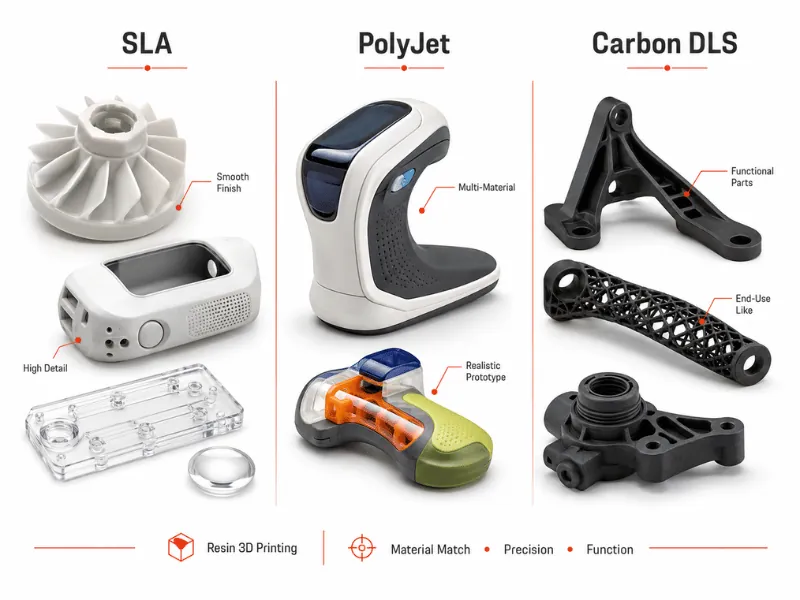
Before diving into the materials, it is crucial to understand the three primary industrial technologies used to process them. Each technology handles the liquid resin differently, dictating the part’s final mechanical properties and scale.
- SLA (Stereolithography):The most established resin technology. It utilizes a deep vat of liquid resin and a highly precise UV laser guided by galvanometers to trace the cross-section of the part. SLA is the workhorse of the industry, ideal for producing large-scale prototypes, highly detailed visual models, and accurate casting patterns.
- PolyJet:This technology operates similarly to a 2D inkjet printer. Instead of a deep vat, a print head jets microscopic droplets of liquid resin onto a build platform, which are immediately cured by a UV flash. PolyJet is the undisputed champion of multi-material printing, allowing engineers to mix rigid plastics with soft rubber-like elastomers in full color within a single build.
- Carbon (DLS – Digital Light Synthesis):A cutting-edge process that uses a continuous liquid interface and oxygen-permeable optics. Instead of pausing between layers, Carbon DLS pulls the part continuously from the resin pool. This drastically reduces print times and yields parts with genuine isotropic mechanical properties that rival end-use injection molded plastics.
Compare Resin 3D Printing Materials: Finding Your Match
Navigating manufacturer-specific resin names can be frustrating. To streamline your procurement process, we have categorized the industry’s most robust resins based on the traditional thermoplastics they are engineered to mimic.
ABS-Like Resins (Tough & Versatile)
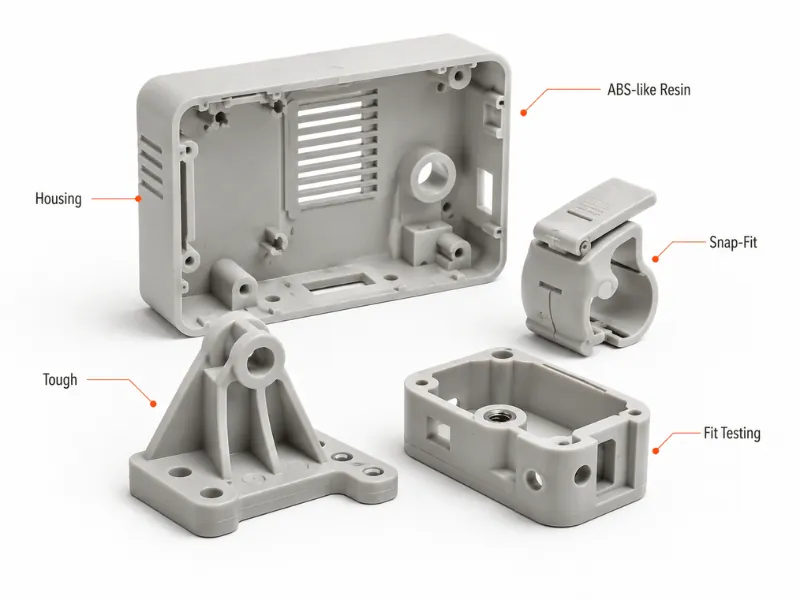
Acrylonitrile Butadiene Styrene (ABS) is one of the most common manufacturing plastics due to its balance of impact resistance, toughness, and structural stability. ABS-like resins are formulated to replicate these exact traits. They are the go-to choice for general-purpose prototyping, offering the durability required to endure drilling, tapping, and functional fit testing without shattering.
If your project involves electronic housings, snap-fit joints, or mechanical brackets, ABS-like resins provide the necessary toughness.
Table 1: ABS-Like Resins Comparison
| Material | Technology | Color | Tensile Strength | Elongation at Break |
| C-UV9400 White ABS-Like | SLA | Off White | 7.4 ksi / 51.0 MPa | 10.5% |
| C-UV9400 Gray ABS-Like | SLA | Matte Gray | 7.5 ksi / 51.7 MPa | 10.2% |
| Imagine Black High-Precision ABS-Like | SLA | Jet Black | 7.7 ksi / 53.1 MPa | 11.8% |
| 8228 High Toughness ABS-Like | SLA | Pure White | 8.0 ksi / 55.2 MPa | 14.0% |
| VeroWhitePlus Rigid ABS-Like | PolyJet | Opaque White | 7.3 ksi / 50.3 MPa | 14.5% |
Polycarbonate (PC)-Like Resins (Strong & High-Temp)
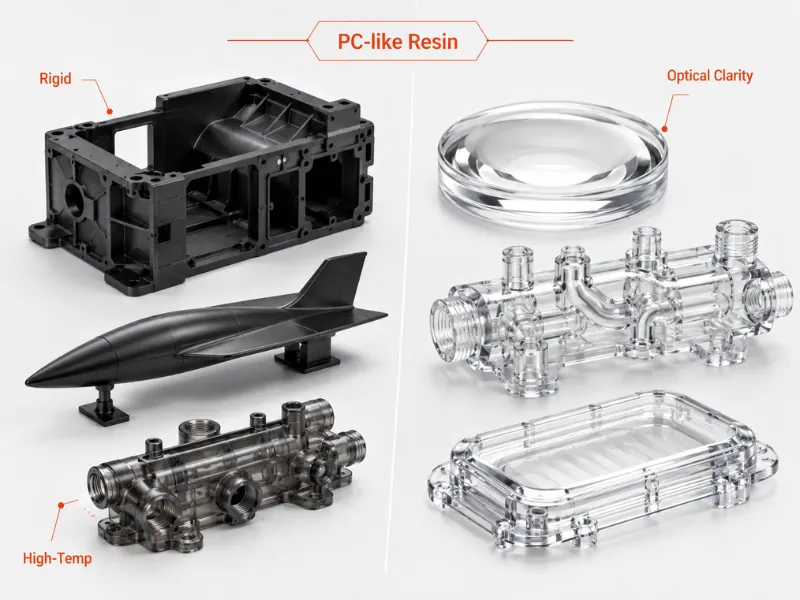
Standard Polycarbonate (PC) is specified when an assembly must endure high mechanical loads, high temperatures, or requires optical clarity. PC-like resins are highly rigid and feature elevated Heat Deflection Temperatures (HDT).
These materials are highly brittle compared to ABS, but their stiffness is unparalleled. They are ideal for applications where geometric deflection is unacceptable, such as wind-tunnel testing models, high-temperature fluid routing manifolds, and clear optical lenses. For extreme environments, ceramic-infused resins push these boundaries even further.
Table 2: Polycarbonate (PC)-Like Resins Comparison
| Materials | Technology | Color | Tensile Strength | Elongation at Break |
| L-Clear High Clear PC-Like | SLA | Clear / Water Clear | 9.2 ksi / 63.4 MPa | 5.8% |
| L-Clear HT High Temp PC-Like | SLA | Amber Translucent | 6.4 ksi / 44.1 MPa | 1.6% |
| HT-110 High Temp PC-Like | SLA | White | 8.2 ksi / 56.5 MPa | 3.0% |
| VeroClear Transparent PC-Like | PolyJet | Water Clear | 7.0 ksi / 48.3 MPa | 11.8% |
Polypropylene (PP)-Like Resins (Flexible & Durable)
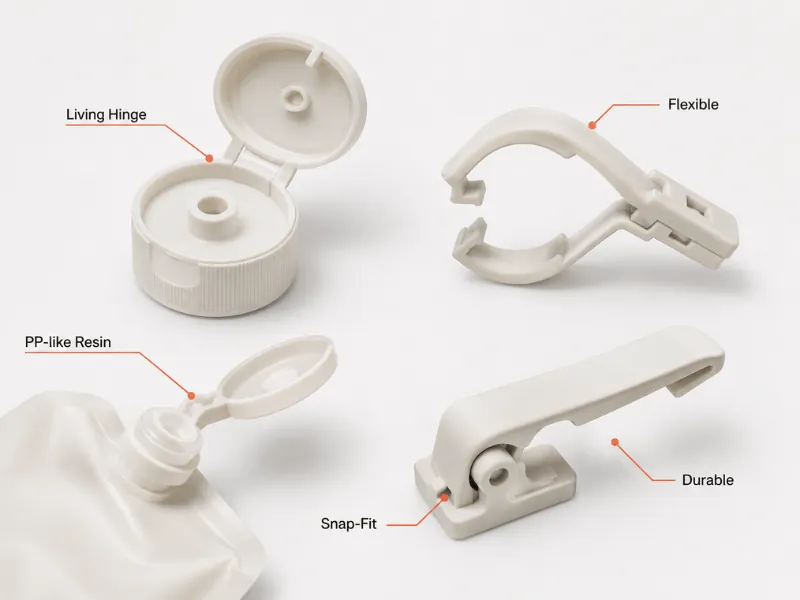
Polypropylene (PP) is known for its remarkable flexibility, low friction, and exceptional fatigue resistance. PP-like resins are engineered for parts that must bend repeatedly without breaking.
These materials are uniquely suited for prototyping living hinges (such as the clasp on a shampoo bottle), flexible packaging, and snap-fit assemblies that require significant deformation during installation. The high elongation at break ensures the material stretches under load rather than fracturing.
Table 3: Polypropylene (PP)-Like Resins Comparison
| Materials | Technology | Color | Tensile Strength | Elongation at Break |
| PP-9300 Domestic PP-Like Resin | SLA | Off White | 6.8 ksi / 46.9 MPa | 18.0% |
| PolyJet PP-Sim Rigid Resin | PolyJet | Opaque White | 6.6 ksi / 45.5 MPa | 17.2% |
Elastomers (Rubber-Like Flexibility)
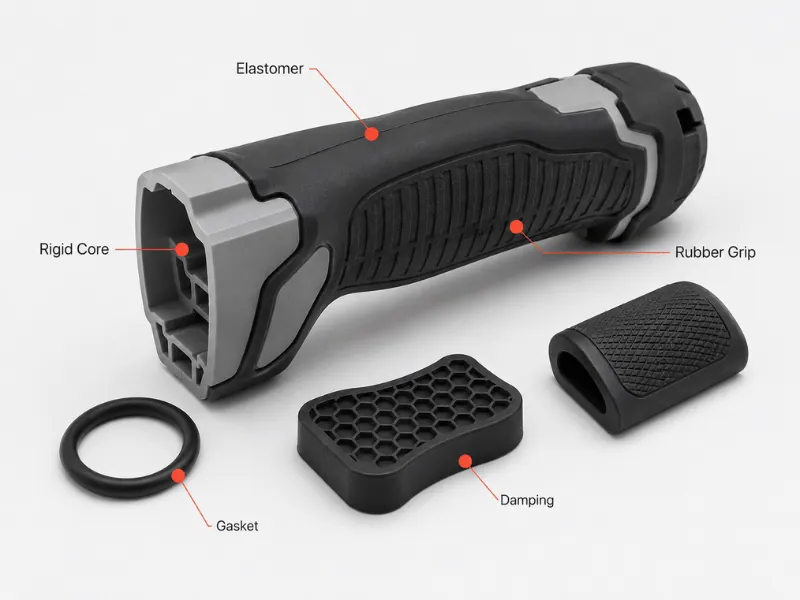
When a design requires shock absorption, non-slip grips, or complex sealing gaskets, engineers turn to elastomers. Using PolyJet technology, designers can digitally blend materials to achieve exact Shore A hardness levels, simulating everything from a soft gel to a hard rubber tire.
This allows for the rapid prototyping of overmolded parts—such as a power tool with a rigid ABS-like chassis and a 50A Shore rubber grip—produced simultaneously in a single print operation. By adjusting the Shore hardness, engineers control the tradeoff between stretch (elongation) and tear resistance (tensile strength).
Table 4: Elastomers (Rubber-Like) Comparison
| Materials | Technology | Colors | Tensile Strength | Elongation at Break |
| F-65 Flexible Rubber Resin | SLA | Black / Translucent | 1.2 ksi / 8.3 MPa | 155% |
| Agilus30 Flexible Rubber Resin | PolyJet | Translucent Clear / Black | 1.1 ksi / 7.6 MPa | 165% |
Precision Guaranteed: Our Industrial Resin 3D Printers
Material science is only effective when paired with industrial-grade manufacturing hardware. While desktop resin printers have become common, they lack the environmental controls and optical precision required for high-stakes B2B engineering.
To guarantee dimensional accuracy across every batch, our production floor is equipped with a fleet of top-tier, industrial Resin 3D Printers. Unlike entry-level machines, our industrial SLA and PolyJet systems feature actively heated resin vats. Maintaining a constant resin temperature ensures the photopolymer’s viscosity remains perfectly stable, which is critical for preventing layer delamination and geometric warping on large-scale parts. Furthermore, our machines utilize self-calibrating laser galvanometers, ensuring that a micro-fluidic channel printed on the edge of the build platform is just as accurate as one printed in the dead center.
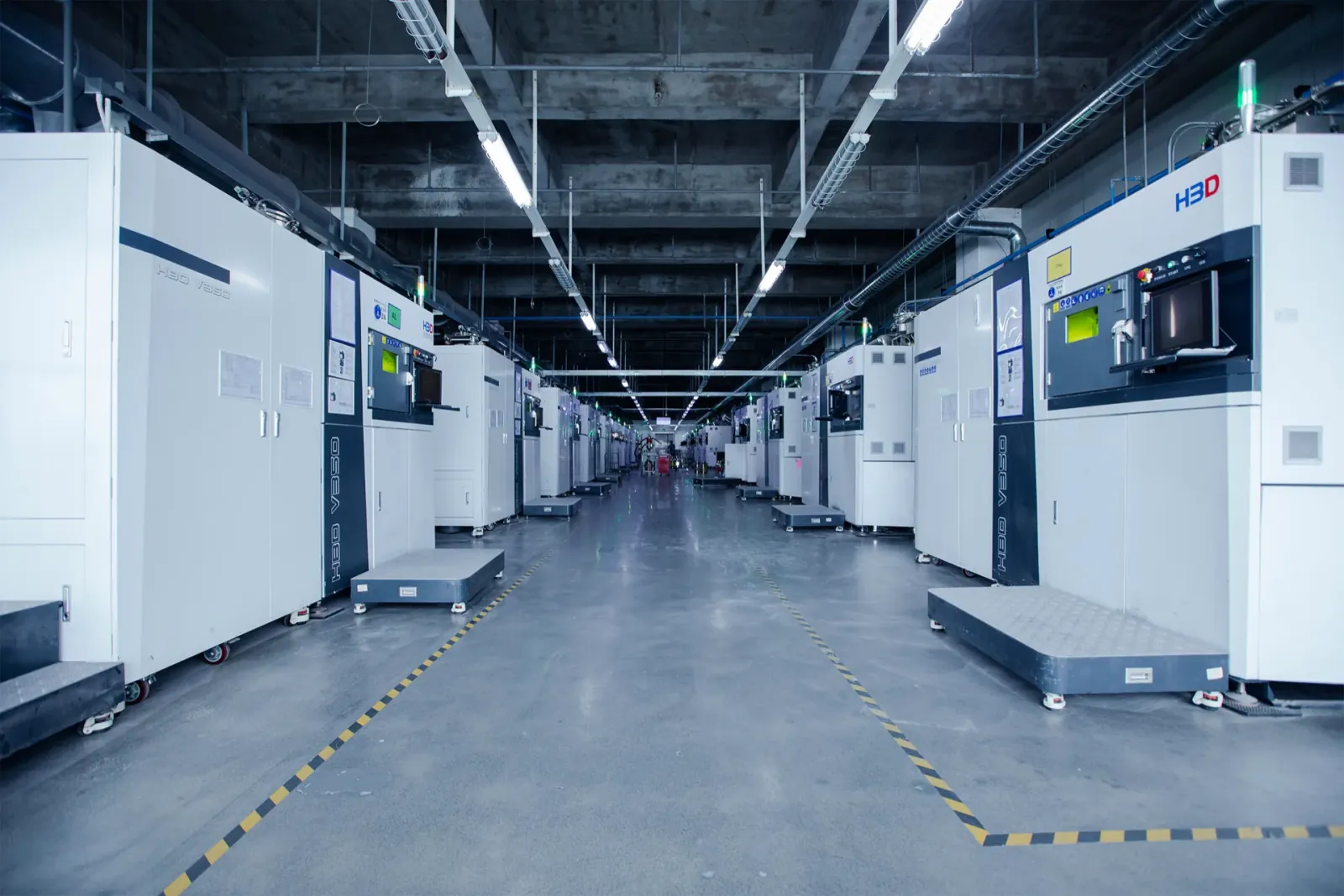
By leveraging industrial Resin 3D Printers, we eliminate the variability that plagues consumer machines, ensuring your prototype arrives with strict tolerances and a flawless finish.
Why Choose Our Resin 3D Printing Service?
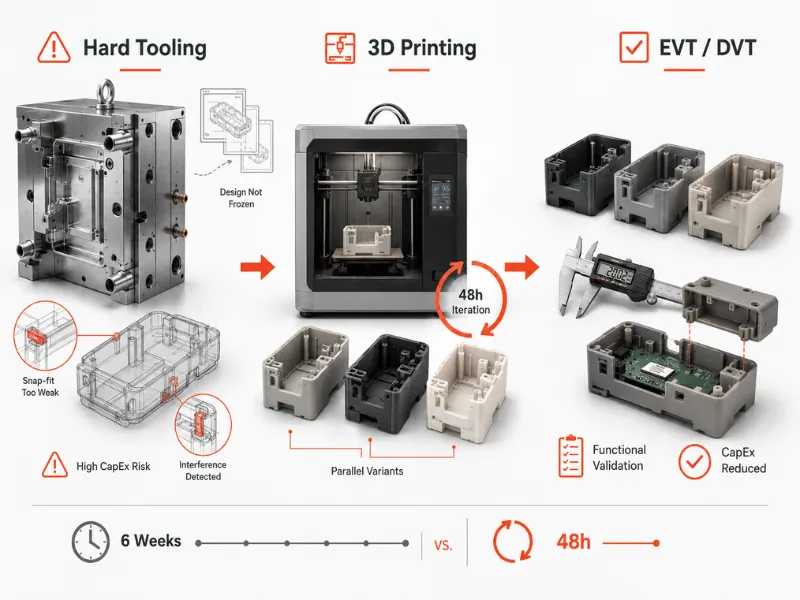
Transitioning from CAD to a physical prototype shouldn’t involve guesswork. Sourcing your components through a professional resin 3d printing service ensures that your designs are optimized for manufacturability and processed with strict quality control.
Following the print process, our engineering team executes rigorous post-processing protocols. Every part undergoes controlled isopropyl alcohol (IPA) solvent washing to remove excess liquid, followed by a calibrated UV post-curing cycle in a thermal oven. This vital final step ensures the polymer chains are fully cross-linked, delivering the maximum tensile strength and elongation metrics promised by the material data sheets.
Ready to validate your design with injection-mold quality? Upload your CAD file to our platform today to explore our extensive material library. Our intelligent quoting system and dedicated manufacturing engineers will help you select the perfect ABS, PC, or Elastomer equivalent, providing an instant, transparent quote to accelerate your product development timeline.
FAQ
Standard modeling resins can be brittle, which is why engineering applications require specialized formulations. By selecting ABS-like or PC-like resins (such as Accura Xtreme or Carbon RPU 70), you achieve high impact resistance and toughness that closely mimics durable injection-molded plastics.
Historically, resin printing was strictly for prototyping due to UV degradation over time. However, modern technologies like Carbon DLS utilize programmable liquid resins that, once thermally activated in a post-curing oven, produce robust, isotropic parts suitable for low-volume, end-use manufacturing in the automotive and medical sectors.
Yes. Both SLA and Carbon DLS require sacrificial support structures to anchor overhangs and resist the peeling forces generated when the part detaches from the resin vat during printing. However, our professional post-processing team carefully removes these supports and sands the contact points flat to ensure an SPI-grade surface finish.
Comment
0 comments
Got thoughts or experiences to share? We’d love to hear from you!