

SLS and SLM look like the same machine because both are laser-based powder bed fusion (PBF). The decision between them comes down to one physical fact: SLS sinters polymer powder into a solid but slightly porous part, while SLM fully melts metal powder into a near-fully-dense metal part. Everything else — material, strength, supports, post-processing, cost — follows from that difference.
This article compares the two processes on the variables that change your part: material, density, mechanical load, geometry, surface finish, post-processing, cost, and lead time. Use the tables to move from “which is newer” to “which one fits my part.”
SLS vs SLM: The One Difference That Matters
Both processes spread a thin powder layer, trace the cross-section with a laser, lower the build platform, and repeat. The powder stays in the bed and supports the part as it builds.
- SLS (selective laser sintering): a CO₂ laser partially melts polymer powder. Particles fuse at their surfaces but the bulk does not liquify. The result is a strong nylon part with small internal pores.
- SLM (selective laser melting): a high-power fiber laser fully melts metal powder into a liquid pool that solidifies as one homogeneous layer. The result is a metal part at near 100% density.
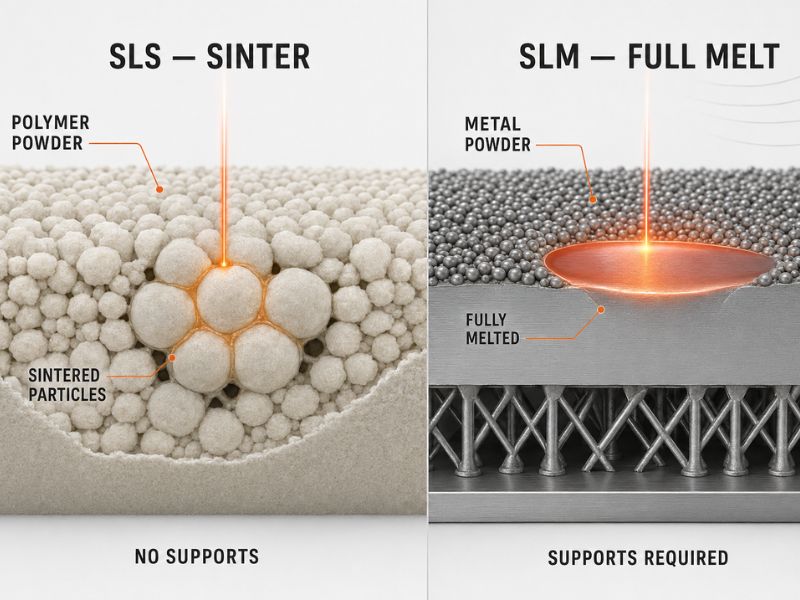
That single gap — sinter vs melt, polymer vs metal — is why SLS needs no supports while SLM usually does, why SLS powder is reusable and SLM runs in inert gas, and why SLM parts carry loads that SLS nylon cannot.
How SLS Works
A CO₂ laser sinters a polymer powder such as nylon 11 or nylon 12. The laser fuses each layer just enough to bond particles; the surrounding unfused powder stays in place and acts as built-in support.
Key behaviors:
- No support structures. Overhangs and internal channels print without added geometry.
- Powder reuse. Unfused powder is collected, screened, and blended with fresh powder for the next build.
- Cooling dwell. The build chamber needs a long cool-down (often 12+ hours) before part removal to avoid thermal shock.
- Materials: PA11, PA12, filled nylons, TPU, and some composites.
After cooldown, parts are blasted to remove surface powder. The core limitation is surface grain and a small risk of warping or oversintering on large flat areas and small holes.
How SLM Works
A fiber laser fully melts metal powder — stainless 316L, titanium TC4, aluminum AlSi10Mg, maraging steel, and similar alloys. The melt pool solidifies layer by layer into a fully dense structure.
Key behaviors:
- Inert gas environment. The chamber is flooded with argon or nitrogen to keep the molten metal from oxidizing.
- Supports required. Overhangs and downward-facing surfaces need added support geometry, which is removed after printing.
- Post-process to tolerance. As-printed parts often need stress-relief heat treatment and machining to hit tight dimensions.
- Materials: pure metals and alloys, broader than SLS in metal grades but limited to metals.
SLM outputs a part whose density and strength approach wrought or CNC-machined metal, which is why it sits in aerospace, medical, and tooling applications.
SLS vs SLM: Side-by-Side Comparison
| Property | SLS | SLM |
| Material class | Thermoplastic powder (nylon, TPU) | Metal powder (steel, Ti, Al, etc.) |
| Bonding method | Sinter / partial melt | Full melt |
| Part density | Partial (some porosity) | Near 100% dense |
| Supports needed | No | Yes (overhangs) |
| Inert gas | No | Yes |
| Surface finish | Grainy, powdery | Smooth metal, finer detail |
| Typical strength | Strong, isotropic, load-limited | Near metal-grade, high load |
| Post-processing | Blast, dye, vapor smooth, plate | Support removal, blast, heat treat, machine, anodize |
| Print volume (typical industrial) | Up to ~550 × 550 × 750 mm | Up to ~350 × 350 × 350 mm |
| Cost driver | Powder + machine time | Metal powder + supports + post-process |
The density row is the line that usually settles the argument: if the part must behave like solid metal, SLM; if functional plastic is enough, SLS.
Material Choices: Nylon vs Metal
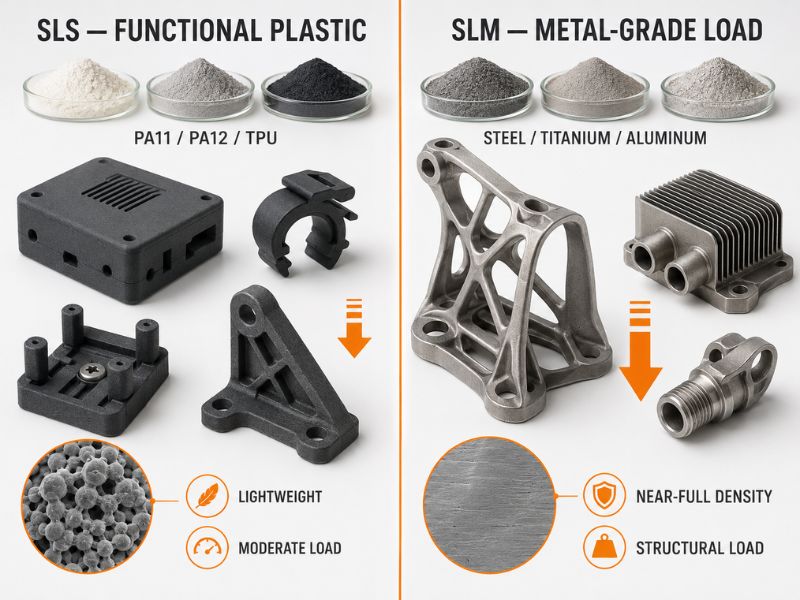
SLS runs on engineering thermoplastics. PA12 is the default for rigid functional parts; PA11 adds toughness; TPU gives flexible sections. These materials are light, chemical-resistant, and easy to dye.
SLM runs on metals. 316L covers most corrosion-resistant needs; TC4 (Ti-6Al-4V) serves medical and aerospace where strength-to-weight matters; AlSi10Mg suits lightweight structural and thermal parts. The alloy list is longer than SLS’s because each metal grade is a separate material system.
Material choice is rarely “which is better” — it is “does the part need to be metal.” Weight and corrosion often push to nylon; load and thermal often push to metal.
Part Density and Mechanical Load
Density sets the load ceiling.
- SLS: slight porosity means lower absolute strength and some variation through thickness. Fine for jigs, enclosures, and brackets that see moderate load. Not the choice for safety-critical load paths.
- SLM: near-full density gives isotropic, weld-like properties. Parts carry structural and cyclic loads comparable to machined metal.
A practical cut: if the part fails by deformation or fatigue under real load, SLM. If it fails only by cosmetic wear or light handling, SLS is enough. Always confirm the load case before quoting — that single check prevents most over-specification.
Surface Finish and Post-Processing
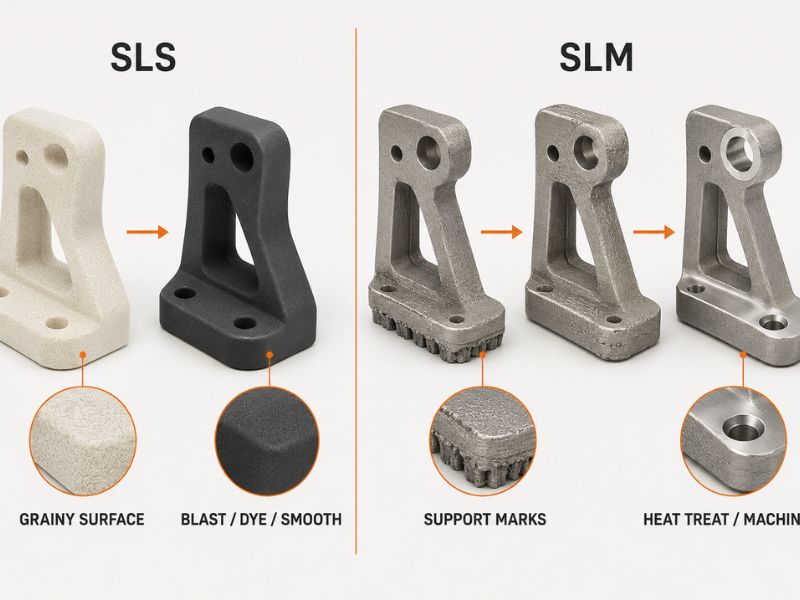
SLS leaves a grainy, powdery surface from the particle size of the feedstock. Blasting cleans it; vapor smoothing or media tumbling can close the texture for touch or seal. Dyeing and plating are common for appearance or wear.
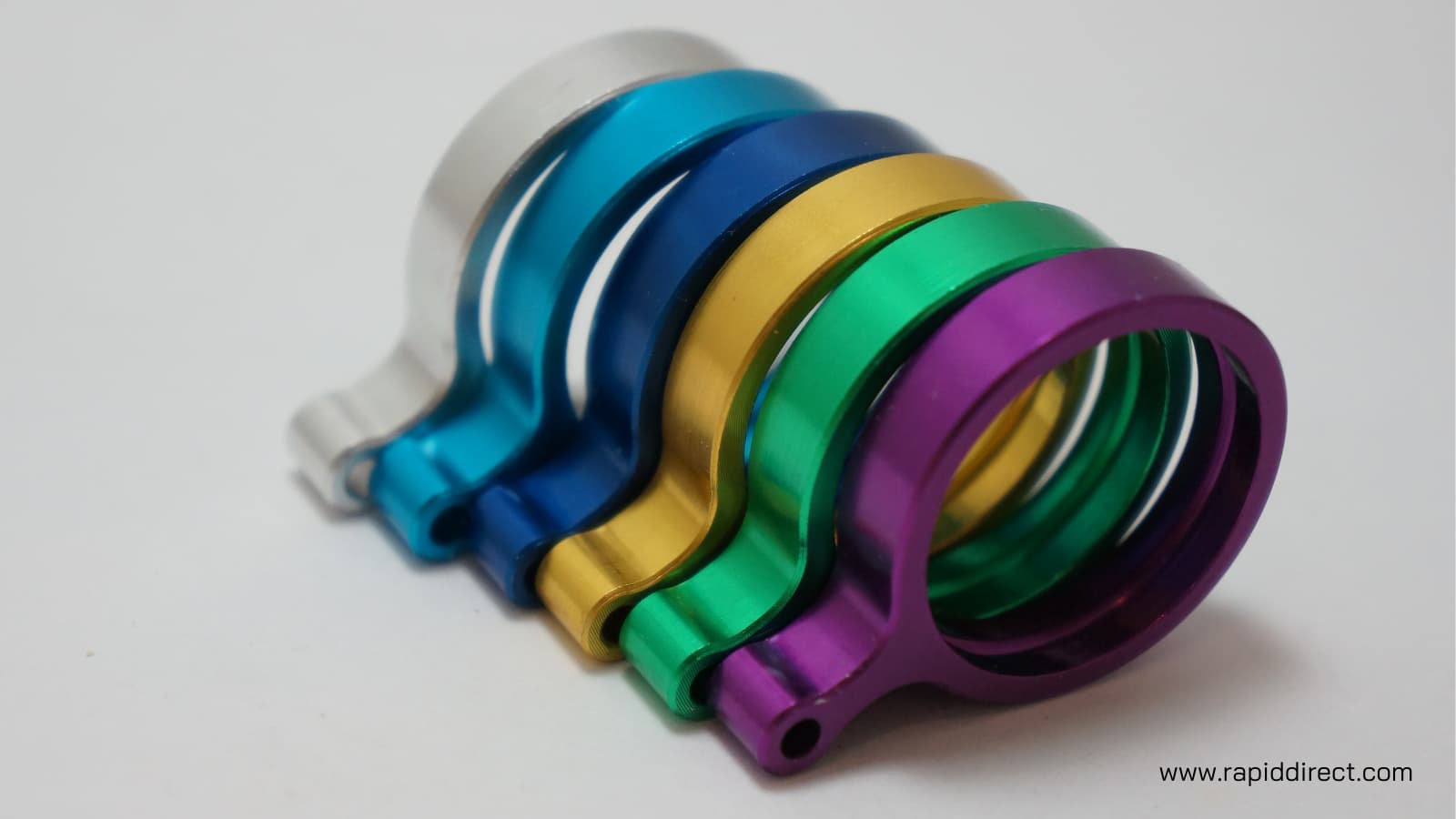
SLM leaves a smoother metal surface with finer features, but support contact points and stair-stepping remain. Typical finishing: support removal, media blasting, stress-relief heat treatment, and optional machining, anodizing, or passivation.
Plan post-processing into the quote. SLM’s support removal and heat treatment add steps SLS avoids, which shows up in both lead time and cost.
Design Rules and Geometry Constraints
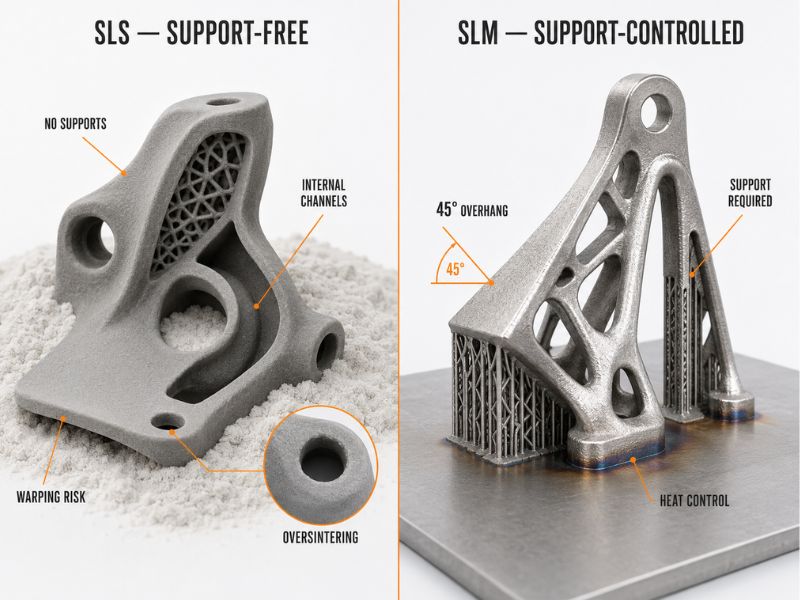
SLS design freedom: no supports means free internal lattices, living hinges in TPU, and conformal cooling channels print cleanly. Watch two failure modes — warping and oversintering on large flat spans, and necking in small holes. Thicker walls and generous hole diameters reduce both.
SLM design limits: supports constrain overhangs. As a rule, overhangs below roughly 45° from horizontal need support, which adds geometry to remove and can mark the surface. Wall thickness must clear the melt pool; very thin features may not fuse.
Both processes handle complex geometry better than subtractive methods, but the constraint type differs: SLS fights warping, SLM fights support and heat.
Cost and Lead Time Reality
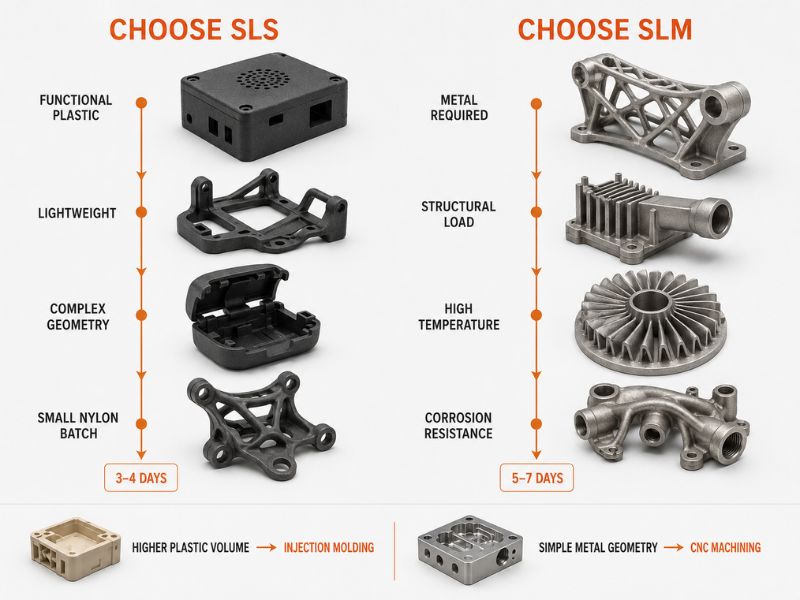
Powder cost sets the floor. SLS nylon runs roughly 80–200 per kg; SLM metal powder starts around 200–500+ per kg depending on alloy. Machine cost is higher for SLM (55k–350k class vs SLS 18k–100k class), which flows into hourly rates.
Lead time tracks post-processing. An SLS build needs a long cool-down plus blasting; SLM adds support removal and often heat treatment. Realistic service lead times land around 3–4 days for SLS and 5–7 days for SLM at many shops, before finishing.
Volume economics: SLS is often the cheaper route for small-to-medium nylon batches because powder recycles and no supports are cut. SLM cost scales with density and support volume, so solid bulky metal parts get expensive fast. For higher volumes, compare against CNC machining (metal) or injection molding (plastic).
When to Choose SLS vs SLM
| If your part needs… | Choose |
| Functional plastic, light weight, complex shape, no supports | SLS |
| Flexible sections (gaskets, grips, living hinges) | SLS (TPU) |
| Metal-grade strength, load-bearing or cyclic load | SLM |
| High thermal or corrosion resistance in metal | SLM |
| Fast, cheap small batch of nylon parts | SLS |
| Low-volume metal part that is hard to CNC | SLM |
When the part is metal and needs tighter tolerances than SLM holds as-printed, CNC machining is the usual next step. When a plastic or metal part moves to higher volume, injection molding or die casting resets the cost curve.
SHBD Metal’s SLS and SLM Capabilities
SHBD Metal runs both processes in-house as part of its 3D printing service, alongside SLA, FDM, MJF, and PolyJet. That matters for sourcing because one supplier can advise the process split instead of pushing a single machine.
The platform returns an instant quote from the CAD file and attaches a free DFM review that flags geometry risks — warping-prone SLS spans, unsupported SLM overhangs, or wall sections that will not fuse. Builds run under ISO 9001 / 13485 / IATF 16949 controls, with 3D printing turnaround quoted as fast as one day for suitable files.
Conclusion
SLS and SLM share the powder bed, but they solve different problems: SLS for strong functional nylon parts without supports, SLM for near-solid metal parts that carry real load. Start the choice from material and load, then check surface, supports, and volume cost.
If the part’s material, load, or tolerance is still open, upload the CAD file for an instant SLS or SLM quote, or request a DFM review to confirm process fit before you commit to a build.
FAQ
SLS nylon is used for low-volume production of enclosures, jigs, and brackets, not just prototypes. It holds up under moderate load and handling, but avoid it for safety-critical load paths where density matters.
Near-solid SLM parts reach properties close to wrought or CNC metal for most alloys, with some anisotropy from the build direction. For the tightest dimensional and surface specs, post-machine the SLM part.
Both processes leave stair-stepping and some shrinkage. For metal parts needing tight limits, plan CNC machining as a secondary operation. For plastic, tighten the SLS design or move to injection molding at volume.
No. DMLS (direct metal laser sintering) sinters metal powder rather than fully melting it, like SLS does for plastic. SLM fully melts the metal, giving higher density. The terms are often used interchangeably by shops, so confirm the bonding method when density matters.
Below a few hundred units, printing usually wins on setup cost. Above that, injection molding (plastic) or die casting (metal) lowers per-part cost, though tooling lead time enters the equation.
A watertight CAD model, target material, expected load or environment, required tolerances, and quantity. Those four inputs let the supplier return a realistic process recommendation and DFM feedback.

Comment
0 comments
Got thoughts or experiences to share? We’d love to hear from you!