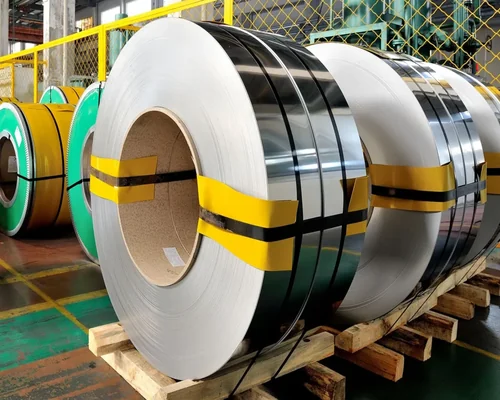
Strip is sheet that has been rolled thin and slit to a width, and the two numbers that matter are thickness and width tolerance. Everything downstream — a stamping die, a roll former, a press feed — assumes the strip arrives within that band, at the temper it was ordered in, and flat enough to run without a camber correction.
Thickness and width held to a band. The tolerance is quoted as a band on both dimensions, because a die set up for one thickness will not accept a strip at the other end of a wide tolerance.
Temper, not just grade. Annealed, quarter hard, half hard and full hard change the yield strength and the springback. The temper goes on the order with the grade.
Slit to the width you feed. Slitting to the coil width your press or roll former takes removes the edge trim you would otherwise scrap on every coil.
Coils that run, not coils that fight. Edge condition, camber and coil winding are specified together, so the strip feeds straight instead of steering through the tooling.
Four properties separate precision strip from ordinary cold-rolled sheet, and all four are things you can measure on the coil rather than see on a sample.
Thickness and width precision
Thickness is held across the width and along the coil, and width is slit to a tolerance rather than a nominal figure, so a progressive die sees the same strip from the first metre to the last.
Stamped and roll-formed parts, shims, spring contacts
Surface quality
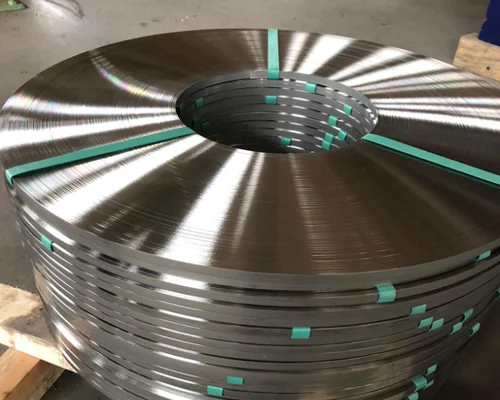
Rolled and annealed to a surface free of scale, scratches and roll marks. Where the strip becomes a visible part, the surface is inspected as a deliverable, not as a by-product.
Visible trim, appliance and architectural parts
Flatness and camber
Tension levelling and controlled slitting keep the strip flat along its length and straight along its edge, which is what stops a coil from steering in a roll former.
Long feed runs, roll forming, automated press lines
Hardness and temper control
Temper is set by cold reduction and verified by hardness, so the springback of the formed part stays inside the tolerance the tool was cut for.
Springs, clips, connectors, blades
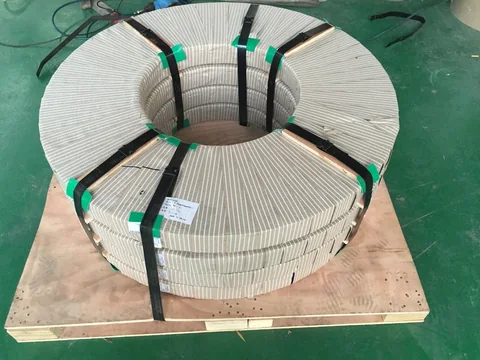
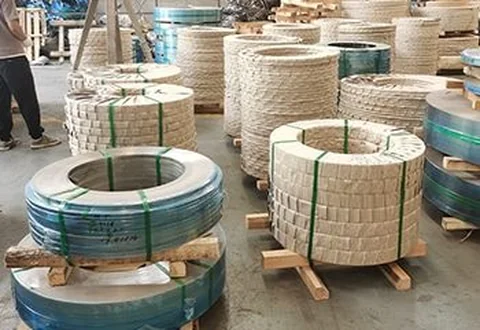
The coil separator matters more than it looks: on an eye-to-sky pack, a wooden separator between child coils keeps the wraps from nesting into each other, so the strip pays off cleanly at the press instead of tangling.
Size Range and Temper
Strip is quoted from the drawing. The window below is the normal range; the achievable band narrows as the strip gets thinner and the width grows.
Swipe the table sideways for the notes →
Parameter
Range
What decides it
Thickness
From 0.05 mm upwards
Thin strip is rolled in passes; below 0.1 mm the tolerance band tightens sharply.
Width
Slit to width, from narrow strip to 1250 mm
The slit width follows the tool, and the edge condition follows the slitting line.
Temper
Annealed, quarter, half and full hard
Temper sets yield strength and springback, so it is ordered with the grade, not after it.
Edge
Slit, deburred or rounded edge
A burr on the edge marks the die and the part; the edge condition is quoted per application.
Coil form
Eye-to-sky, ribbon wound, or cut to length
The winding and the separators decide how the strip pays off at the press.
Grades
301, 304/304L, 316L, 430, 631 and 17-7PH on request
Spring work pushes the choice to 301 or 631; corrosion duty to 316L.
What Precision Means in Strip
Precision in strip is a set of measurements taken on the coil, not a claim on a data sheet. These are the four that decide whether the tool runs.
Tolerance on both dimensions
Thickness and width each carry their own band. A tool cut for one end of the band will not accept the other, so both numbers belong on the purchase order.
Flatness along the length
A coil that is not flat will not feed at constant height. Tension levelling is what makes the strip run the same way from the outside of the coil to the core.
Camber and edge quality
Camber is the sideways bow that makes strip steer; burr is what marks the die. Both are controllable at slitting and both are usually discovered too late.
Temper consistency
Hardness has to hold along the coil, not just at the sample. A soft patch changes springback and the part drifts out of tolerance mid-run.
How We Help Customers
Strip is usually bought to feed a tool that already exists, so the tool defines the specification. These are the four numbers we confirm.
01
Give the thickness and width with their tolerances
The band, not the nominal. A die set up for 0.5 mm will not run 0.48 mm without a change in the part it produces.
02
Name the grade and the temper
301 for spring work, 304 or 316L for corrosion duty, and the temper that gives the yield strength the part was designed around.
03
Specify the edge and the coil form
Slit or deburred, eye-to-sky or ribbon wound, with separators where the coil is packed in child coils, so the strip pays off without tangling.
04
Agree the inspection and the documents
Thickness, width, hardness and surface are recorded against the coil number, so a problem can be traced to a coil rather than to a delivery.
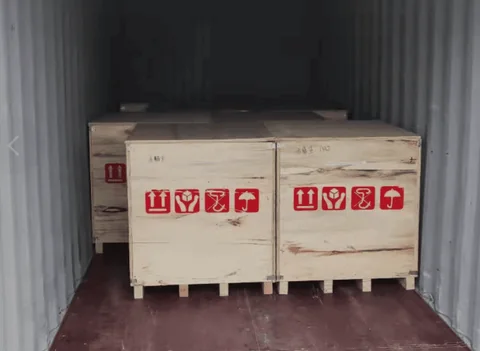
Coils are cased for export so the edges and the surface arrive unmarked, and the case carries the coil numbers against the certificate.
Real Applications
Strip is the material behind parts that are stamped, formed or coiled by the kilometre, where consistency matters more than any single property.
Blades, cutlery and cutting edges
Hard-temper strip in 420, 440C or 301, where the edge is ground after forming and the temper decides how long it holds.
Springs, clips and contacts
301 and 631 in the temper that gives the spring rate the design expects, stamped and formed without a further heat treatment.
Electronics and connectors
Thin strip with a controlled surface for plating, slit to the width the stamping die feeds, with the camber held so the reel runs true.
Medical and surgical parts
316L strip for instrument components and single-use device parts, where surface finish and cleanliness are inspected rather than assumed.
Have a strip width, thickness band and temper to quote? Send the specification, quantity and any certification requirement and we will come back with what we can supply.