

When uploading a Gerber file to a third-party digital aggregator, the initial automated quote often displays a baseline placement cost as low as $0.01 per SMT joint. However, procurement specialists are frequently hit with unexpected cost adjustments on the final invoice once non-recurring engineering (NRE) allocations, mandatory X-ray inspection for bottom-terminated components, and firmware flashing overheads are factored in. To execute a truly cost-efficient PCB assembly strategy, the engineering evaluation must look beyond bare-board line items and compute the total landed cost.
The baseline pricing for electronics manufacturing operates on a steep sliding scale dictated by production volume. While a primary quote covers standard substrate fabrication, automated pick-and-place positioning, and basic visual quality checks, the final cost varies widely based on layer stack-up complexity, specific component geometry, and requested lead-time constraints.
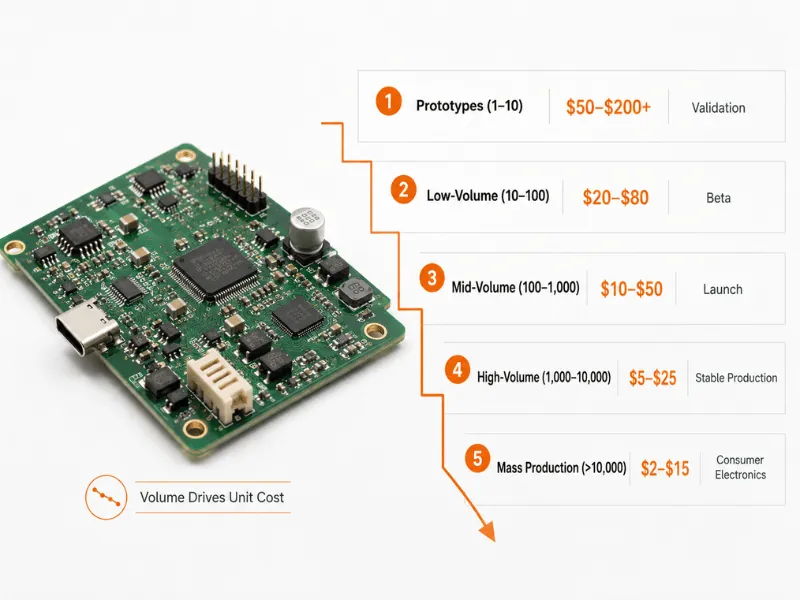
| Production Volume | Estimated Cost Per Board | Ideal Application Scenario |
| Prototypes (1–10 units) | $50 – $200+ | Design validation, client demonstration units |
| Low-Volume (10–100 units) | $20 – $80 | Product Beta testing, limited market releases |
| Mid-Volume (100–1,000 units) | $10 – $50 | New product launches, small-scale market deployment |
| High-Volume (1,000–10,000 units) | $5 – $25 | Mature, stable mass-production products |
| Mass Production (>10,000 units) | $2 – $15 | Standardized consumer electronics |
The True Formula for Your PCB Assembly Cost Estimate
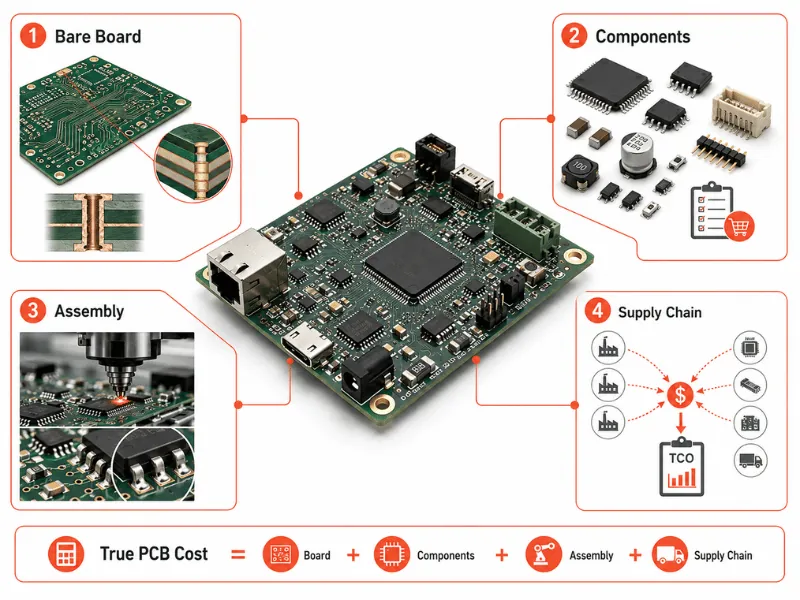
To accurately estimate your budget, you must abandon the basic “Board + Labor” math. The true pcb assembly cost estimate formula for 2026 encompasses all logistical and secondary processing variables. Total Cost = PCB Fabrication + BOM + Assembly Labor + Value-Added Services (Programming/Coating) + Testing (AOI/X-Ray/FCT) + Logistics/Tariffs/Exchange Rates.
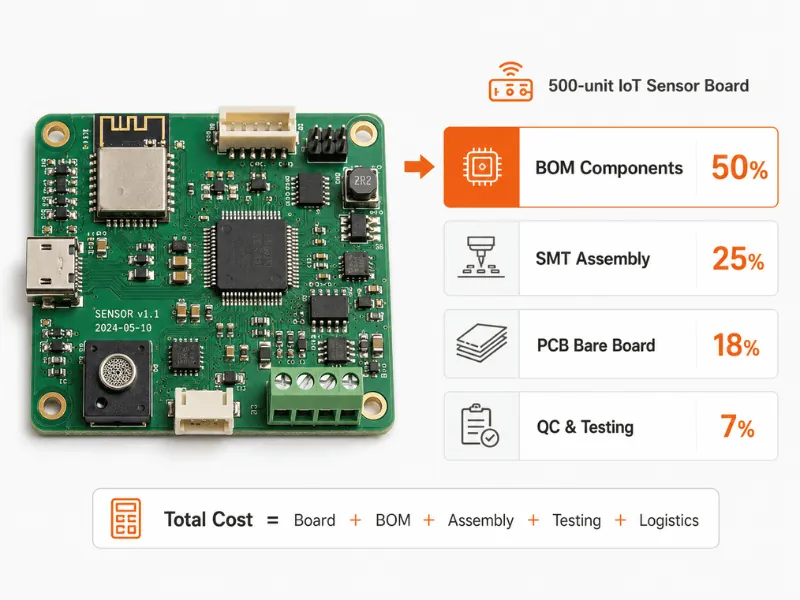
A standard 500-unit run of a 4-layer IoT sensor board perfectly highlights the reality of these proportions. In this scenario, the bare board represents only 18% of the total cost, while the Bill of Materials (BOM) consumes a massive 50%. For high-end, highly complex multi-chip boards, the BOM can account for up to 70% of the total expenditure.
| Cost Category | Total Amount (Per Unit) | Percentage of Total Cost |
| PCB Bare Board | $1,250 ($2.50 / unit) | 18% |
| BOM (Components) | $3,500 ($7.00 / unit) | 50% |
| SMT Assembly Labor | $1,750 ($3.50 / unit) | 25% |
| QC & Testing | $500 ($1.00 / unit) | 7% |
| Total Landed Cost | $7,000 ($14.00 / unit) | 100% |
The 5 Core Drivers of PCB Assembly Pricing
1. Circuit Board Layer Count (The Exponential Multiplier)
The number of layers in your PCB stack-up directly correlates with fabrication difficulty and material consumption. A simple 1-2 layer board serves as the 1x baseline price, suitable for low-end LED drivers. Pushing a design to 8 layers for high-speed network switches instantly multiplies the base fabrication cost by 5 to 6 times.
Engineering Heuristic: Always prioritize optimizing your routing and ground plane strategies. If you can successfully route a board on 4 layers instead of 6, you will drastically control manufacturing costs.
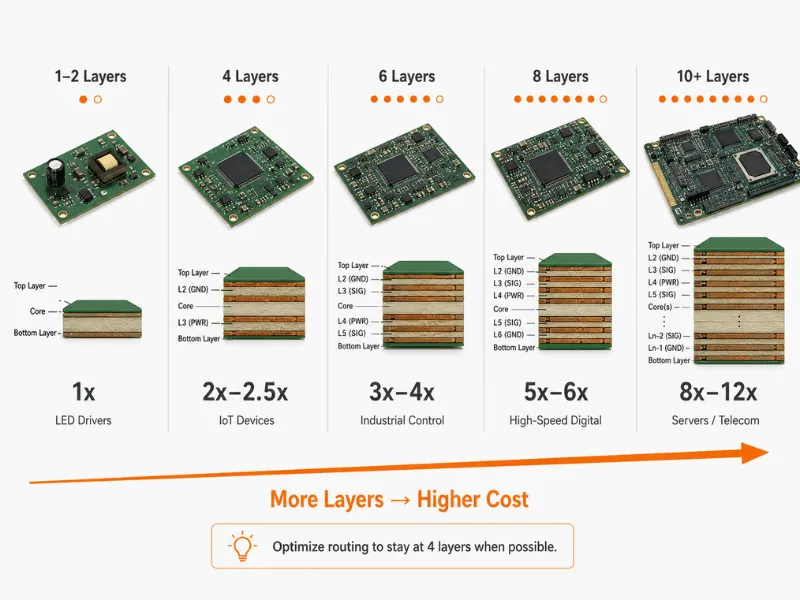
| Layer Count | Relative Cost Multiplier | Typical Applications |
| 1–2 Layers | 1x (Baseline) | Simple LED drivers, low-end consumer goods |
| 4 Layers | 2x – 2.5x | IoT devices, majority of consumer electronics |
| 6 Layers | 3x – 4x | Industrial controllers, RF boards |
| 8 Layers | 5x – 6x | Network communications, high-speed digital |
| 10+ Layers | 8x – 12x | Servers, telecom base station equipment |
2. Component Types and SMT/THT Processing Fees
Standard 0402 or 0603 passive components incur extremely low labor costs, typically ranging from $0.001 to $0.01 per placement without any added processing fees. However, specifying complex BGA or QFN packages drastically alters your pcb assembly cost because these components require specialized handling and mandatory X-ray inspection. BGA components will typically add $0.10 to $0.50 per chip in placement fees alone, completely excluding the cost of the X-ray.
The method of placement also heavily dictates the labor rate. While automated SMT placement costs between $0.001 and $0.02 per point, manual Through-Hole Technology (THT) insertion skyrockets to $0.05 – $0.15 per point. Furthermore, designing a board that requires a mixed SMT and THT process will inflate your total assembly labor cost by 20% to 40%.
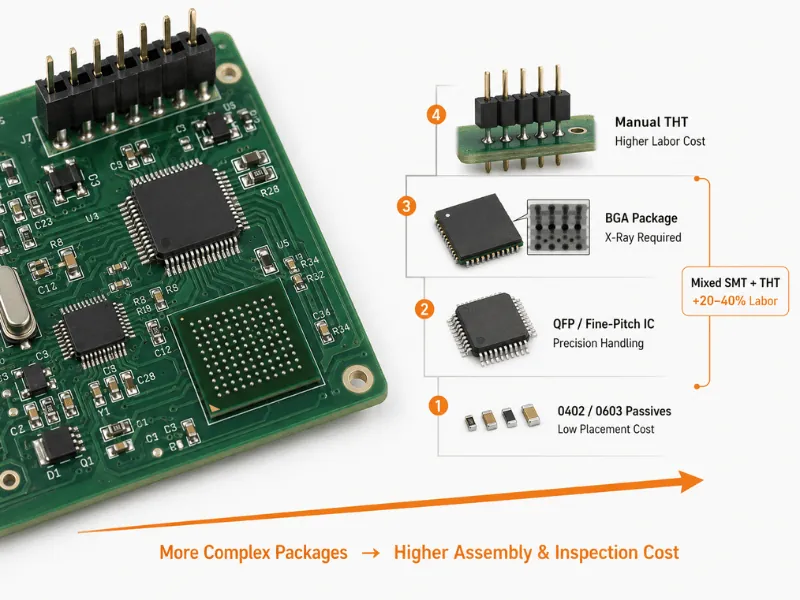
| Component Package | SMT Point Calculation | Additional Processing Fees |
| 0201 Micro Passives | 2 points | +$0.01 / component |
| 0402 / 0603 Passives | 2 points | Standard rate, no markup |
| SOIC / QFP | Equal to pin count | Standard rate |
| Fine-Pitch ICs (≤0.5mm) | Equal to pin count | +$0.02 – $0.05 / component |
| BGA Packages | Equal to solder ball count | +$0.10 – $0.50 / component + X-Ray fee |
3. Advanced PCB Substrates (The Hidden Multipliers)
Transitioning from standard FR4 to exotic laminates does not just increase the bare board price; it inherently complicates the assembly phase. Advanced materials demand specialized thermal profiling, altered lamination press cycles, and customized chemical plating. If your manufacturer fails to adjust the reflow thermal profile for a Heavy Copper board, the solder will fail to wet properly, leading to catastrophic failure rates.
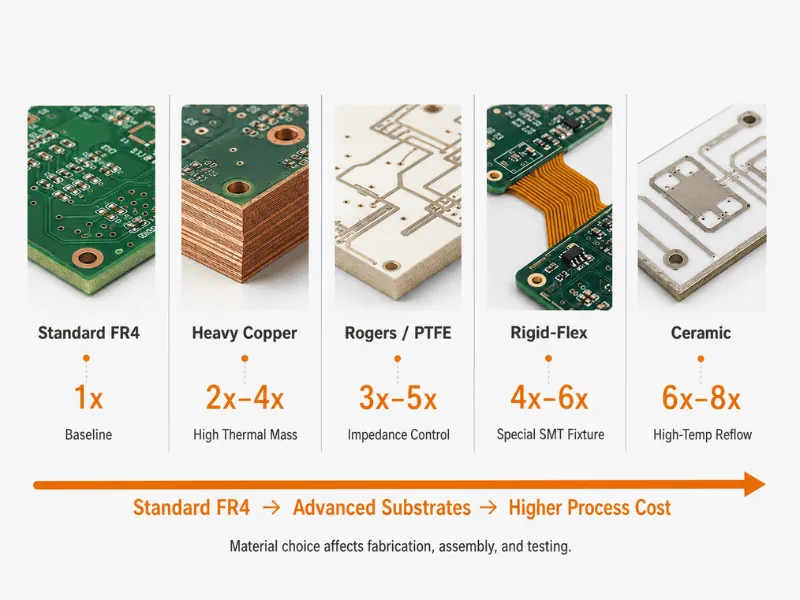
| Substrate Type | Cost Multiplier vs Standard FR4 | Key Driver of Cost |
| Standard FR4 | 1x (Baseline) | Standard chemical processing and reflow temperatures. |
| Rigid-Flex | 4x – 6x | Requires complex multi-stage pressing and specialized SMT fixtures to prevent warpage during assembly. |
| Ceramic (AlN/$Al_2O_3$) | 6x – 8x | Extreme hardness requires diamond-tipped drilling; unique thermal mass requires specialized high-temp reflow profiling. |
| Rogers / PTFE | 3x – 5x | Specialized chemical desmear processes and strict impedance control testing required prior to assembly. |
| Heavy Copper | 2x – 4x | Requires multiple etching passes and significantly increased reflow thermal mass to achieve proper solder wetting. |
4. Production Volume and Fixed NRE Cost Dilution
The reason a 5-unit prototype run costs $87 per board while a 5,000-unit run costs $9.06 comes down to fixed Non-Recurring Engineering (NRE) costs. Every PCBA run requires static setup fees regardless of the volume: custom solder stencils ($30–$150), pick-and-place machine programming ($50–$200), First Article Inspection ($100–$300), and custom test fixtures ($200–$2,000+). When you order low volumes, these heavy static fees are absorbed by only a few units, massively inflating the unit price.
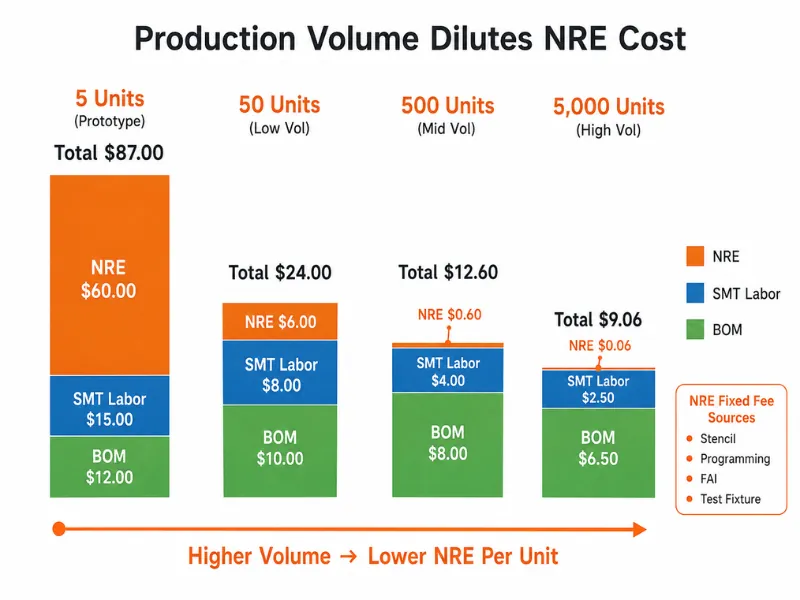
| Order Quantity | NRE Fee Dilution (Per Unit) | SMT Labor (Per Unit) | BOM Cost (Per Unit) | Total Cost (Per Unit) |
| 5 Units (Prototype) | $60.00 | $15.00 | $12.00 | $87.00 |
| 50 Units (Low Vol) | $6.00 | $8.00 | $10.00 | $24.00 |
| 500 Units (Mid Vol) | $0.60 | $4.00 | $8.00 | $12.60 |
| 5,000 Units (High Vol) | $0.06 | $2.50 | $6.50 | $9.06 |
5. Lead Time Premiums and Expediting Costs
Standard production cycles typically require 10 to 15 days, which serves as the baseline pricing for well-planned projects. Forcing the factory floor to expedite the process to 5-7 days will incur a 30% to 50% premium. In critical scenarios like urgent hardware bug fixes or imminent trade show deadlines, pushing for extreme 24-72 hour turnarounds will trigger a massive 200% price surge.
Beware the Hidden Fees: Testing, Value-Added Services, and Logistics
Mandatory Inspection and Testing Costs
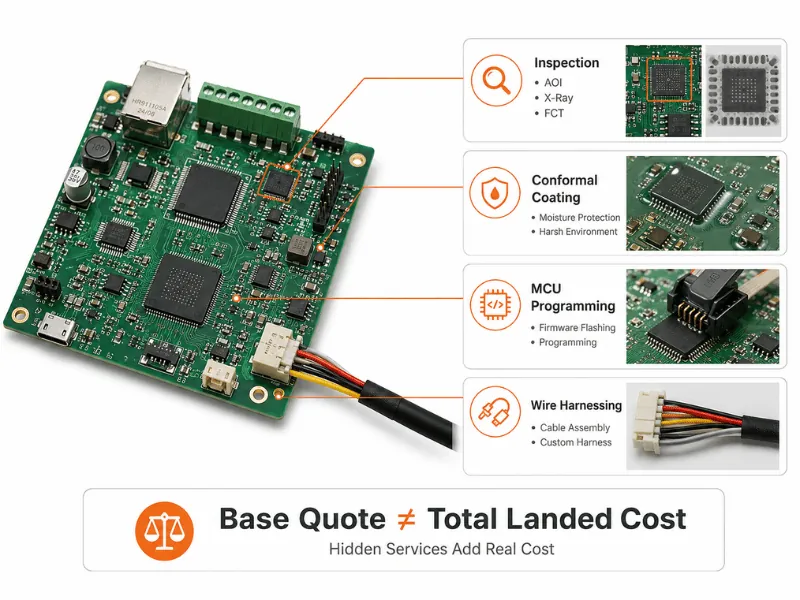
Basic visual inspection is cheap ($0.10 – $0.50) and applied to all orders, but it is entirely inadequate for complex architectures. High-density boards require Automated Optical Inspection (AOI) at $0.20 – $1.00 per board, while full Functional Circuit Testing (FCT) can range from $5 to $50+ depending on the complexity of your test firmware.
Pro Tip: Never attempt to save the $1 to $5 per board X-ray inspection fee on BGA components. Skipping this critical step guarantees a high failure rate, resulting in RMA and rework losses that can be 50 times higher than the initial testing fee.
Value-Added Manufacturing Services Pricing
Standard quotes assume a pristine laboratory environment. If your IoT hardware deploys outdoors, a bare board will fail rapidly due to moisture and chemical exposure. Specialized protective measures like conformal coating, IC MCU programming, and custom wire harnessing are critical to field survival but are rarely included in initial automated quotes.
| Service Type | Estimated Cost Range per Unit | Ideal Application |
| Conformal Coating | $0.50 – $3.00 | Industrial controllers, marine electronics, and harsh-environment IoT devices requiring moisture/dust protection. |
| IC Programming (MCU) | $0.10 – $0.50 | Flashing firmware to microcontrollers prior to SMT placement to accelerate final system testing. |
| Wire Harnessing & Cables | $1.00 – $5.00+ | Custom cable assemblies for automotive panels or complex multi-board mechanical enclosures. |
Global Logistics, Tariffs, and Regional Sourcing
Sourcing PCBA from China’s Pearl River Delta (Shenzhen/Dongguan) offers the industry’s fastest supply chain and lowest baseline manufacturing costs. However, international procurement managers must aggressively factor in regional nuances, such as import tariffs (which often hit 25% for US-bound assembled electronics) and expedited global air freight. A technically cheap board from an overseas Tier-3 factory quickly becomes a liability when unexpected border customs and heavy shipping weights double your landed cost.
8 Strategies for Strict PCB Assembly Cost Control
Achieving true cost efficient pcb assembly requires engineering foresight, not just haggling over penny fractions. Implement these 8 foundational pcb assembly cost control strategies to secure your NPI budget:
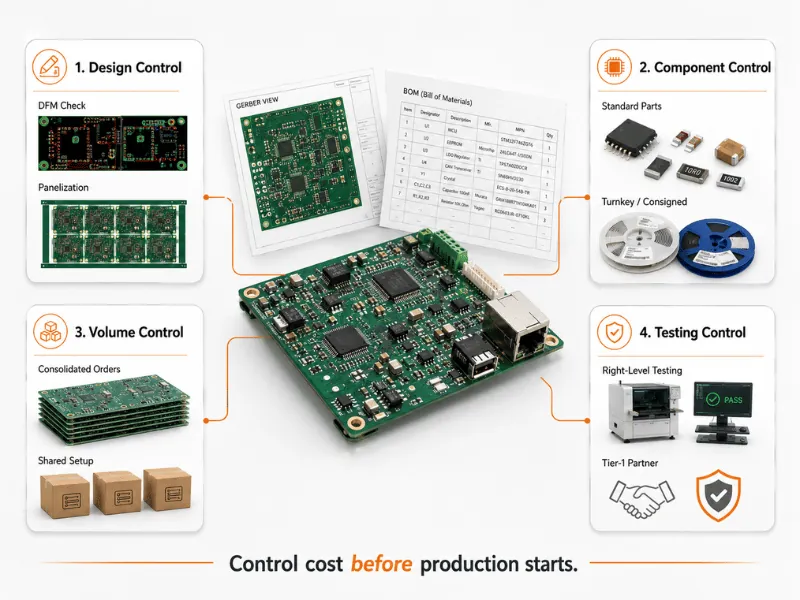
- Early DFM Pre-checks: Verify manufacturability directly with the factory before finalizing Gerber files to eliminate costly mid-production redesigns.
- Component Standardization: Force your design team to utilize standard 0402/0603 passive components and avoid scarce, single-source ICs.
- Consolidate Orders: Merge multiple product variations into a single larger order to dilute the heavy static setup fees for stencils and programming.
- Optimize Procurement Modes: Choose strategically between full-turnkey (factory buys everything) or consigned (you supply the expensive, hard-to-find ICs) based on current market availability.
- Optimized Panelization: Configure your board arrays to maximize the utilization of standard laminate sheets, reducing raw material waste by 15% to 20%.
- Merge Prototypes: Group multiple distinct prototype designs onto a single multi-project panel to avoid paying separate machine setup fees.
- Strategic Testing Allocation: Do not pay for full Functional Circuit Testing (FCT) on simple prototypes, but absolutely mandate X-ray inspection for every BGA package.
- Long-Term Strategic Partnerships: Avoid hopping between cheap brokers. Establishing long-term volume agreements with a single Tier-1 manufacturer often secures baseline discounts of around 15%.
Industry Pricing Baselines & 2026 Trends
Different industries carry distinct compliance and testing burdens that heavily dictate the final price. Consumer electronics benefit from massive scale ($5 – $30 per unit), while medical devices ($50 – $500 per unit) carry high premiums due to strict traceability and ISO 13485 certification requirements. Looking through 2026, AI-optimized SMT machine routing is projected to reduce placement labor times by 15% to 25%, while the widespread adoption of 01005 micro-components will require heavier upfront equipment investments from manufacturers.
Why Choose Us for Low-Cost PCB Assembly Without Compromise
Brokerage models rely on adding 20-40% markups while obscuring the actual factory floor, leaving you blind to quality control practices and hidden NRE fees. True low-cost PCB assembly isn’t about finding the cheapest per-pin placement rate; it’s about partnering with a transparent manufacturer that provides upfront NRE structures, free DFM, and optimized supply chain logistics.
SHBD Metal operates as a transparent Tier-1 digital factory integrated directly into the Pearl River Delta’s massive component ecosystem. Our AI-driven platform provides instant quoting and automated DFM feedback, ensuring your PCB assembly cost estimate is exact and reliable. Experience cost-efficient PCB assembly without the hidden traps—upload your BOM and Gerber files to SHBD Metal today to secure transparent pricing and accelerate your product launch.
FAQ
Always demand a fully unbundled quote to audit the supplier’s true pricing model. Scrutinize the breakdown for hidden Non-Recurring Engineering (NRE) costs, check the component attrition rate (the markup applied for wasted/lost parts during SMT), and ensure specific testing protocols like X-ray or AOI are listed as individual line items rather than bundled surprises.
Yes, prototype units carry a significant premium because heavy fixed setup fees—such as stencil creation, machine programming, and First Article Inspection (FAI)—must be absorbed by a tiny volume. Furthermore, sourcing components at retail quantities rather than bulk wholesale drastically increases the BOM pricing for prototypes.
Procurement managers must meticulously check initial quotes for omitted NRE engineering fees, separate solder stencil charges, and MCU firmware programming costs. Additionally, ensure that fees for critical BGA X-ray inspections, conformal coating, custom packaging, and emergency component procurement premiums are explicitly quantified before signing the contract.
Comment
0 comments
Got thoughts or experiences to share? We’d love to hear from you!