

Polypropylene (PP) is one of the most widely produced thermoplastics globally. It shows up in automotive bumpers, food containers, medical syringes, living hinges, and textile fibers. Injection molding is the dominant process for turning PP resin into these parts at scale.
This guide covers what you need to move from resin selection to a mold-ready design: material properties that drive process decisions, processing parameters that affect part quality, grade selection, DFM rules specific to PP, and troubleshooting common defects.
What Makes Polypropylene Suitable for Injection Molding
Polypropylene is a semi-crystalline thermoplastic polymerized from propylene monomers. Its combination of low cost, chemical resistance, and fatigue life makes it a workhorse material in injection molding.
Key properties that affect molding behavior:
| Property | Value | What It Means for Molding |
| Melt temperature | 160–170°C | Wide processing window; forgiving of barrel temperature variation |
| Density | 0.90–0.91 g/cm³ | Lightest commodity plastic; lower material cost per part |
| Shrinkage | 1.5–2.5% | Higher than ABS or PC; requires mold compensation and uniform cooling |
| Moisture absorption | <0.03% | Near-zero; pre-drying is usually unnecessary unless material has been exposed to humidity |
| Crystallinity | 50–70% | Cooling rate controls crystallinity and final dimensions |
PP comes in three main families:
- Homopolymer: Highest stiffness and chemical resistance. Used for rigid structural parts.
- Impact copolymer: Added ethylene content improves low-temperature impact. Common in automotive interiors and battery cases.
- Random copolymer: Better clarity and lower melting point. Used in transparent packaging and medical applications.
Processing Parameters That Control Part Quality
PP injection molding tolerates a range of settings, but hitting the right window for your part geometry and grade is what separates consistent production from a scrap bin.
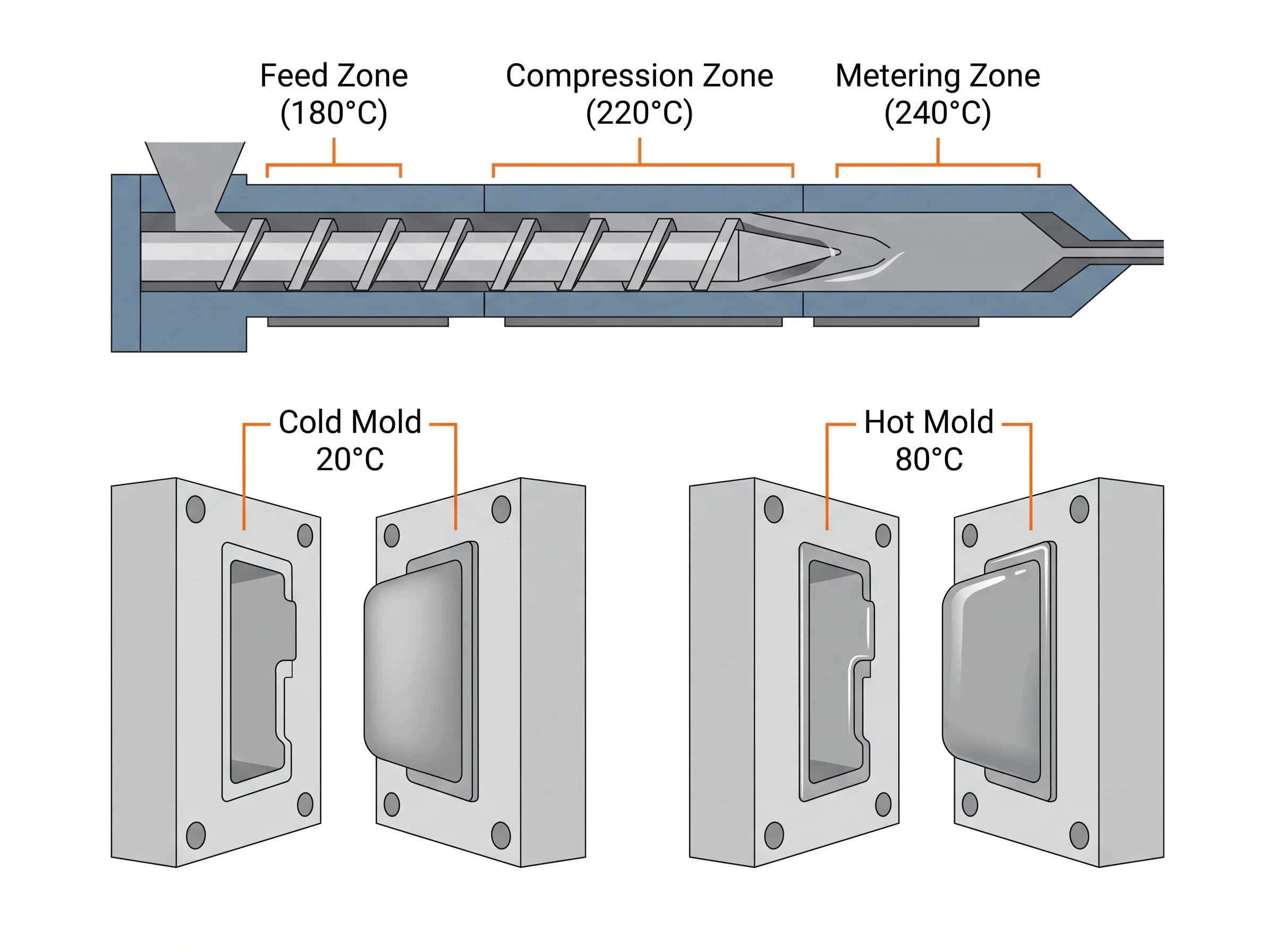
Melt and Mold Temperature
| Zone | Recommended Range | Notes |
| Barrel (rear to nozzle) | 180–240°C | Higher for fast-fill thin walls, lower for thick sections to avoid degradation |
| Mold | 20–80°C | Cold mold = faster cycle, lower crystallinity. Hot mold = better surface finish, higher dimensional stability, longer cycle |
Mold temperature has an outsized effect on PP because it directly controls crystallization rate. A mold at 20°C produces parts quickly but with higher internal stress and a matte surface. Raising the mold to 60–80°C improves gloss, reduces warpage, and increases crystallinity—at the cost of longer cooling time.
Injection Pressure and Speed
PP has low melt viscosity, which helps it fill thin sections easily. Typical injection pressure runs 80–130 MPa. For thin-wall parts or glass-filled grades (PP-GF), pressure may need to push toward the upper end.
Use multi-stage injection speed control—a slower initial fill to avoid jetting, then ramp up to pack the cavity before switching to holding pressure. This is especially important for PP because its high shrinkage means packing pressure directly determines dimensional accuracy.
Holding Pressure and Cooling Time
Holding pressure should be 50–70% of injection pressure and maintained until the gate freezes. Undershooting holding time leaves sink marks; overshooting adds cycle time without benefit.
Cooling time is the dominant slice of the cycle. Thick PP sections (above 3 mm) may need 20–30 seconds of cooling. Uniform wall thickness is not just a design rule—it is a cycle-time optimization lever.
Material Grade Selection
Choosing the right PP grade depends on what the part needs to do:
| Application | Recommended Grade | Why |
| Living hinges | Homopolymer, high MFR (20–50 g/10 min) | High flexural fatigue resistance; thin-flow capability |
| Automotive interior | Impact copolymer | Low-temperature ductility; good surface finish |
| Food packaging | Random copolymer | Clarity, lower processing temperature |
| Structural brackets | PP-GF20, PP-GF30 | Glass fiber boosts stiffness and HDT |
| Chemical tanks | Homopolymer | Maximum chemical resistance |
Filled grades like PP-GF20 (20% glass fiber) roughly double tensile strength compared to unfilled PP but increase viscosity, requiring higher injection pressure. The glass fibers also create anisotropic shrinkage—more along the flow direction than across it. The mold design needs to account for this.
Design Guidelines for PP Injection Molded Parts
PP’s shrinkage range and semi-crystalline nature mean standard injection molding design rules apply, but the thresholds are different from amorphous plastics like ABS or PC.
Wall Thickness
Keep wall thickness between 1.0–3.0 mm. Below 1.0 mm, flow resistance climbs sharply. Above 3.0 mm, cycle time balloons and sink marks become hard to control. Uniform walls are the single most effective way to reduce warpage in PP parts.
Living Hinges
PP is the dominant material for integral hinges because it can flex millions of cycles without failing. Design rules:
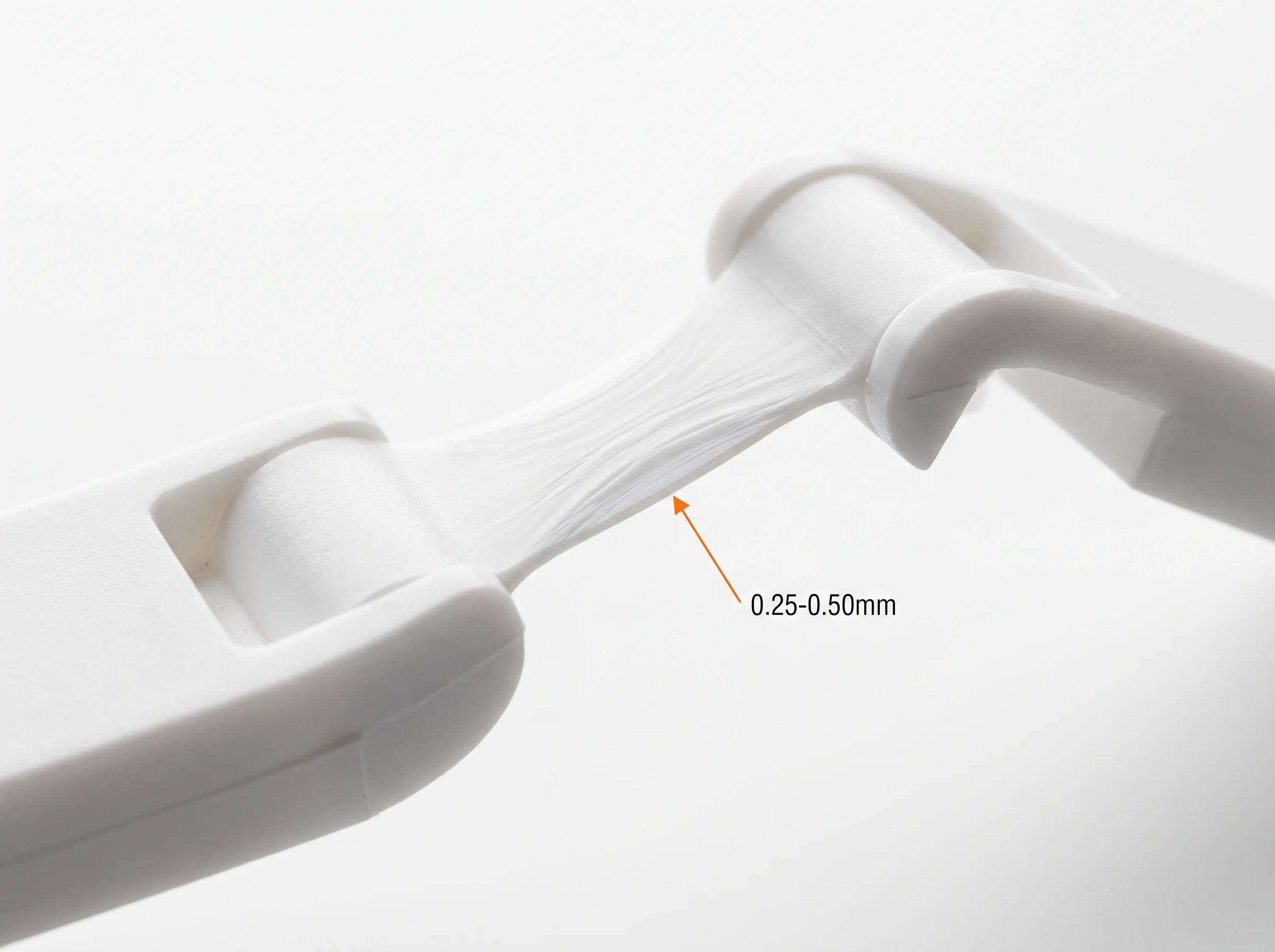
- Hinge thickness: 0.25–0.50 mm
- Land length (length of the thin section): 0.5–0.75 mm
- Gate the part so melt flows across the hinge, not along it—molecular orientation perpendicular to the hinge axis triples flex life
- Flex the hinge immediately after ejection while the part is still warm to orient the polymer chains
Draft Angles
PP shrinks onto the core, so draft angles need to clear the part from the mold:
- Core (inner surfaces): 1.0–2.0°
- Cavity (outer surfaces): 0.5–1.0°
- Textured surfaces: add 1° per 0.025 mm of texture depth
Shrinkage Allowance
Mold cavities must be cut larger than the nominal part dimensions. Apply 1.5–2.5% depending on the grade and filler content. Glass-filled grades shrink less (0.5–1.0%) but directionally. Run a mold flow analysis before cutting steel for tight-tolerance parts.
Common Defects and How to Fix Them
| Defect | Likely Cause | Fix |
| Warpage | Uneven cooling; non-uniform wall thickness | Balance cooling channels; uniform wall design; increase mold temperature |
| Sink marks | Insufficient packing; thick sections | Extend holding time; increase holding pressure; core out thick areas |
| Short shots | Low melt temperature; insufficient venting | Raise barrel temperature 10–20°C; add vents at fill-end locations |
| Flash | Excessive injection pressure; worn mold | Reduce peak injection pressure; check parting line wear |
| Brittleness | Material degradation from overheating | Lower barrel temperature; reduce residence time; check for hot spots |
| Weld lines | Melt fronts meeting behind core pins | Relocate gate; increase mold and melt temperature; improve venting at weld location |
SHBD Metal Support for PP Injection Molding
SHBD Metal provides injection molding from prototype through production volumes, with instant online quoting and free DFM feedback. For PP parts, the platform’s automated analysis flags wall thickness variation, draft angle issues, and potential sink-mark zones before tooling starts.
Mold flow analysis is available as part of the DFM review, which helps predict fill patterns, weld line locations, and shrinkage distribution for your specific PP grade. Production molds are built and run through an ISO 9001 and IATF 16949 certified facility.
Conclusion
Polypropylene injection molding succeeds or fails on three fronts: grade selection, processing parameters, and part design. Get the melt temperature, mold temperature, and packing pressure right for your grade, and most quality issues disappear. Design with PP’s high shrinkage in mind—uniform walls, proper draft, and gate placement that aligns molecular orientation with stress paths.
If you have a PP part design and want a manufacturability check, upload your CAD file to SHBD Metal for an instant quote and free DFM analysis.
FAQ
Mold temperature ranges from 20°C to 80°C, depending on the part requirements. 20–40°C works for fast cycles and non-cosmetic parts. 60–80°C produces better surface finish, higher crystallinity, and improved dimensional stability—at the cost of longer cooling time.
Unfilled PP shrinks 1.5–2.5%. Glass-filled grades (PP-GF20, PP-GF30) shrink 0.5–1.0% but directionally—more along the flow direction than across it. Mold cavities must be cut oversize to compensate.
PP-GF20 is polypropylene reinforced with 20% glass fiber by weight. It roughly doubles tensile strength and increases heat deflection temperature compared to unfilled PP. Use it for structural brackets, under-hood components, and any part that needs higher stiffness without switching to a more expensive engineering plastic.
No. Living hinges require homopolymer PP with a high melt flow rate (20–50 g/10 min). Copolymer grades lack the flexural fatigue resistance. The gate must be positioned so melt flows across the hinge—molecular orientation perpendicular to the hinge axis is what makes repeated flexing possible.
A 3D CAD file (STEP or IGES), a 2D drawing with critical dimensions and tolerances, the target PP grade or performance requirements, and the expected annual volume. If the part has living hinges, snap fits, or thin walls, note these features so the DFM review can flag potential issues.
Production mold lead times start around 15 working days, depending on mold complexity, cavity count, and surface finish requirements. Prototype molds (single-cavity, aluminum) can be delivered faster—often within 10 days.
Comment
0 comments
Got thoughts or experiences to share? We’d love to hear from you!