

You finalized the CAD on Monday. Marketing wants production-grade samples for the trade show in three weeks. A hardened steel mold takes 10 weeks and runs $20K or more before the first part comes out. That is not a timeline problem — it is a process-selection problem, and rapid injection molding exists to solve it.
Rapid injection molding uses the same injection process as full production molding. The plastic melts, fills a cavity under pressure, cools, and ejects. The difference is the tooling: aluminum or soft steel molds machined in days to weeks instead of hardened steel molds that take months. The parts coming off the machine are real injection molded parts — same resins, same mechanical properties, same surface finish as what will run in production.
This guide covers how rapid injection molding works, what tooling options are available, which materials are compatible, where the real cost and lead-time boundaries sit, and when to use it — or not.
What Is Rapid Injection Molding?
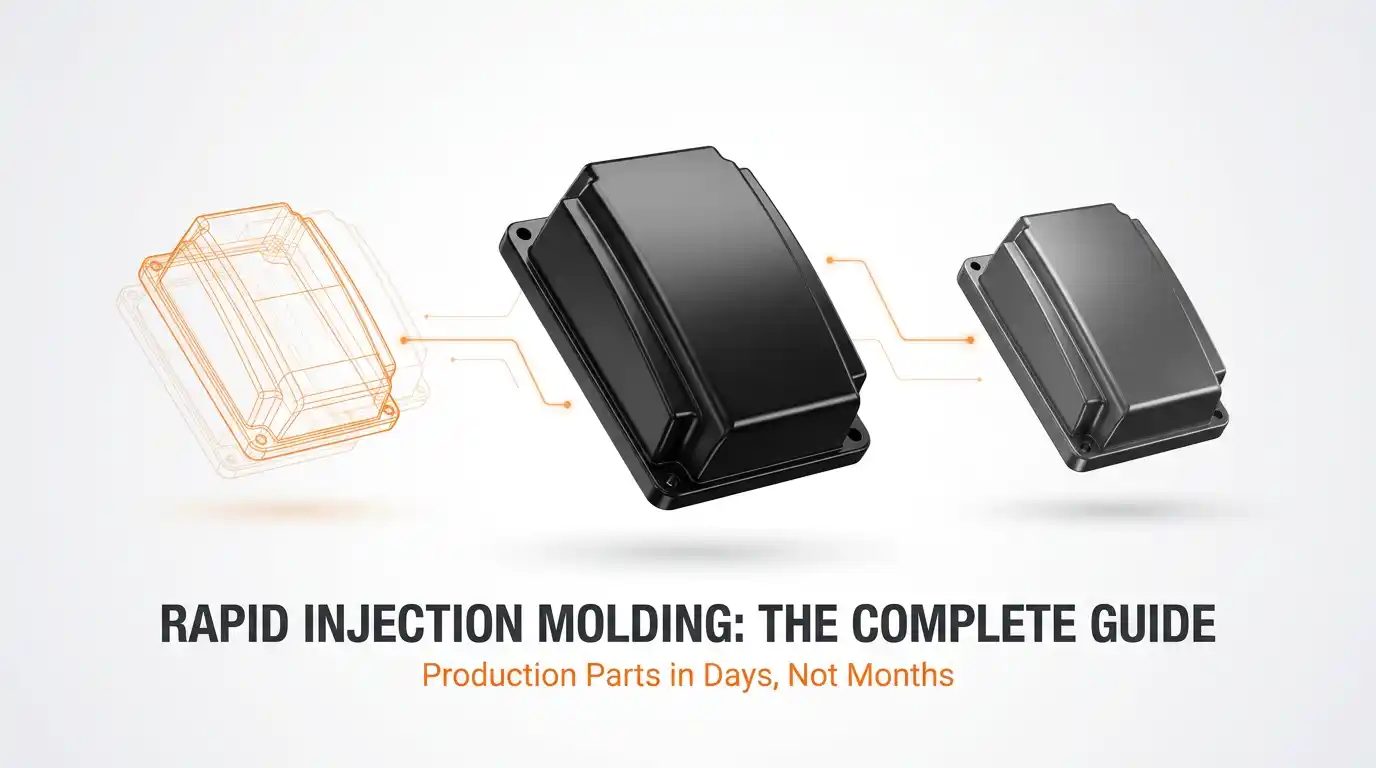
Rapid injection molding is conventional injection molding with faster-to-produce tooling. The injection process itself is unchanged: a screw melts thermoplastic pellets inside a heated barrel, injects the molten resin under pressure into a mold cavity, and ejects the solidified part after cooling. Cycle times are the same — a few seconds to a minute per shot, depending on part geometry.
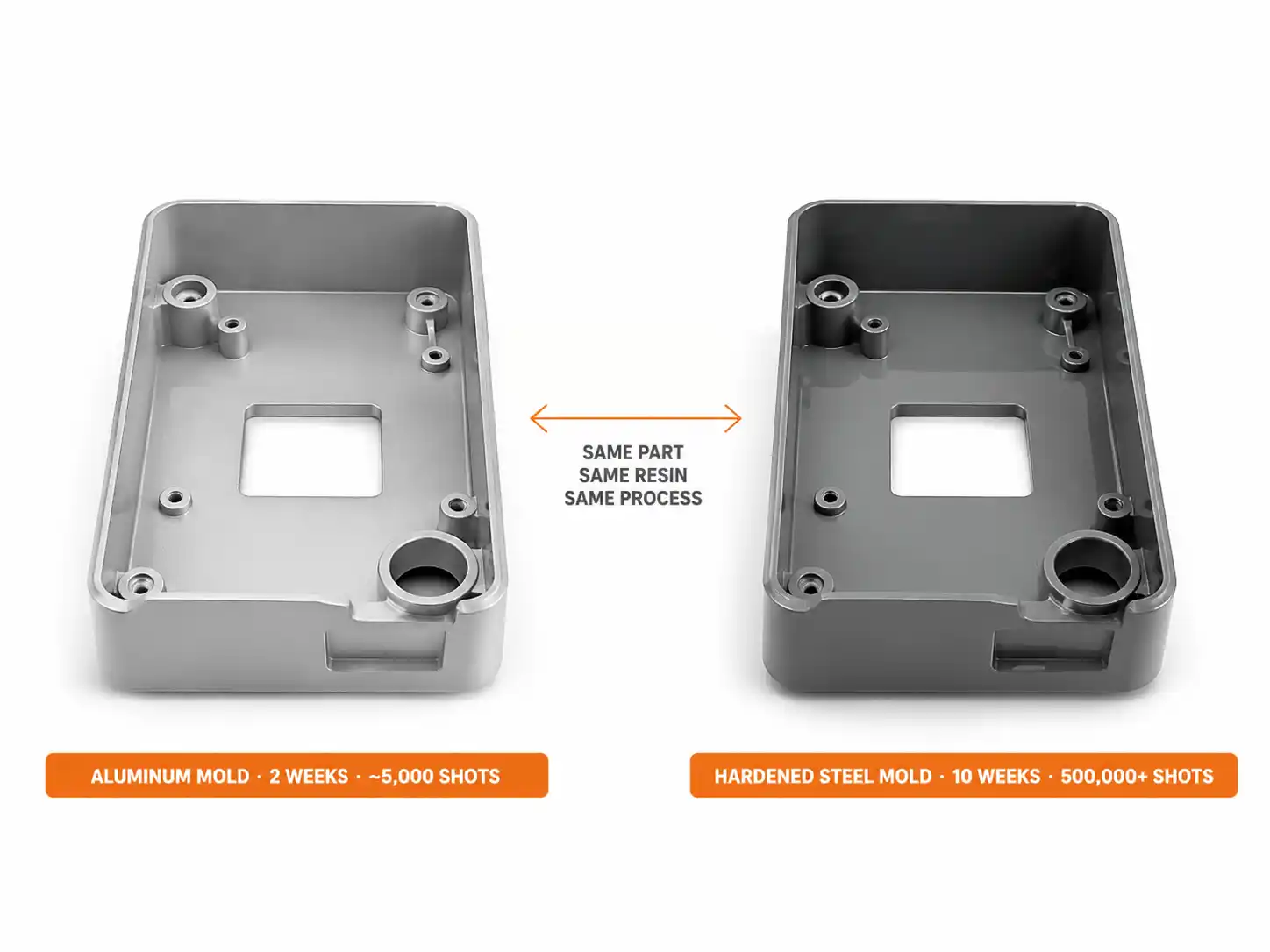
What makes it “rapid” is the tooling strategy. A traditional production mold is machined from hardened tool steel (H13, S136, DC53), requiring heat treatment cycles, precision grinding, and often 8–12 weeks to complete. A rapid injection mold is machined from aluminum or pre-hardened steel — materials that cut faster, skip heat treatment, and can go from CAD to first shots in 2–5 weeks.
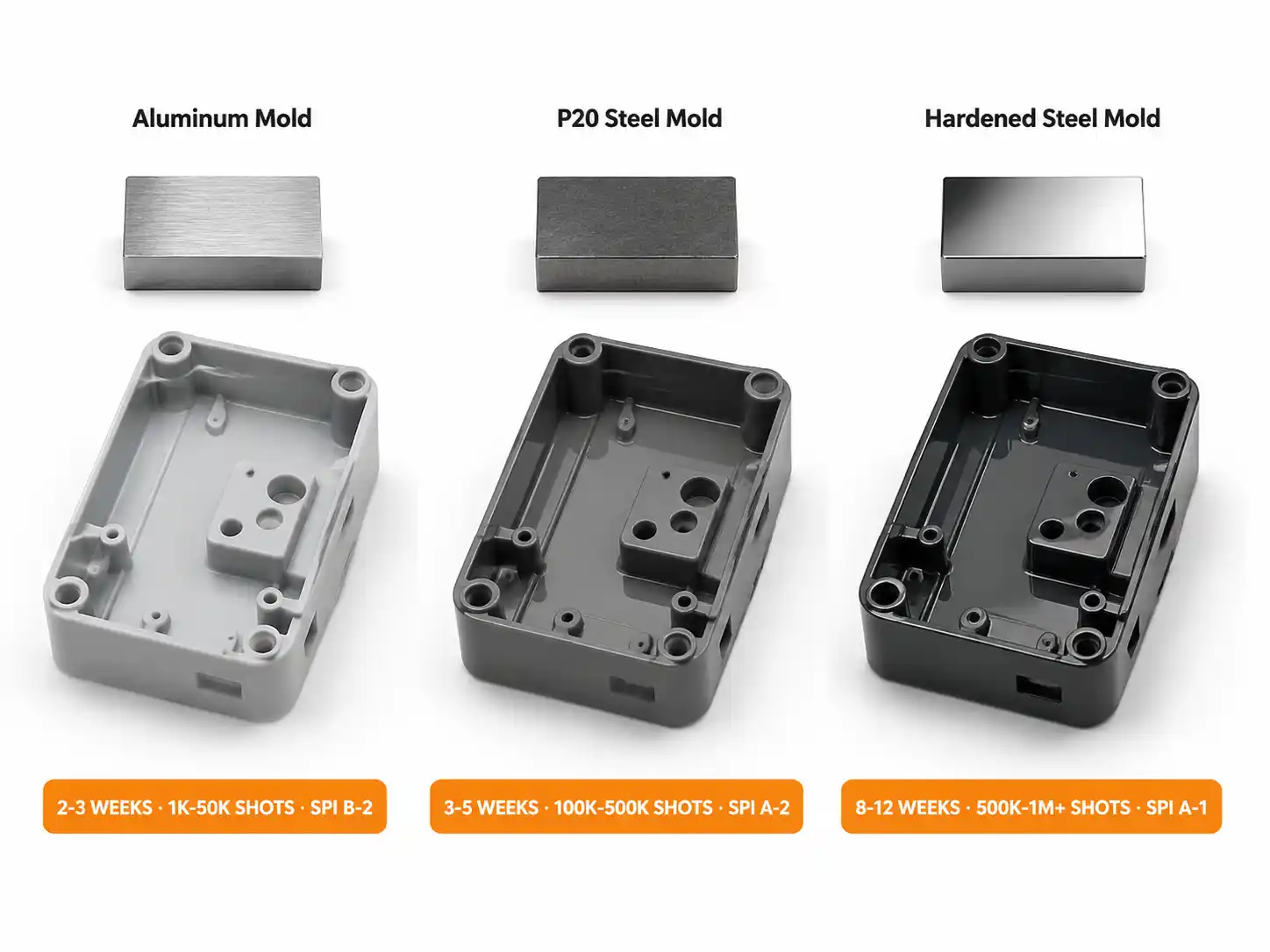
The trade-off is mold life. An aluminum mold may last 1,000–50,000 shots depending on resin abrasiveness and part geometry. A hardened steel production mold runs 500,000 to over 1 million cycles. For the prototyping and low-volume window where rapid tooling operates, mold longevity is rarely the binding constraint.
Note: Rapid injection molding should not be confused with reaction injection molding (RIM), which mixes liquid thermosetting polymers — typically polyurethane — that chemically cure inside the mold. The acronym is the same. The processes are unrelated.
Rapid vs Traditional Injection Molding
The injection molding machine does not know the difference. The mold material, lead time, and tool life create the separation.
| Factor | Rapid Injection Molding | Traditional Injection Molding |
|---|---|---|
| Mold Material | Aluminum (6061, 7075, QC-10) or pre-hardened steel (P20, NAK80) | Hardened tool steel (H13, S136, DC53) |
| Tooling Lead Time | 2–5 weeks | 8–12 weeks (longer for multi-cavity) |
| Mold Cost | $1,500–$15,000 (single cavity, complexity-dependent) | $20,000–$100,000+ |
| Mold Life | 1,000–50,000 shots (aluminum); 100,000–500,000 (P20) | 500,000–1,000,000+ shots |
| Tolerances | ±0.05–0.10 mm | ±0.02–0.05 mm |
| Ideal Volume | 100–10,000 parts | 10,000+ parts |
| Design Revision Speed | 1–3 days (aluminum insert or recut) | 5–15 days (steel modification) |
| Surface Finish | SPI B-2 to A-3; limited texturing | Full VDI 3400 texture range; SPI A-1 mirror polish |
The cost crossover point varies by part complexity, but as a general rule: if total production volume is under 5,000 parts, aluminum rapid tooling is more economical. Above 10,000 parts, the amortized per-part cost of a hardened steel mold pulls ahead. Between those numbers, a pre-hardened P20 mold often delivers the best balance.
Tooling Options for Rapid Injection Molding
Choosing a tooling material means trading machining speed, cost, and surface quality against mold life and material compatibility. Three main routes exist.
Aluminum Molds
Aluminum is the most common rapid tooling material because it cuts roughly three to five times faster than steel and requires no post-machining heat treatment. A simple single-cavity aluminum mold can be ready in 7–10 business days from approved CAD.
Aluminum also conducts heat roughly four to five times faster than steel. That shortens cooling cycles and improves throughput on short runs. For a prototyping run of 500–2,000 parts, the thermal conductivity advantage is real.
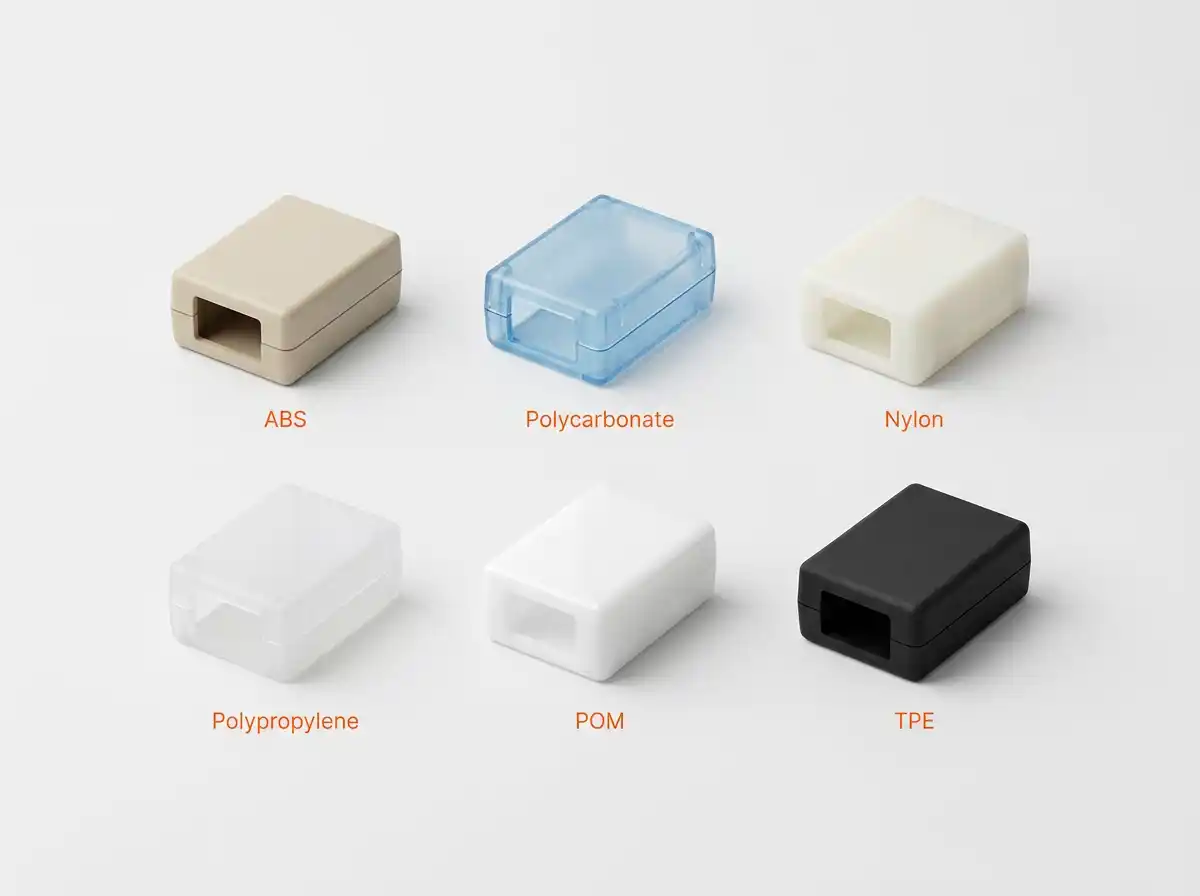
Aluminum molds work well with most standard thermoplastics: ABS, polycarbonate, nylon (unfilled), polypropylene, POM, and TPE/TPU. They do not handle glass-filled or carbon-fiber-filled resins well — the abrasive filler erodes the cavity surface, particularly around the gate area. High-temperature resins like PEEK and PEI also push aluminum beyond its practical temperature ceiling (roughly 250°C).
Surface finish on aluminum tooling is good but not production-grade. Expect SPI B-2 (fine diamond polish) or A-3 (medium diamond buff). Mirror-polish SPI A-1 and deep chemical textures are steel-only processes. If the prototype needs to validate a textured A-surface for a consumer product, consider P20 soft steel instead.
Soft and Semi-Hardened Steel Molds (P20, NAK80)
Pre-hardened steels split the difference between aluminum speed and hardened steel durability. P20 tooling can be delivered in 2–4 weeks — longer than aluminum but still weeks faster than a full hardened steel mold. P20 is weldable, which matters during prototyping: if design changes require cavity modification (engineering change orders, or ECOs), welding and re-machining a P20 cavity is faster and cheaper than starting over.
NAK80 is a semi-hardened steel with excellent polishability. It is the go-to choice when the prototype mold needs to produce glossy or optically clear parts — think lenses, display covers, or cosmetic A-surfaces destined for customer-facing evaluation.
Soft steel molds handle glass-filled and abrasive resins that would destroy an aluminum cavity, and they support tighter tolerances. The cost premium over aluminum is real — typically 40–60% more — but the extended shot life (100,000–500,000 cycles for P20) makes it the correct choice when the prototype run needs to double as a bridge production tool.
Master Unit Die (MUD) Inserts
A MUD system uses a standard mold frame with swappable insert pairs. The frame is a fixed investment; each new design requires only new cavity and core inserts.
For teams iterating multiple part designs on a shared mold base — common in consumer product development where several housing variants are tested simultaneously — MUD tooling can reduce initial mold cost by up to 66% compared to building a complete mold per design. The trade-off is that MUD frames constrain part size and gate placement within the standardized insert pocket dimensions.
Tooling Decision Table
| Scenario | Recommended Tooling | Why |
|---|---|---|
| 100–500 parts, non-abrasive resin, 2-week deadline | Aluminum (7075 or QC-10) | Fastest to machine, adequate shot life |
| 500–5,000 parts, standard thermoplastics | Aluminum or P20 | P20 if design may change; aluminum if pure speed |
| 500–5,000 parts, glass-filled nylon or abrasive resin | P20 steel | Aluminum will erode too quickly |
| 5,000–10,000 parts, cosmetic A-surface required | NAK80 or P20 | Aluminum cannot achieve mirror polish |
| Glossy or optically clear parts at any volume | NAK80 | Best polishability outside of full hardened steel |
| Multiple design variants, shared mold base | MUD with aluminum or P20 inserts | Frame cost amortized across designs |
Materials Compatible with Rapid Tooling
Rapid injection molding supports the same thermoplastics used in production molding — the material running through a rapid mold is identical to what will run in a hardened steel production tool. That is the core advantage over 3D printing and urethane casting for functional testing: the test data transfers directly to production because the material behavior is identical.
Standard Materials (Aluminum Mold Compatible)
- ABS — Good strength and toughness; the most common prototyping choice
- Polycarbonate (PC) — Impact resistance and optical clarity
- Nylon (PA6, PA66) — Toughness and chemical resistance; unfilled grades only for aluminum
- Polypropylene (PP) — Lightweight, flexible, excellent chemical resistance; ideal for living hinges
- POM (Acetal/Delrin) — Low friction, dimensional stability; mildly corrosive — monitor mold condition
- TPE/TPU — Rubber-like flexibility for grips, seals, and overmolded parts
Materials Requiring Steel Tooling
- Glass-filled nylon (PA66-GF30) and carbon-fiber-filled grades — abrasive; erode aluminum cavities within hundreds of shots
- PEEK, PEI (Ultem), PPS — Processing temperatures exceed 300°C; aluminum loses strength at these temperatures
- PVC — Corrosive off-gassing accelerates mold wear on both aluminum and soft steel
Material Selection Checklist
When choosing a resin for a rapid injection molding project, verify four points:
- Processing temperature — Below 250°C for aluminum; below 300°C for P20
- Abrasiveness — Unfilled grades only for aluminum; filled grades need P20 or harder
- Part function — If the part undergoes mechanical testing (snap-fits, load-bearing, fatigue), use the exact production resin, not a proxy
- Regulatory requirements — For medical (ISO 13485) or automotive (IATF 16949) applications, use the certified production-grade material in the rapid mold so validation data carries forward to qualification
When to Use Rapid Injection Molding
Rapid injection molding fits some scenarios cleanly and falls short in others. The table below maps the most common situations to the best process choice.
| Scenario | Fit | Reason | Better Alternative |
|---|---|---|---|
| Functional prototypes needing production-grade material properties | ✅ Strong fit | 3D-printed parts cannot replicate injection molded snap-fit, hinge, or load-bearing behavior in the target resin | — |
| Bridge tooling — getting parts to market while production steel mold is being built | ✅ Strong fit | Delivers real molded parts in 2–4 weeks; test feedback refines the production mold design in parallel | — |
| Low-volume production (500–5,000 parts) where steel mold ROI does not close | ✅ Fit | Aluminum or P20 mold cost amortizes across the run without the $20K+ upfront of hardened steel | — |
| Early-stage form exploration (design still changing weekly) | ❌ Poor fit | CAD is not DFM-ready; recutting molds for every design iteration erases the speed advantage | 3D printing, CNC machining |
| Single-digit or sub-100 quantities | ❌ Poor fit | Mold cost cannot amortize across fewer than 100 parts | CNC machining, vacuum casting |
| Production volumes above 10,000 units | ❌ Poor fit | Hardened steel mold per-part cost pulls ahead decisively; rapid tooling becomes the more expensive option at scale | Traditional injection molding |
The decision heuristic is straightforward: if the design is stable and the need is 100–10,000 production-grade parts on a compressed timeline, rapid injection molding is the answer. Outside that window, other processes deliver better economics.
DFM Considerations for Rapid Tooling
A rapid mold cuts faster than a steel mold. It does not forgive bad DFM — and the compressed timeline leaves less room to fix problems after tooling.
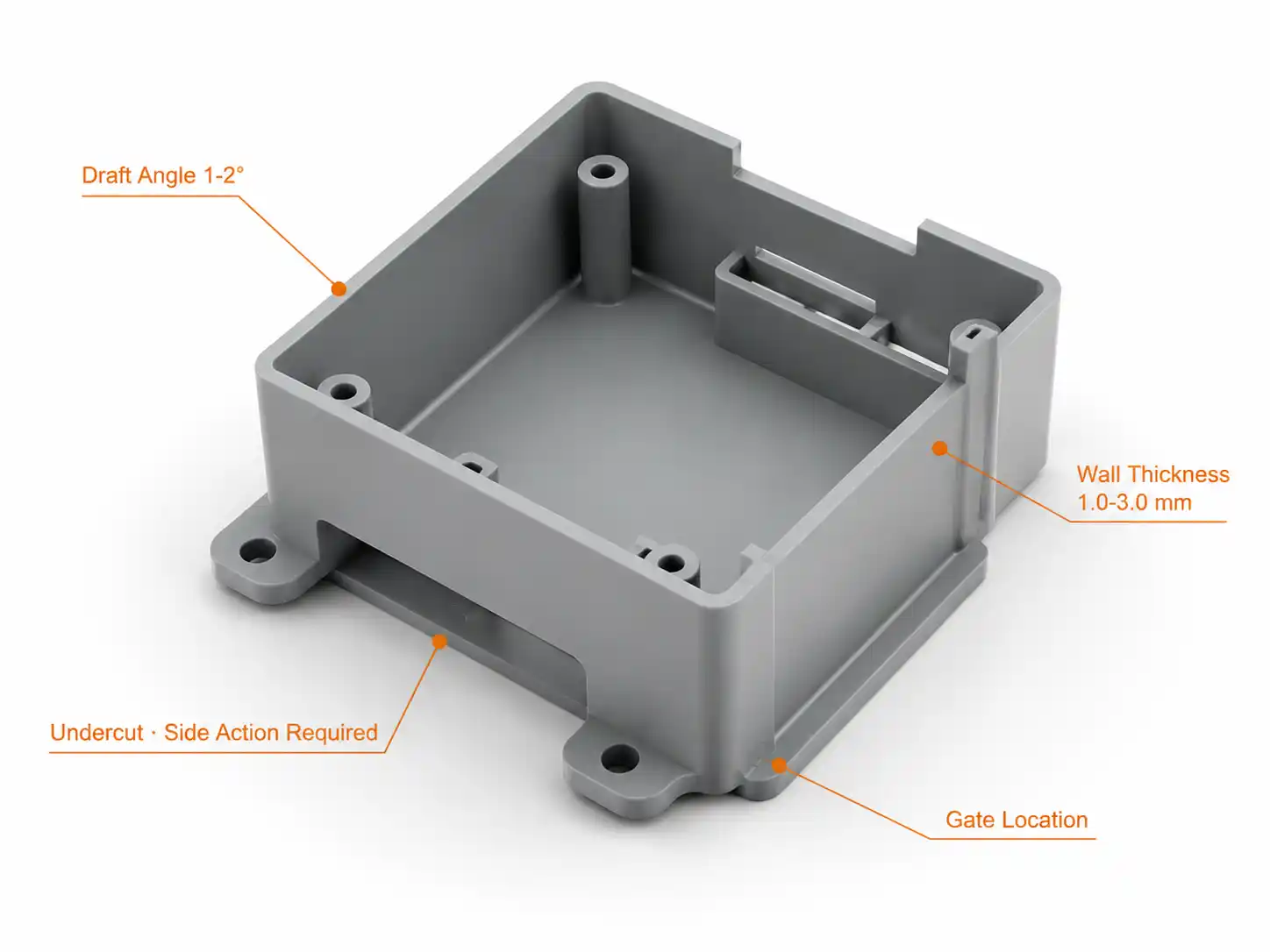
Aluminum molds cannot be welded and repaired the way P20 or hardened steel can. If a cavity feature is machined incorrectly or a design change requires geometry modification, the fix is often a full recut — erasing the speed advantage that rapid tooling is supposed to deliver. This makes the upfront DFM review more critical for rapid injection molding than for traditional production tooling, where the longer timeline and repairable steel provide more margin for correction.
Standard injection molding DFM rules apply: minimum 1–2° draft per side, consistent wall thickness between 1.0–3.0 mm, and avoidance of undercuts that require side actions unless the budget and timeline can absorb the added cost ($1,000–$2,500 and 3–5 days per side action). The difference with rapid tooling is that every missed DFM issue costs time that is already the tightest constraint in the project.
Cost and Lead Time Realities
Understanding where the money and time go helps set realistic expectations before the first RFQ. For a full breakdown of cost drivers, see our guide to injection molding costs.
Tooling Cost Ranges
These are typical single-cavity aluminum mold costs for a part roughly the size of a smartphone case:
| Mold Complexity | Aluminum Cost | Lead Time |
|---|---|---|
| Simple open-and-shut, no side actions | $1,500–$3,500 | 7–10 business days |
| One side-action slide | $4,000–$6,000 | 10–15 business days |
| Two slides with lifters | $6,000–$10,000 | 15–20 business days |
| Threaded inserts or collapsing cores | $10,000–$15,000+ | 20–25 business days |
P20 steel molds add roughly 40–60% to these costs and 1–2 weeks to the timeline.
Lead Time Breakdown
A typical rapid injection molding project timeline for a moderate-complexity part:
| Stage | Duration |
|---|---|
| DFM review and feedback | 1–2 business days |
| Aluminum tooling fabrication | 5–10 business days |
| T1 sampling and dimensional verification | 1–2 business days |
| Production run (500–2,000 parts) | 1–3 business days |
| Total: CAD to finished parts | 8–17 business days |
Per-Part Cost
The per-part cost crossover between rapid and traditional tooling depends on volume and mold complexity:
- Under 1,000 parts: Aluminum rapid tooling dominates. Mold cost is the main expense; per-part material and machine time are secondary.
- 1,000–5,000 parts: Aluminum or P20 rapid tooling remains competitive. The crossover point shifts downward if the part is complex or the resin is expensive.
- 5,000–10,000 parts: The decision depends on material and tolerance requirements. P20 is often the right choice here — longer mold life without the full cost of hardened steel.
- Above 10,000 parts: Hardened steel production mold is the correct economic choice. The higher upfront mold investment is recovered through lower per-part cost across the production run.
An online quoting platform that provides instant DFM feedback can compress the pre-tooling phase by eliminating the back-and-forth of traditional RFQ processes. Instead of waiting days for a manual quote, the system identifies geometry issues at upload and returns a manufacturability analysis alongside pricing — cutting what used to be a week of email exchange into hours.
How SHBD Metal Supports Injection Molding Projects
SHBD Metal provides injection molding services from prototype aluminum tooling through production-grade steel molds. The platform supports the full range of molding processes — including insert molding and overmolding — with standardized quality practices across the manufacturing network.
Uploading a CAD file to the quoting platform returns a price estimate and a free DFM analysis. The DFM check identifies draft angle issues, wall thickness variations, undercut conflicts, and potential gate placement problems before any mold steel is cut. That shortens the loop between design review and tooling start.
Injection molded parts are produced to ±0.05mm tolerances under an ISO 9001:2015 quality system, with IATF 16949 and ISO 13485 certifications for automotive and medical device applications. The manufacturing network spans owned facilities and 700+ certified partner factories, providing capacity flexibility from prototype runs through volume production.
Conclusion
Rapid injection molding solves a specific problem: the gap between 3D-printed prototypes and production steel tooling. It delivers real injection molded parts — same materials, same process, same mechanical behavior — in days to weeks rather than months. The trade-off is mold life: aluminum tooling is a bridge, not a permanent production asset.
The decision comes down to three numbers: production volume, required timeline, and material aggressiveness. Under 5,000 parts with non-abrasive resin and a tight deadline, aluminum rapid tooling is the strongest option. For glass-filled materials, cosmetic surfaces, or volumes approaching 10,000, pre-hardened steel like P20 offers a better balance. Above 10,000 parts, the economics shift toward hardened steel production tooling.
If your project needs injection molded parts and the clock is the constraint, upload the CAD file for an instant quote and free DFM analysis. The feedback loop from design upload to manufacturability review takes hours, not days.
FAQs
A simple part with no side actions typically delivers first shots in 7–10 business days from approved CAD. Parts with side actions or complex geometry take 15–20 business days. Total timeline from file upload to finished production run is typically 2–4 weeks.
Yes — with one important exception. Standard thermoplastics (ABS, PC, PP, nylon, POM, TPE/TPU) run identically in aluminum and steel molds. Glass-filled, carbon-fiber-filled, and high-temperature resins (PEEK, PEI) require steel tooling because they abrade or overheat aluminum cavities. The value of rapid tooling is that the material properties, shrinkage behavior, and surface finish are identical to what production tooling will produce.
The crossover typically sits between 5,000 and 10,000 parts, depending on part complexity and resin cost. Below 5,000 parts, aluminum rapid tooling is usually the more economical total investment. Above 10,000 parts, the amortized per-part cost of a hardened steel mold pulls ahead. Between those numbers, P20 pre-hardened steel is often the correct middle ground.
Side actions, lifters, and threaded cores are the biggest cost drivers. Each side action adds roughly $1,000–$2,500 to mold cost and 3–5 days to tooling lead time. Undercuts that require collapsing cores can push aluminum tooling above $15,000 for a single-cavity mold — at that point, evaluating whether P20 steel makes more sense is worth doing.
Yes, provided the tooling supplier holds the relevant certifications. For medical devices, ISO 13485 certification is required; for automotive, IATF 16949. The rapid mold should run the exact certified production-grade resin so that validation data transfers to production qualification. A DFM review that accounts for regulatory material requirements is essential before tooling starts.
Upload a 3D CAD file (STEP, IGES, or native format) to the quoting platform. The system analyzes part geometry for manufacturability, identifies potential issues, and returns a price estimate and DFM report. The entire cycle — upload to actionable feedback — typically completes within hours, compared to days of email-based RFQ processes with traditional suppliers.

Comment
0 comments
Got thoughts or experiences to share? We’d love to hear from you!