
Not every part should be machined, and not every part should be printed — but a surprising number of parts sit squarely in the middle, where SLS manufacturing is the ideal answer. Selective laser sintering (SLS) is an additive manufacturing process that fuses powdered polymer into solid, functional parts, and it has quietly become one of the most practical technologies for bridging the gap between prototype and production.
Unlike resin printing, SLS parts need no support structures. Unlike FDM, they are strong, isotropic, and consistent enough for real-world use. And unlike machining, SLS can produce geometries — internal lattices, conformal channels, living hinges — that no cutting tool can reach. For engineering teams, that combination makes SLS the default answer to a specific question: "I need functional parts, fast, without tooling."
This guide explains how SLS manufacturing works, where it fits among other processes, which materials and applications it serves, and how to design for it. SHBD Metal's 3D printing services include SLS alongside SLA, MJF, and metal printing options.
What Is SLS Manufacturing?
SLS manufacturing — selective laser sintering — is an additive manufacturing process in which a laser selectively fuses layers of powdered thermoplastic material to build a part. The process was developed in the 1980s and commercialized in the 1990s, and today it is one of the most widely used industrial 3D printing technologies for functional parts.
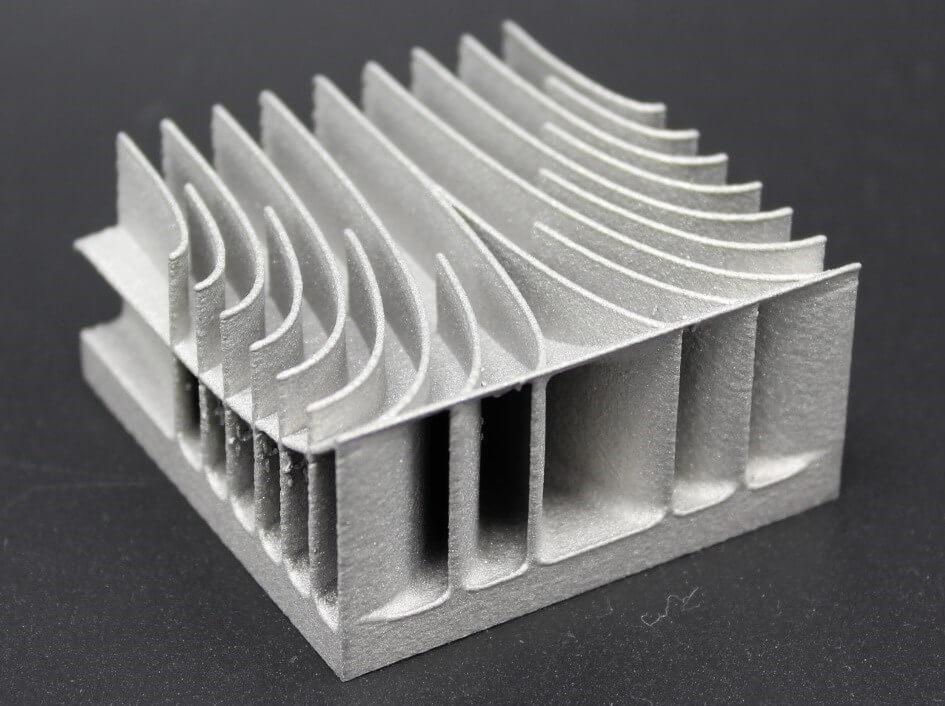
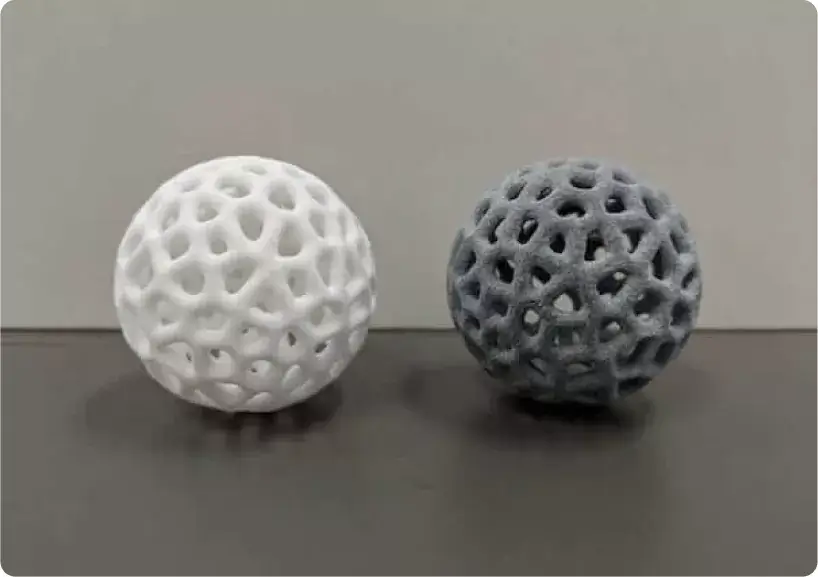
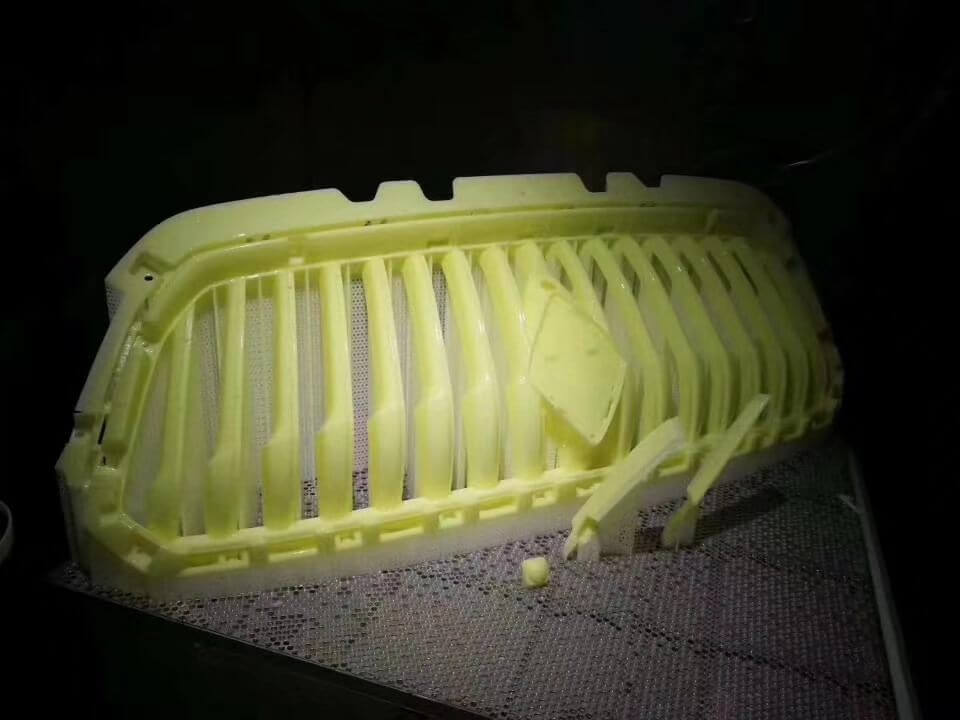
The key word is "sinter": the laser heats the powder particles just enough to fuse them together without fully melting them. Because the unfused powder surrounding each part acts as its own support structure, SLS can produce geometries that are impossible in almost any other process — interlocking assemblies, complex internal channels, and delicate lattices — with no supports to remove and no witness marks to clean up.
How Selective Laser Sintering Works
Understanding how SLS works helps you design for it and set realistic expectations:
- Powder bed preparation: A thin layer of polymer powder — typically nylon (PA12) — is spread across the build platform by a roller.
- Laser scanning: A CO₂ laser traces the cross-section of the part, heating the powder to just below its melting point and fusing the particles together.
- Layer repetition: The platform drops by one layer thickness (typically 0.1–0.12 mm), a fresh layer of powder is spread, and the laser scans the next cross-section.
- Cooling: The entire powder cake cools slowly inside the machine — often for several hours — to prevent warping.
- Depowdering: Parts are dug out of the cooled cake, and excess powder is recovered, sieved, and reused.
- Post-processing: Parts are bead blasted, and may be dyed, vapor smoothed, or machined for critical features.
Because every part in the build chamber shares the same powder cake, SLS is exceptionally efficient: dozens of parts can be nested and printed in a single build, with the machine running unattended overnight.
SLS vs Other 3D Printing Processes
SLS competes with several additive processes, and each has a distinct profile:
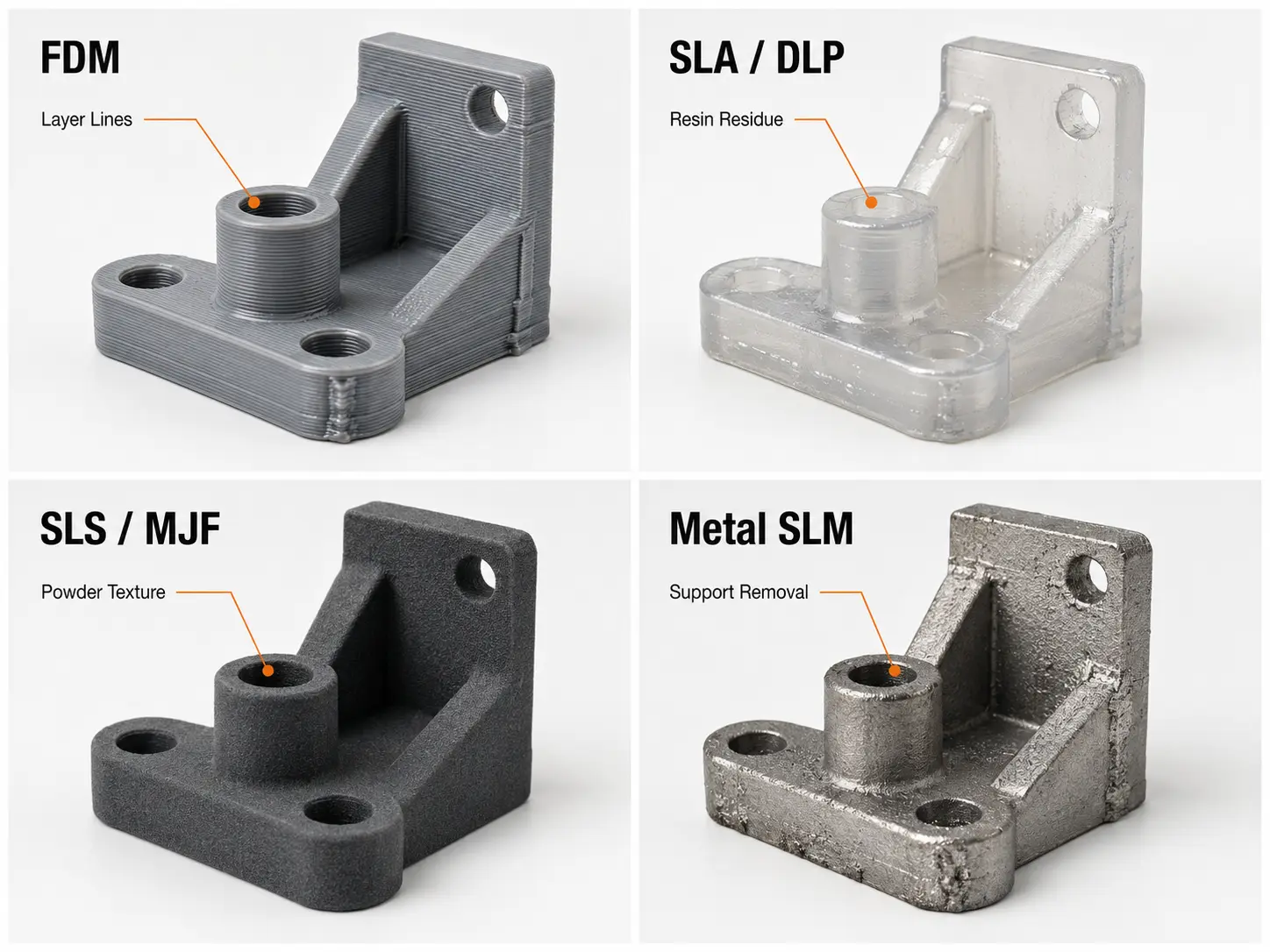
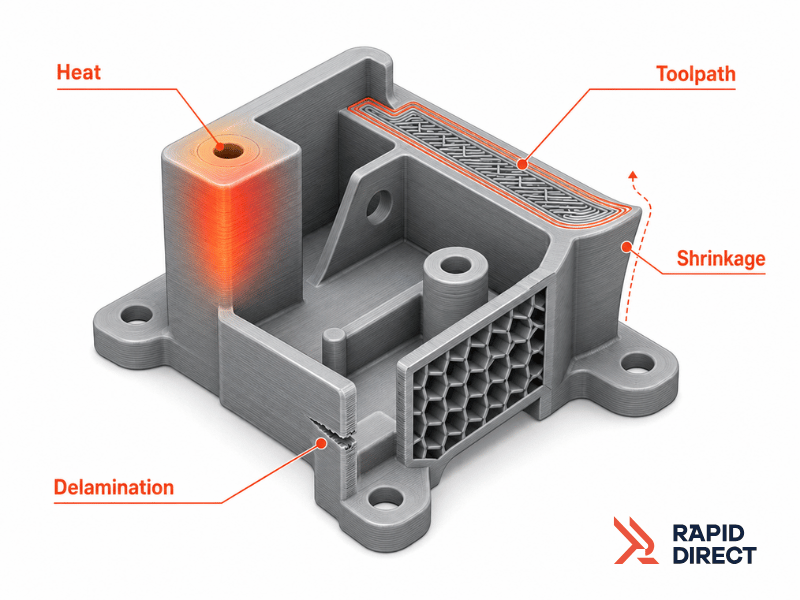
- vs FDM: FDM (fused deposition modeling) is cheaper per machine and per kilogram of material, but parts are weaker, anisotropic, and require supports. SLS wins on strength, accuracy, and complexity — at a higher cost per part.
- vs SLA: SLA (stereolithography) produces the smoothest surfaces and finest details of any plastic printing process, but the resins are brittle and require support structures. SLS parts are tougher and more functional.
- vs MJF: Multi Jet Fusion, also powder-based, generally prints faster with slightly different surface characteristics. Both produce production-capable nylon parts; the practical differences come down to cost per part and specific mechanical behavior.
- vs CNC machining: Machining wins on material properties, tolerances, and surface finish; SLS wins on geometric freedom, zero tooling, and overnight turnaround. Many teams use SLS to validate designs before committing to CNC machining for production.
SLS Materials: Nylon and Beyond
Nylon (polyamide) dominates SLS, and for good reason. PA12 offers excellent strength, fatigue resistance, chemical resistance, and a low moisture absorption rate that makes it dimensionally stable. PA11 adds greater impact resistance and a bio-based origin. Around this core, the material catalog expands considerably:
- Glass-filled nylon (PA12-GF) — added stiffness and heat resistance for structural and jig-and-fixture applications.
- Carbon-fiber-filled nylon — higher stiffness-to-weight ratio for drone frames and functional prototypes.
- Flame-retardant nylon — for electronics housings and aerospace interior parts.
- TPU (thermoplastic polyurethane) — flexible, elastic SLS parts for seals, gaskets, and soft-touch components.
- Alumide — nylon filled with aluminum powder for a metallic appearance and improved stiffness.
SLS materials are engineering materials, not display materials: they carry datasheets with tensile strength, elongation, and heat deflection values. For load-bearing or high-temperature applications, compare printed properties against machined alternatives in our materials guide.
Applications of SLS Manufacturing
SLS earns its place across the product development cycle and beyond:
- Functional prototypes — parts strong enough for assembly, fit testing, and field trials, printed in days.
- Low-volume production — bridge quantities of 10 to 1,000 parts while injection molding tooling is in progress.
- Jigs and fixtures — custom tooling, assembly aids, and inspection fixtures printed overnight for the shop floor.
- End-use parts — ducts, vents, housings, and brackets in industries from medical devices to automotive and robotics.
- Complex geometries — conformal cooling channels, lattice structures, living hinges, and snap-fit assemblies that cannot be molded or machined.
- Spare and obsolete parts — digital inventory: print on demand instead of warehousing slow-moving components.
Design Guidelines for SLS Parts
Designing for SLS is more forgiving than almost any other manufacturing process, but a few guidelines keep parts reliable and economical:
- Wall thickness: Keep walls above 0.8–1 mm; thicker walls (2 mm+) are stiffer but cost more in powder and time.
- Clearances: For moving assemblies, design 0.3–0.5 mm clearance between parts that must articulate.
- Text and details: Raised text and fine details should be at least 0.5 mm tall to survive depowdering and blasting.
- Holes: Holes under 1.5 mm diameter may need post-drilling for precise fit; larger holes print cleanly.
- Surface finish: Plan for a matte, slightly grainy surface (Ra 6–12 µm); specify vapor smoothing or machining for aesthetic or sealing surfaces.
SLS tolerances typically land around ±0.3% of the dimension with a ±0.2 mm floor — adequate for most functional assemblies, but worth confirming against critical fits.
Cost and Lead Time Considerations
SLS pricing is driven by build volume and part density rather than part count. Because parts are nested in the powder bed, adding more parts to a build barely changes cost — which is why SLS per-part price drops so dramatically with quantity. The main cost drivers are:
- Material usage — both fused part volume and powder consumed by the job.
- Build height — the tallest part determines how many layers the entire build needs.
- Cooling and depowdering time — long builds take hours to cool before parts can be handled.
- Post-processing — blasting is standard; dyeing, coating, or machining add cost.
Lead times are measured in days: a typical order — design review, print, cool, depowder, blast, ship — completes in 3–5 business days.
Frequently Asked Questions
What does SLS stand for in manufacturing?
SLS stands for selective laser sintering. It is an additive manufacturing process that uses a laser to fuse powdered polymer material layer by layer into solid parts. It is one of the most widely used industrial 3D printing technologies for functional plastic parts.
Is SLS suitable for production parts or just prototypes?
Both. SLS is used for functional prototypes, bridge production while tooling is being made, and end-use parts — especially in low to medium volumes where injection molding tooling is not economical. Nylon SLS parts are strong, durable, and consistent enough for many production applications.
How strong are SLS printed parts?
SLS nylon parts are among the strongest of any plastic 3D printing process. PA12 offers tensile strength around 45–50 MPa and good elongation and impact resistance, with near-isotropic properties. Glass- and carbon-filled grades increase stiffness further for structural applications.
What is the difference between SLS and SLM?
Both are powder-bed laser processes, but SLS sinters polymer powder for plastic parts, while SLM (selective laser melting) fully melts metal powder for metal parts. The "sintering" in SLS fuses particles without complete melting; SLM reaches full melt for high-density metal components.
Why doesn't SLS need support structures?
Because the unfused powder surrounding the part acts as a natural support. Every layer is supported by the powder below it, so overhangs, undercuts, and internal channels print without sacrificial supports — a unique advantage of powder-bed printing.
Get Your SLS Manufacturing Quote
At SHBD Metal, our SLS manufacturing service turns CAD files into functional nylon parts in days — with no tooling, no minimum order quantity, and no supports to design around. Our engineers review your geometry for printability, recommend the right material grade, and handle post-processing from bead blasting to dyeing and vapor smoothing.
Upload your CAD files today and receive a detailed quote within hours. Whether you need a functional prototype this week or bridge production while your tooling is built, we are ready to help you bring your design to life.