
A US PCB shop is no longer just a fallback for ITAR-bound builds. For NPI teams that need to talk to an engineer in their own time zone, or for medical and aerospace programs where the supply chain has to be auditable, a domestic board house is often the default. This list ranks ten US manufacturers by how well they serve prototype-to-low-volume engineering builds, then puts them next to China on cost, IP, and lead time so you can choose with eyes open.
USA vs China PCB Manufacturing — Pros, Cons, and How to Choose
Most “US vs China” comparisons collapse into “China is cheap, US is safe.” The real decision is more granular.

US PCB manufacturing — strengths
- IP sits under US legal protection; NDAs and ITAR handling are routine, not exceptions.
- Engineering collaboration happens in your working hours, with direct phone and email access.
- Short, auditable supply chains suit aerospace, defense, and regulated medical programs.
- Compliance (AS9100, ISO13485, ITAR) is built into how the shop operates, not bolted on.
US — limits
- Per-board cost runs higher than China at volume, sometimes several times higher.
- Total national capacity is smaller; very high-layer or bleeding-edge HDI commodity pricing is thinner.
- Lead times for raw laminate can stretch when domestic mills are booked.
China PCB manufacturing — strengths
- Unmatched cost efficiency at scale, with a mature component and laminate ecosystem.
- Massive capacity; well-fed lines turn prototypes fast once tooling is set.
- Strong competition keeps turnaround aggressive for standard builds.
China — limits
- Logistics and customs add days to every shipment, and geopolitics can disrupt both tariff and routing.
- Time-zone and language friction slow design-spin iteration.
- Sensitive IP needs deliberate handling; not every shop runs the same export-control discipline.
Decision table
| Dimension | US shop | China shop |
| Per-board cost (volume) | High | Low |
| Prototype lead time | Fast, local | Fast, plus shipping |
| IP / legal protection | Strong | Depends on partner |
| Compliance (ITAR / AS9100 / ISO13485) | Native | Case-by-case |
| Engineering communication | Same time zone | Off-shift |
| Best for | NPI, regulated, low-mix-high-value | Cost-driven, high-volume, mature design |
How to choose
- Pick a US shop when the build is ITAR-controlled, medical/aerospace-regulated, low-volume high-mix, NPI-tight, or IP-sensitive.
- Pick China when cost drives the program, the design is mature, volume is high, and the content is non-sensitive.
- Pick a hybrid when you want China’s cost without losing US-level communication and control — the model SHBD Metal runs with a US office over a China factory.
How to Choose a US PCB Manufacturer
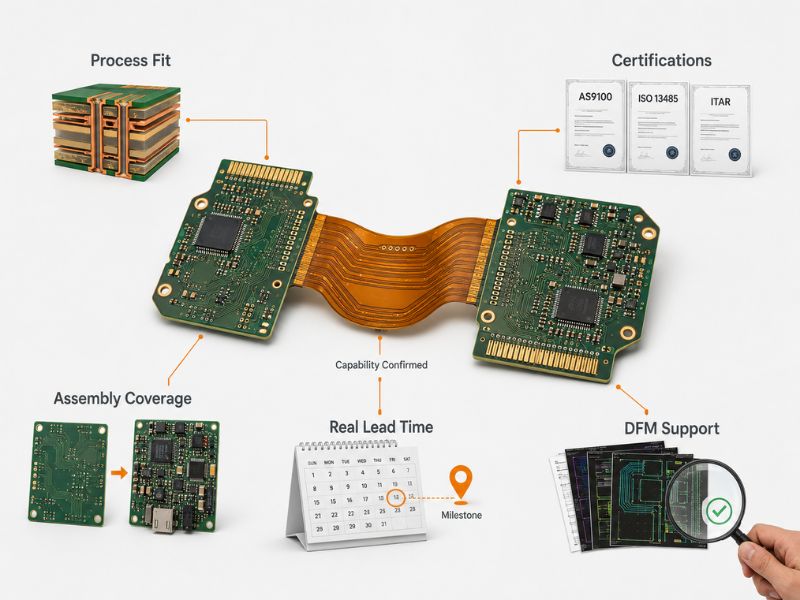
Within the US shortlist, screen on the same axes a Chinese quote would fail on:
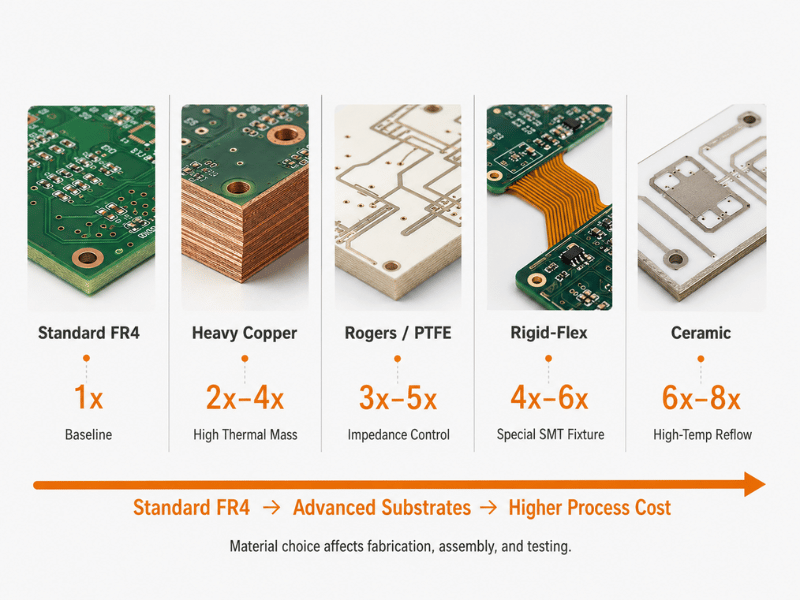
- method fit — rigid, HDI, flex, rigid-flex, RF/microwave, or heavy copper. Confirm the shop actually runs your stack, not just lists it.
- Certifications — AS9100 and ISO13485 for aerospace/medical; ITAR registration if the program demands it.
- Assembly coverage — some US board houses fab only; others run turnkey SMT/THT so the bare board never leaves the building.
- Turnaround honesty — “24-hour” means different things for a 2-layer vs a 12-layer HDI. Ask what the quoted slot actually covers.
- Engineering access — you want DFM feedback before the spin, not a rejection after the fact.
At a Glance
| Manufacturer | Location | Focus | Assembly | Best for |
| Sierra Circuits | Sunnyvale, CA | Quick-turn, HDI, flex | Yes (SMT/BGA/PTH) | 1-day prototypes |
| AdvancedPCB / Advanced Circuits | Aurora, CO | Prototype→production, 40L | Yes | Defense, medical |
| Summit Interconnect | Anaheim, CA | Rigid/flex/HDI/RF | Yes (turnkey) | RF microwave systems |
| TTM Technologies | Costa Mesa, CA | Advanced, RF/microwave | Partial | Aerospace, defense |
| Sanmina | San Jose, CA | Rigid-flex/HDI 70+L | Yes | High-integration programs |
| SOMACIS Inc | Poway, CA | HDI/flex/multilayer | Yes | Aerospace, medical |
| Calumet Electronics | Michigan | Multilayer/RF/flex | Yes | Extreme-environment |
| Amphenol Printed Circuits | Nashua, NH | Rigid-flex, 28GHz backplane | Yes | Defense, aerospace |
| All Flex Solutions | Eden Prairie, MN | Flex/rigid-flex | Yes | Medical, auto flex |
| Epec, LLC | New Bedford, MA | Rigid/flex/HDI/RF/heavy Cu | Yes | US+China hybrid DFM |
Quick-Turn Prototyping vs High-Volume Production
US PCB shops run on two different operating models, and quoting the wrong one wastes a cycle. Tell them apart by who they are built to serve:
- Quick-turn / prototype shops — built for individuals, startups, and engineering teams iterating fast. Low or no MOQ, online instant quoting, free DFM, and same-day to multi-day turns. Sierra Circuits, AdvancedPCB / Advanced Circuits, and Epec take a one-off 2-layer board as readily as a pilot run.
- Volume / qualified-production houses — built for established programs with audited supply chains. MOQs, program management, and longer lead times; they optimize for repeatable high volume, not one-off spins. TTM Technologies and Sanmina are the clear examples.
- Specialized engineering houses (in between) — Summit Interconnect, SOMACIS, Calumet, Amphenol, and All Flex Solutions serve low-to-mid volume builds with deep process focus (RF, flex, aerospace, extreme environment). They sit between the two poles: more capable than a quick-turn platform, less volume-driven than TTM or Sanmina.
Match the shop type to your stage: a prototype spin belongs with the first group; a frozen design heading to 10k+ units belongs with the second.
The Top 10, Profile by Profile
1. Sierra Circuits — Sunnyvale, CA

The quick-turn reference point for US prototyping. Same-day and 24-hour turns on standard stacks, HDI and flex capability, and in-house SMT/BGA/PTH assembly so the first article can be a finished board. Limits: premium pricing at volume, and ultra-high-layer builds route through longer queues.
2. AdvancedPCB / Advanced Circuits — Aurora, CO
Prototype-to-production under one roof, up to 40 layers, with FreeDFM™ pre-flight checking. Strong in defense and medical where documentation discipline matters. Limits: not the cheapest for simple 2-layer runs where a platform shop wins.
3. Summit Interconnect — Anaheim, CA

Rigid, flex, HDI, and RF/microwave with full turnkey assembly. A frequent pick for RF systems that need the board and box-build integration handled together. Limits: lead times extend on complex multilayer stacks.
4. TTM Technologies — Costa Mesa, CA

The largest US advanced-PCB manufacturer, with deep RF/microwave, aerospace, defense, and automotive programs. If the build needs qualified, audited volume, TTM is on the shortlist. Limits: not a quick-turn prototype shop — NPI spins go through a heavier process.
5. Sanmina — San Jose, CA
High-integration production with complex rigid-flex and HDI past 70 layers, plus full assembly. A Fortune 500 operation for programs that need the board inside a larger system. Limits: MOQs and program overhead suit production, not one-off spins.
6. SOMACIS Inc — Poway, CA

HDI, flex, and multilayer for aerospace, defense, and medical, carrying ISO9001, AS9100, and ISO13485. Limits: capacity is tuned to qualified programs rather than walk-in prototypes.
7. Calumet Electronics — Michigan
Multilayer, RF/microwave, and flex for extreme-environment use, with AS9100D and ITAR registration. Limits: a specialist shop, so commodity pricing is not its lane.
8. Amphenol Printed Circuits — Nashua, NH

Rigid-flex from 1 to 30 layers and 28GHz backplanes for defense and aerospace. Limits: defense-grade focus means commercial quick-turn is not the core pitch.
9. All Flex Solutions — Eden Prairie, MN
Flex and rigid-flex specialist serving medical, aviation, and automotive. Limits: if your design is mostly rigid HDI, a broader shop fits better.
10. Epec, LLC — New Bedford, MA
Rigid, flex, HDI, RF, and heavy copper, with a US shop plus a China partner and free DFM plus 24/7 access. Limits: the hybrid model means some volume flows offshore, which you weigh against the cost saving.
Match the Manufacturer to Your Project
- Prototype spin tomorrow — Sierra Circuits or AdvancedPCB.
- RF/microwave system — Summit Interconnect or TTM.
- Aerospace/defense / ITAR — Calumet, SOMACIS, or Amphenol.
- Flex or rigid-flex only — All Flex Solutions.
- High-integration production — Sanmina or TTM.
- US engineering, China cost — Epec’s hybrid, or the model below.
Where SHBD Metal Fits: US Office, China production
China PCB shops share real drawbacks — longer logistics, off-shift communication, and IP that needs careful handling. SHBD Metal answers those with ten-plus years of production experience and a dedicated engineering team, not with marketing.
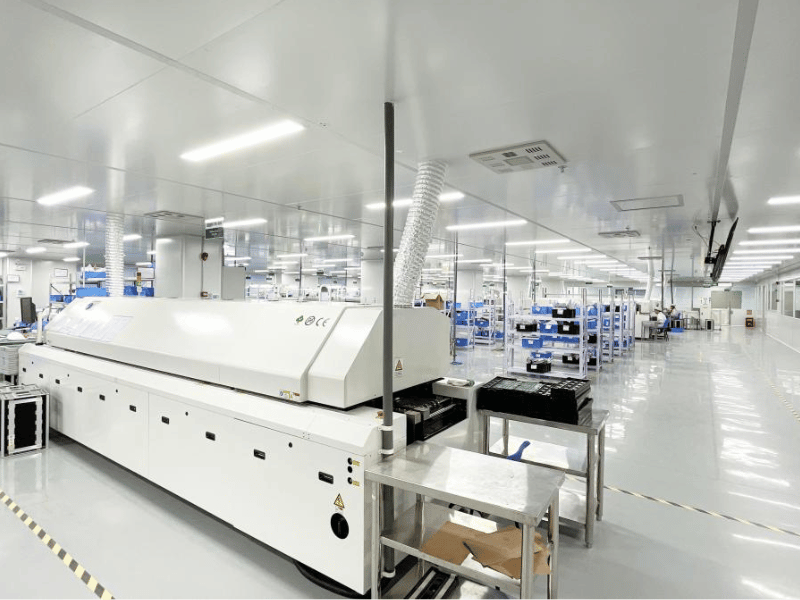
The US office means you work in your own time zone: file review, DFM feedback, and order tracking all happen during your day, with English-speaking engineers who have shipped boards for over a decade. The manufacturing stays on SHBD Metal’s own 30,000㎡ smart factory — 6 SMT lines, 150k PCBA units per month, prototype bare boards from a 12-hour turn with no MOQ, and PCBA in 3–5 days (1–2 urgent). Certifications cover ISO9001, IATF16949, ISO13485, ISO14001, ISO45001, and IPC Class 2/3, with RoHS/REACH/FCC/CE/UL; the test chain runs SPI, AOI, X-ray, flying probe, FCT, FAI, and IQC.
For a US project that wants China’s cost without giving up control, SHBD Metal is one of the few setups that holds both ends.
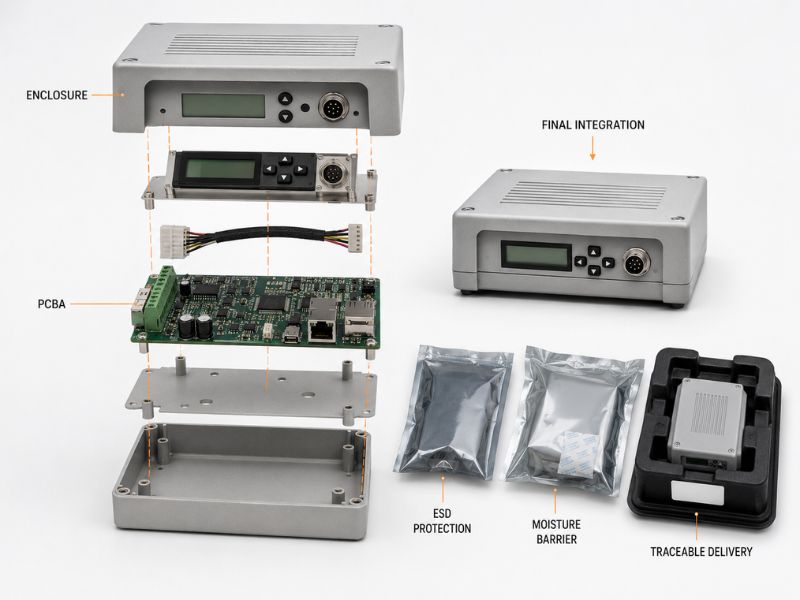
Need the enclosure too? SHBD Metal also runs in-house CNC, 3D printing, sheet metal, and injection molding, so the board and housing validate in the same workflow — one handoff fewer, one failure point fewer.
Common Mistakes When Picking a US PCB Manufacturer
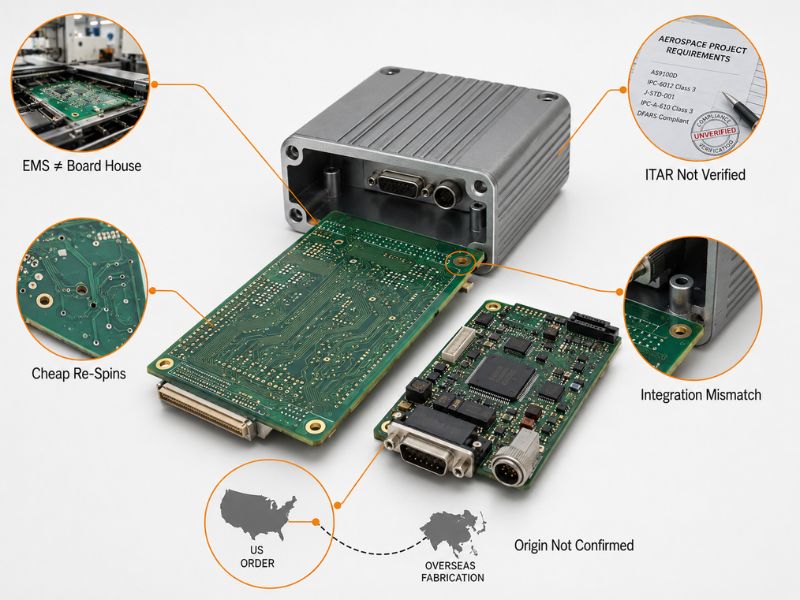
- Calling an EMS a board house. Jabil, Flex, and Plexus assemble systems; the bare board often comes from elsewhere. If you need the substrate made, screen for fabrication, not just assembly.
- Skipping the ITAR check. Aerospace and defense programs fail audit when the shop isn’t registered. Confirm before you send files.
- Chasing the lowest price only. A cheap board that needs three re-spins costs more than a pricier first-pass build.
- Splitting board and enclosure across shops. The last 10% of a product is integration; keeping it in one workflow avoids the mismatch tax.
- Assuming “US company” means “US made.” Verify where the board is actually fabricated before you commit.
Conclusion
The US PCB market spans same-day prototype shops like Sierra Circuits and aerospace-grade programs like TTM and Calumet. Pick by process fit, certification, and how much engineering contact your build needs — the comparison table above narrows it fast.
Got a build in mind? Send your project requirements to SHBD Metal’s US team for an instant fabrication or assembly quote, review DFM feedback in your own time zone, and talk to engineers who have shipped boards for a decade. If you’d rather start with a US shop, the Top 10 above is your shortlist; if you want China’s cost with US-level support, we’re one message away.
FAQ
Choose a US shop for ITAR, medical/aerospace compliance, low-volume high-mix, tight NPI, or IP-sensitive work. Choose China for cost-driven, high-volume, mature, non-sensitive designs. Choose a hybrid (US office over a China factory) when you want both.
ITAR (International Traffic in Arms Regulations) controls defense-related technical data. If your PCB sits inside a controlled military or aerospace program, the manufacturer must be ITAR-registered — confirm before sharing files.
Sierra Circuits leads on 1-day turns; AdvancedPCB / Advanced Circuits and Epec also serve fast NPI spins with in-house DFM.
Ask for the current certificate numbers and the issuing body, then cross-check the scope (layers, processes, assembly) matches your build. AS9100 and ISO13485 are the marks for aerospace and medical.
When your constraint is cost or capacity rather than ITAR, SHBD Metal’s US office plus China factory removes the old “cheap but hard to reach” trade-off. A decade of process experience means your Gerber is engineered before it hits the line, not discovered broken on it.
All Flex Solutions specializes in flex/rigid-flex for medical, aviation, and automotive; SOMACIS and Amphenol Printed Circuits also run flex in qualified programs.