

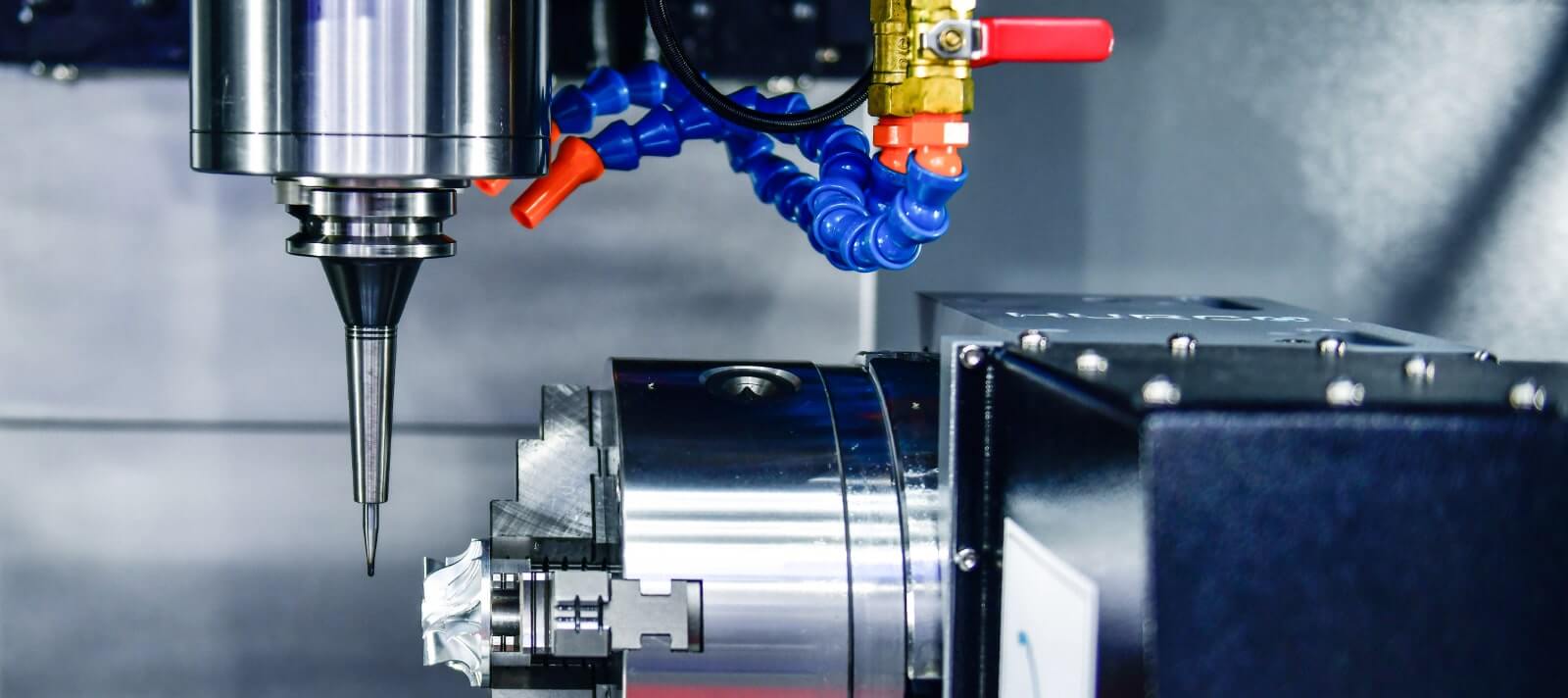
CNC milling is one of the most impressive technological advances of this century. Although most people are more familiar with 3D printing as a way to produce precise physical prints, CNC milling has been around for longer and is still widely used today.
From its wide range of applications in the electronics industry to its prevalent use by manufacturing companies, the technology is still rapidly growing and evolving as more and more companies are discovering its effectiveness in producing high-quality CNC machined parts.
Still, even though the process and uses of CNC milling are well-known to people operating in the industry, those on the outside might be much less familiar with how it can be applied or even how it works.
What is CNC Milling?
CNC milling is a type of CNC machining process that uses milling machines, equipped with rotary cutting tools and controlled by computer numerical control technology, to perform precise movements and tasks. CNC milling makes it possible to take a digital design of an object and produce it in a physical form from raw materials.
To understand the CNC Milling process, let us break it down into its two components — 'CNC' and 'Milling'. Milling is one of types of machining operations where a workpiece is rotated along rotational axes and cutting tools are used to chip away pieces of the workpiece. CNC stands for Computer Numerical Control, allowing control of the cutters and workpiece movement with computer software.
Who Invented CNC Milling?
The concept of milling dates back to the 18th century. However, the first CNC milling machines were first developed in the early 1950s. The credit for inventing the CNC milling machines goes to Richard Kegg, who created this machine with assistance from MIT in 1952 and called it the Cincinnati Milacron Hydrotel.
How Does CNC Milling Work?
In principle, CNC milling is a basic process where you take an initial workpiece and keep on removing material from it at different locations with a cutting tool. To reach these different locations, the workpiece keeps on rotating. In actuality, the whole CNC milling process goes through a number of steps.
Stages of a Typical CNC Milling Process
Creating CAD Model: First, you need to prepare a CAD model blueprint for your intended part shape using Computer Aided Design (CAD) software.
Converting CAD to CNC: The CNC milling machine will not recognize a CAD model directly. However, you can convert the CAD model to a CNC program very easily using CAM software.
Setup of CNC Milling Machines: Before starting the program, it is important to properly set up the machine and the workpiece.
Executing the Program: Once the machine is properly set up, the operator can execute the CNC machine program. The entire milling process that follows will be done automatically.
CNC Milling Methods
Due to the vast application of the CNC milling process, there are many different forms of CNC milling operations available:
- Plain Milling: Creates flat surfaces parallel to the rotational axes of the cutting tool.
- Angular Milling: Removes material at an angle that is not a right angle.
- Face Milling: The workpiece is milled at a right angle to the rotational axes of the cutter.
- Side Milling: A rotating cutter removes material from the side of a workpiece.
- End Milling: One of the most versatile operations, using an end mill to cut slots, pockets, and 3D geometries.
- Slot Milling: Creates slots, grooves, or channels in a workpiece.
- Form Milling: Applies to machining irregular surfaces such as curves.
- Gang Milling: Two or more cutting tools are mounted on a single machine arbor.
- Gear Milling: A niche form for creating gears using curved cutters.
- Thread Milling: Cuts internal or external threads with a rotating cutter.
Types of CNC Milling Machines
- Horizontal Milling: Spindle is parallel to the workpiece surface.
- Vertical Milling: Spindle is perpendicular to the stationary workpiece.
- Multi-Axis Milling: Cutting tool can move in four or more directions (e.g., 5-axis machines).
- Column and Knee Milling: Precise vertical movement for accurate milling.
- Ram Milling Machine: Cutting tool moves on the horizontal axis via a movable ram.
- Fixed Bed Manufacturing Milling Machine: Stationary workpiece on a worktable mounted on the bed.
- Planer Milling: Cutting action occurs in a single plane by linear relative motion.
Applications & Uses of CNC Milling
CNC milling works with a wide range of materials including metals, plastics, elastomers, ceramics, composites, and even glass. Industries that use CNC milling include:
- Automotive: Custom parts for vehicles and manufacturing processes.
- Aerospace: High-precision components for aircraft safety and function.
- Metal Fabrication: Backbone of any metal fabrication workshop.
- Agriculture: Large custom-made tools and components.
- Electronics: Shaping conductors, polymers, and boards.
- Medical: Prostheses, scalpels, implants, and surgical devices.
- Defense: Military components and weapon prototypes.
Advantages of CNC Milling
- High Production Rate: Automated process with no human speed limitations.
- Unmatched Precision: Accuracy second to none, eliminating human error.
- Longevity: Machines can run continuously for days without stopping.
- Fewer Personnel: Automated process reduces labor costs.
- Advanced Possibilities: Can produce complex designs beyond manual capabilities.
- Consistency: All parts match perfectly without deviations.
- Scalable: Suitable for industries of every size.
CNC Milling vs 3D Printing
Basics: CNC milling is subtractive (removes material), while 3D printing is additive (adds material layer by layer).
Versatility: CNC milling works with a wider range of materials including metals, plastics, and ceramics.
Ease of Use: 3D printing is simpler with less setup. CNC milling requires a skilled operator.
Accuracy: Most CNC milling machines have superior accuracy over 3D printing.
Cost: For large-scale requirements, milling is cheaper. For prototypes, 3D printing tends to be more cost-effective.
How Much Does a CNC Milling Machine Cost?
The price range for CNC milling machines is very wide. You can find a small horizontal milling machine for as low as $10,000, while large CNC machines with advanced features can cost upward of $300,000.
Start Your CNC Milling Project Today
SHBD Metal offers precision CNC milling services for prototypes and production parts. Contact us or request a quote today.
Comment
0 comments
Got thoughts or experiences to share? We’d love to hear from you!