
Hot chamber die casting is the quickest route from molten metal to a finished casting — as long as the alloy melts at a low enough temperature. Zinc, magnesium, lead and tin all qualify, and for those metals the process reaches cycle times that a cold chamber machine cannot match.
Because the melting pot and the die sit inside a single machine, the metal never has to be carried across the shop floor before it is injected. This guide covers how the machine is built, how one casting cycle runs, what the method costs, where it wins, and how it compares with cold chamber die casting when a part has to be routed to the right process.
The Hot Chamber Method Explained
Every die casting route shares the same basics: a die holding a cavity, molten metal forced under pressure into that cavity, solidification, and then ejection of the finished part before the cycle repeats. What sets the hot chamber variant apart is where the metal comes from — the furnace is part of the machine, not a separate unit standing beside it.
Cold chamber machines keep the furnace at a distance precisely because the heat would damage the tooling. Alloys with low melting points do not create that problem, so a hot chamber machine can keep its melt in a pot next to the die and feed the cavity directly. Nothing has to be ladled from one place to another, which removes a handling step, a temperature loss and a source of operator risk in one move.
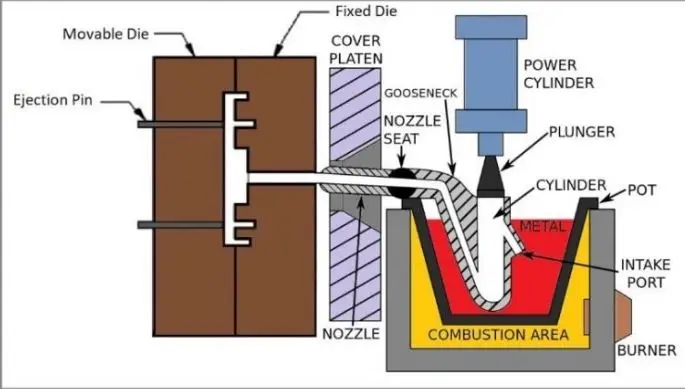
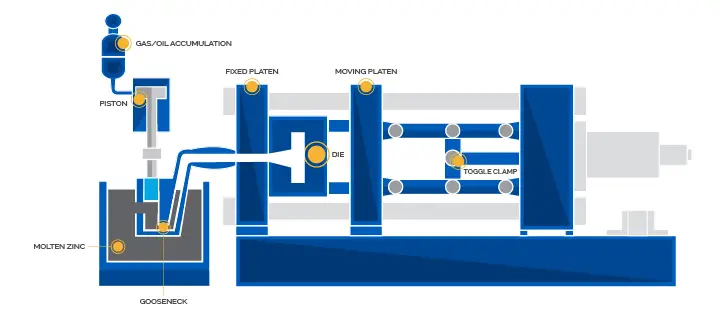
The supply path runs through a gooseneck that stays submerged in the melt, so the injection mechanism is permanently primed and ready for the next shot.
Inside a Hot Chamber Die Casting Machine
The equipment is an assembly of subsystems that all have to survive continuous contact with hot metal. The five below are the ones that define how the machine behaves.
Furnace
The melting pot is the heart of the setup. A combustion chamber burns fuel to generate the working temperature needed to liquefy the charge. On a hot chamber machine the pot sits immediately beside the die rather than in a separate bay, which is what makes direct feeding possible.
Gooseneck
This component exists only on hot chamber machines. It carries molten metal from the pot to the die and remains immersed in the melt throughout operation, so it must tolerate a permanent thermal load — cast or forged steel of good quality is the usual material. A cylindrical lining inside it houses the hot chamber and the plunger. Because service conditions are so harsh, most goosenecks are treated as replaceable items even when they are well made.
Nozzle
The nozzle controls how molten metal travels out of the gooseneck and into the die. It works as the gateway that delivers metal into the mould in a smooth, controlled direction. Any metal left in the passage once the shot finishes drains back to the furnace through the same nozzle, so nothing is stranded.
Hydraulic Plunger
The plunger drives metal into the die and keeps it under pressure while the casting sets. It travels up and down inside the hot chamber and takes its power from an oil or gas hydraulic cylinder.
Die
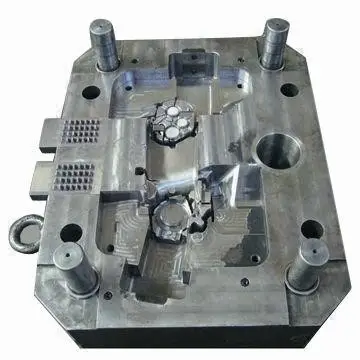
The die holds the cavity, the ejector pins that free the part, and — depending on the geometry being produced — cores and other inserts. As hardware, a hot chamber die is much like the tooling used by other casting methods; the difference lies in how metal arrives at the cavity.
The Four Steps of a Casting Cycle
With the components clear, the sequence itself is short:
- Chamber filling: the plunger lifts and opens the intake port. Molten metal from the pot flows into the hot chamber inside the gooseneck.
- Injection: the plunger travels down and drives that metal through the nozzle into the cavity until it is completely filled.
- Pressure hold: pressure stays on the metal after the cavity is full, which is what produces a dense, well-formed casting. Typical figures run from 5 to 35 MPa, set by the alloy and by geometry features such as part size and contour.
- Cooling and ejection: the casting solidifies in the cavity. The plunger then returns to its starting position and the die opens to release the part, which goes on to post-processing while the machine starts the next cycle.
Advantages and Drawbacks
Manufacturers weighing this method against alternatives need both sides of the picture, since the strengths and the restrictions come from the same design decision.
What Works in Its Favour
Speed, cost per part, casting quality and die life are the four areas where hot chamber casting performs best.
Fast cycles. At these working temperatures both melting and solidification happen quickly, and because the pot feeds the die directly, no time is lost in transit. Under good conditions a machine can complete up to 15 cycles per minute.
Lower cost per part. Higher output feeds straight into profitability. The integrated furnace also gives the machine a smaller footprint than a cold chamber cell with its separate furnace, and it removes the equipment and labour that would otherwise be spent moving molten metal.
Longer die life. The die never faces the extreme temperatures that shorten tool life in cold chamber work. Slower wear means a die that lasts longer and needs less maintenance attention.
Less material waste. Metal stays in a closed loop between pot and die, so the spillage and losses that come with transporting molten metal simply do not arise.
Where It Falls Short
Material ceiling. Only low melting point alloys — zinc, magnesium, tin and lead — can be run. A design that calls for aluminium or a copper alloy cannot be produced this way, which narrows the material portfolio available to the engineer.
Volume requirement. Die tooling is expensive, so the economics only work at volume. A low-volume programme should be costed carefully before committing, because the tooling spend may never pay back.
Die casting also competes directly with injection molding for a number of parts, and knowing both processes is part of specifying a part correctly.
Metals That Work in a Hot Chamber Machine
The process is compatible with low melting point alloys. Two of them carry almost all industrial demand.
Zinc Alloys
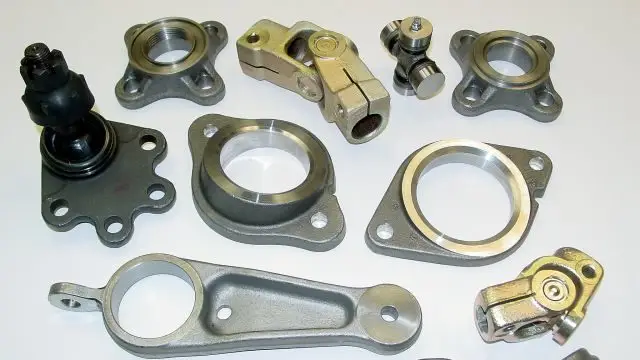
Zinc is the metal most often run on these machines. Castings come out strong and hard with good wear behaviour, and the alloys melt at roughly 420°C, comfortably inside the low-temperature window the process requires. Zinc also conducts heat and electricity well, which suits parts that carry circuitry or need to dissipate heat.
Molten zinc flows readily, and that fluidity is what lets thin walls and fine detail fill reliably — a direct benefit in dimensional consistency and in the complexity a design can carry. The metal is inexpensive and recycles well, keeping material cost predictable.
Magnesium Alloys
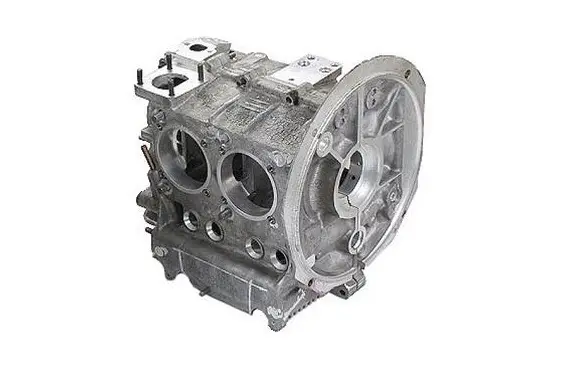
Magnesium brings low density to the same process. It is strong for its weight, recyclable, and conducts heat and electricity much as zinc does, so thin-wall capability and accuracy come with it. One property sets it apart: magnesium castings shield against radio frequency and electromagnetic interference, which matters for electronics and communications hardware.
Why Aluminium Alloys Are Excluded
Aluminium alloys need at least about 660°C before they melt, well above the ceiling for hot chamber work. Keeping a furnace coupled to the die at that temperature is not viable: tool life and dimensional accuracy both fall away quickly. Aluminium parts therefore belong on cold chamber machines, where the melt is handled separately from the die.
Where Hot Chamber Castings Are Used
The alloys above map onto a set of well-established applications.
- Automotive: the largest market for these castings. Zinc alloys go into engine and transmission hardware and into items such as rearview mirror housings, while high-performance vehicles use magnesium castings to shed weight.
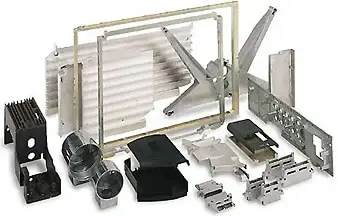
- Electronic enclosures: zinc and magnesium both conduct well, which makes them useful for smartphone components and for enclosure bodies that shelter integrated circuits.
- Decorative hardware: tin alloys take a fine finish and appear in jewellery and household decorative products.
- Aerospace: weight is the driver. Zinc and magnesium alloys reduce mass in aerospace components, and tin alloys feature in gas turbine parts and motors for aerospace vehicles.
Hot Chamber vs Cold Chamber Die Casting
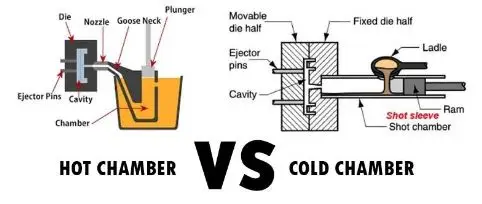
These are the two main die casting routes, and the differences show up in cost, output and part quality. The short version:
- Furnace arrangement: on a hot chamber machine the pot and the die form one unit. A cold chamber machine keeps them apart, often at different points on the factory floor.
- Cycle time: cold chamber machines run slower because melting and cooling take longer, so output per hour is lower.
- Alloy range: hot chamber work is limited to zinc, magnesium and tin. Cold chamber machines handle higher melting alloys, aluminium alloys in particular.
- Safety: hot chamber operation is generally the safer of the two — less molten metal is in motion and working temperatures are lower. Cold chamber installations demand more investment in operator and equipment protection.
- Capital and running cost: cold chamber setups cost more to buy and to run. Higher energy consumption, more temperature-related wear and shorter die life all add to the bill.
Hot Chamber Die Casting at SHBD Metal
SHBD Metal casts zinc and magnesium parts by hot chamber die casting, with the tooling side of the job covered by our mould and tool making capability. Alloy choice, wall thickness and draft are reviewed against the drawing before a die is cut, so filling and ejection are settled before production begins rather than after the first samples.
Grade and process options are listed in our materials library, and the full casting capability set is described on the die casting service page. Every batch passes dimensional inspection under our quality system, with documented results, so tolerance and traceability are confirmed before parts ship.
If the design is still open, send the drawing and we will confirm which casting route suits the alloy, the wall sections and the production volume you have in mind.
Ready to Cast Your Parts?
Get Instant QuoteFAQs
What sets hot chamber die casting apart from other casting routes?
The melting pot is built into the machine and feeds the die directly, so metal is injected straight from the furnace instead of being transferred from a separate unit.
Which metals can be cast this way?
Low melting point alloys: zinc, magnesium, tin and lead are the usual choices.
How fast does the process run?
Up to 15 cycles per minute under good conditions, which is why it is associated with high-volume production.
Why can aluminium not be used?
Aluminium alloys melt at 660°C or above. Coupling a furnace to the die at that temperature would destroy tool life and dimensional accuracy.
Is hot chamber casting cheaper than cold chamber casting?
Per part it usually is — output is higher, energy and maintenance costs are lower and dies last longer. The tooling investment still has to be paid back by volume.
Does SHBD Metal offer hot chamber die casting?
Yes. SHBD Metal casts zinc and magnesium parts on hot chamber equipment and supports the tooling, material selection and inspection that go with them.
Comment
0 comments
Got thoughts or experiences to share? We’d love to hear from you!