
Silicone may be the correct material for a component, but silicone injection molding may still be the wrong production process. If a mold is released before the design, material hardness, bonding performance, and production demand are confirmed, the result may be an expensive mold change or a failed validation. The decision therefore depends on how the part must perform, whether its geometry is moldable, and how many parts will be needed over the product’s lifetime. This guide focuses specifically on liquid silicone rubber injection molding, commonly called LSR injection molding.
Quick Answer: Is Silicone Injection Molding Right for Your Part?
Use this answer-first table to screen the project before requesting production tooling. It separates strong LSR applications from projects that need more design validation or a lower-commitment prototype process.
| Project Condition | Silicone Injection Molding Fit |
| Silicone-specific temperature or environmental performance is required | Strong fit |
| Long-term sealing or compression recovery matters | Strong fit |
| The part contains thin walls or flexible undercuts | Potentially strong fit after DFM |
| Repeatable medium- or high-volume production is required | Strong fit |
| The part requires silicone overmolding | Strong fit after bonding validation |
| The design is still changing | Weak fit |
| Only a few prototypes are needed | Usually weak fit |
Key takeaway: Silicone injection molding is most suitable when the application requires true silicone performance, the design is stable, and expected lifetime demand can justify dedicated tooling. A suitable material does not automatically make injection molding the correct process.
7 Key Criteria for Choosing Silicone Injection Molding
1. The Application Requires Silicone-Specific Performance
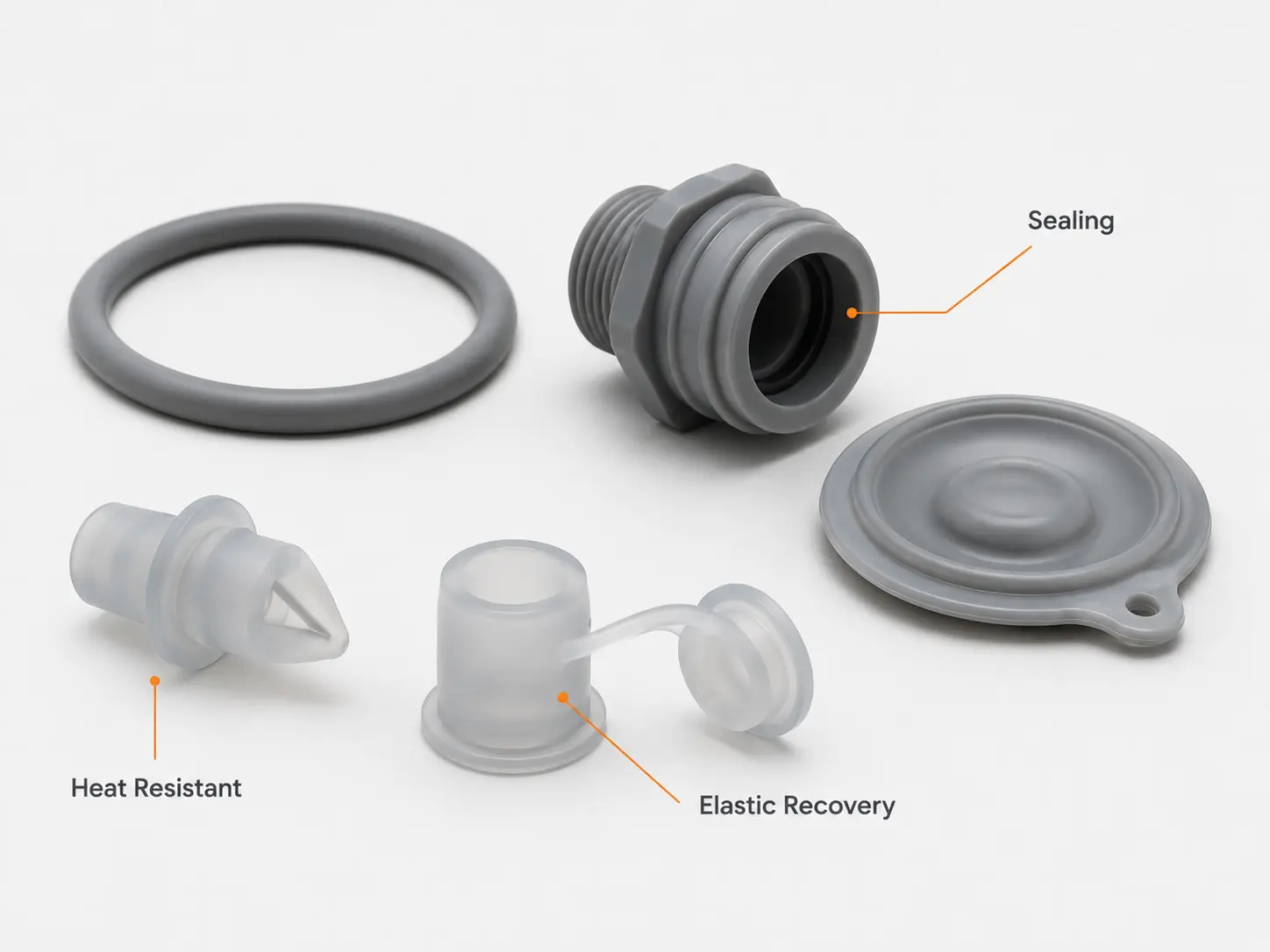
The first question is whether the application genuinely requires silicone. LSR makes sense when a component must keep working through temperature changes or prolonged exposure to sunlight and outdoor weather. It is also useful when electrical insulation or demanding service conditions rule out less durable elastomers.
These requirements are common in medical silicone injection molding, food-contact parts, electrical seals, outdoor gaskets, and skin-contact products. A soft feel by itself is not a compelling reason to choose silicone. For a less demanding application, TPE, TPU, flexible resin, or polyurethane may meet the performance requirements with simpler processing or lower cost.
After selecting silicone as the material family, verify the exact LSR grade in the conditions the part will face. It must withstand the intended temperature and chemical exposure while providing the required hardness. If the product will be sterilized or sold in a regulated market, the formulation must also support the chosen sterilization method and relevant certification.
2. Long-Term Sealing or Compression Recovery Is Critical
LSR is a strong candidate for gaskets, seals, valves, diaphragms, and membranes that repeatedly deform and recover after compression. Initial leak testing, however, tells only part of the story. A seal should continue to hold contact pressure after it has aged, experienced temperature changes, and gone through repeated loading.
Long-term sealing performance depends on several factors:
- Pressure direction: Service pressure may either strengthen the seal or push it out of position, depending on the design.
- Compression set and material hardness: These properties affect how well the silicone returns to its original shape after prolonged compression.
- Seal and groove geometry: The groove must provide sufficient squeeze without overstressing or permanently deforming the material.
- Surface finish and assembly tolerances: Variations in mating surfaces or component dimensions can create inconsistent contact pressure and leakage paths.
Even a well-chosen silicone grade cannot compensate for unstable seal geometry. Before finalizing the mold, test the complete sealing system under realistic pressure and temperature. The test should also reproduce the fluids, loading cycles, and aging conditions expected in use.
3. The Part Has Complex Flexible Geometry
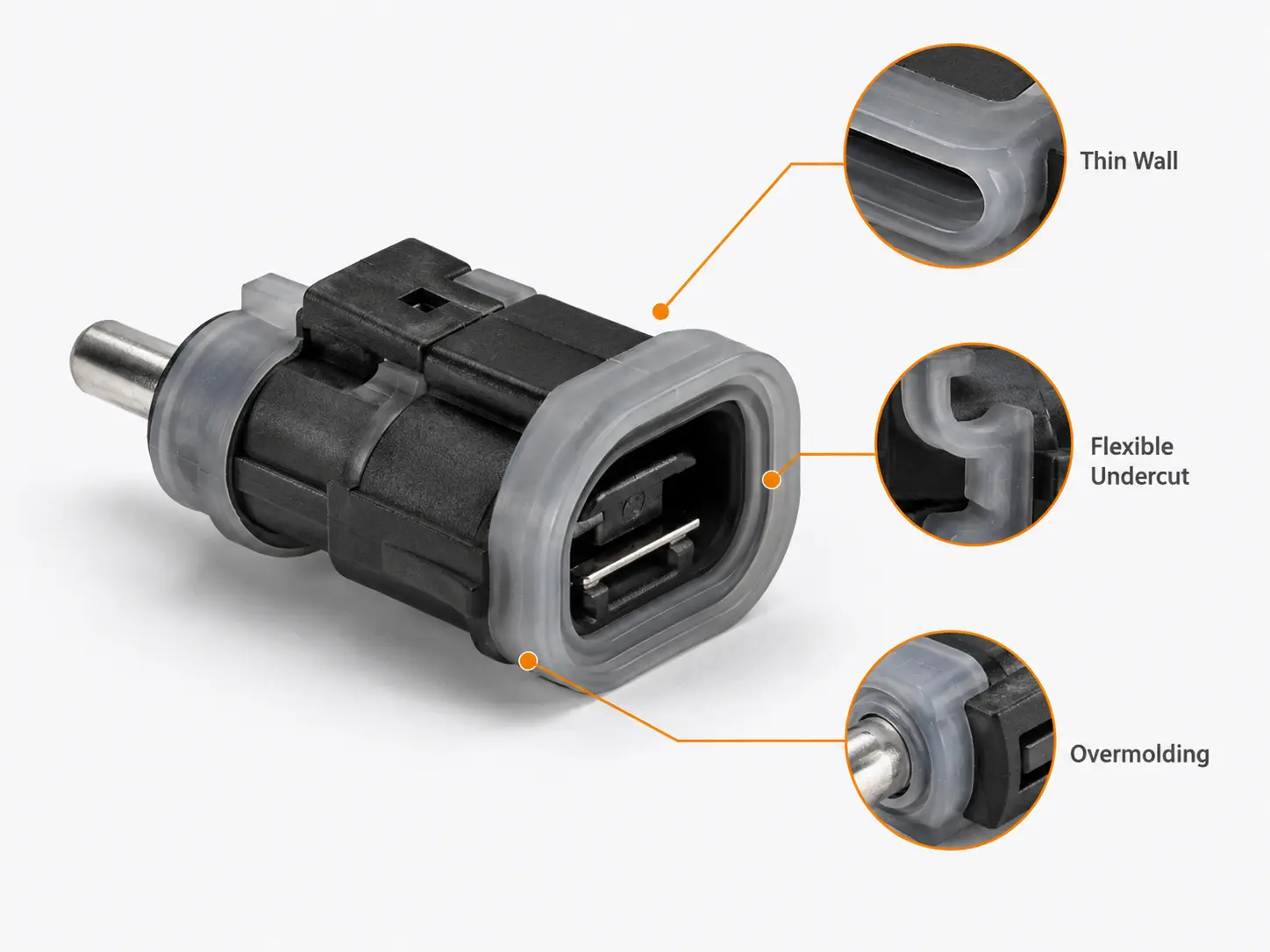
Because uncured LSR has low viscosity, it can flow into thin walls and fine features that are difficult to fill with a stiffer thermoplastic. It works well for details such as sealing lips and narrow channels. Once cured, the flexible part can bend during demolding, so some undercuts can be released without adding permanent side actions to the mold.
The same flow behavior creates tooling risks. LSR can enter small clearances, which makes poorly controlled shutoffs and parting lines prone to flash. Air may become trapped in thin or enclosed sections and cause incomplete filling. An undercut that appears releasable in CAD may still stretch or tear the finished part during removal.
A silicone-specific DFM review should follow the material through the mold: where it enters, how air escapes, and how the cured part is released. This review can reveal risky wall transitions or poorly placed parting lines before steel is cut, when corrections are still relatively inexpensive.
4. Lifetime Production Volume Can Justify Tooling
LSR injection molding requires dedicated tooling and controlled equipment for material metering, mixing, injection, and heat curing. The upfront investment is usually higher than casting or printing, but repeat-part cost can become more favorable across a sufficient production life.
Use lifetime demand rather than the first purchase order to evaluate the tooling decision. A small initial order may still justify molding when annual demand is stable and the product is expected to remain in production for several years.
Because silicone injection molding cost is project-specific, it should be evaluated across the expected production life. Total program cost includes:
- Mold design and manufacturing
- Raw material
- Molding cycle time
- Inspection and validation
- Packaging
- Secondary operations
A higher-cavity mold may increase the initial tooling cost but reduce the unit price when annual and lifetime demand are sufficient. For this reason, the decision should be based on total program cost rather than tooling price alone.
There is no universal minimum quantity for LSR injection molding. A part-specific quote should reflect both expected annual demand and lifetime quantity. It should also account for the material grade, quality requirements, and required validation activities.
5. Batch Repeatability and Quality Traceability Are Required
LSR injection molding is a strong fit when production requires controlled material mixing, stable curing conditions, and documented batch history. Two-component LSR must be accurately metered and mixed before injection, making process control important to cure consistency and final properties. This control is fundamental to the injection molding of liquid silicone rubber, especially when performance or regulatory requirements must be documented.
Define critical-to-quality requirements before production. For injection molded silicone parts, the quality plan may need to cover:
- Sealing features and allowable flash
- Hardness and visual defects
- Bonding strength or leak performance
- Required material documentation
Flexible silicone parts also need agreed measurement conditions. Fixture pressure can change the measured shape, as can gravity, temperature, and part handling.
The inspection plan should define restraint methods and measurement fixtures that will be used. It should also establish sampling frequency, first-article approval, and the required batch records. Without an agreed method, the supplier and customer may obtain different dimensional results from the same acceptable part.
6. The Part Requires Overmolding or Component Integration
LSR can be molded over plastic substrates, metal inserts, electronic components, or prepared assemblies. This approach combines a rigid support with a flexible function, which may serve as a seal, grip, membrane, protective layer, or strain-relief feature.
Successful bonding begins with substrate compatibility and surface cleanliness. It may also depend on the selected surface treatment or primer. Insert position, mold temperature, and cure conditions must then remain controlled during molding. A material datasheet alone does not confirm that the complete overmolded assembly will pass validation.
Mechanical interlocks can improve retention when chemical adhesion is uncertain. Holes and grooves can anchor the silicone to the insert, while ribs and captive features provide additional physical retention.
Insert movement and thermal exposure must also be reviewed. Sensitive electronics or plastic substrates may require controlled mold conditions, lower-temperature material systems, or additional protection during molding.
7. The Design Is Stable Enough to Enter Tooling
Dedicated tooling is appropriate only when the functional design is mature enough to resist frequent changes. The geometry should have passed functional testing, and the selected material hardness should represent the intended production behavior.
Assembly interfaces, sealing surfaces, and critical dimensions should be stable. Before mold manufacturing, the team should also review gate locations, parting lines, and vent positions, as well as any acceptable witness marks.
Production expectations must be credible enough to support the investment. A forecast based only on an unconfirmed launch target is weaker than demand supported by approved testing, purchase planning, or an established product schedule.
The design is generally ready when:
- Functional geometry has been tested.
- Material hardness has been confirmed.
- Assembly interfaces are stable.
- Critical dimensions and inspection methods are defined.
- Gate and parting-line locations have been reviewed.
- Expected production volume is credible.
DFM should take place before tool release, not after the first molded samples fail. Its purpose is to identify filling and flash risks, confirm venting and demolding, and review tolerance and tooling concerns while they can still be corrected in CAD.
When Should You Choose Another Silicone Manufacturing Process?
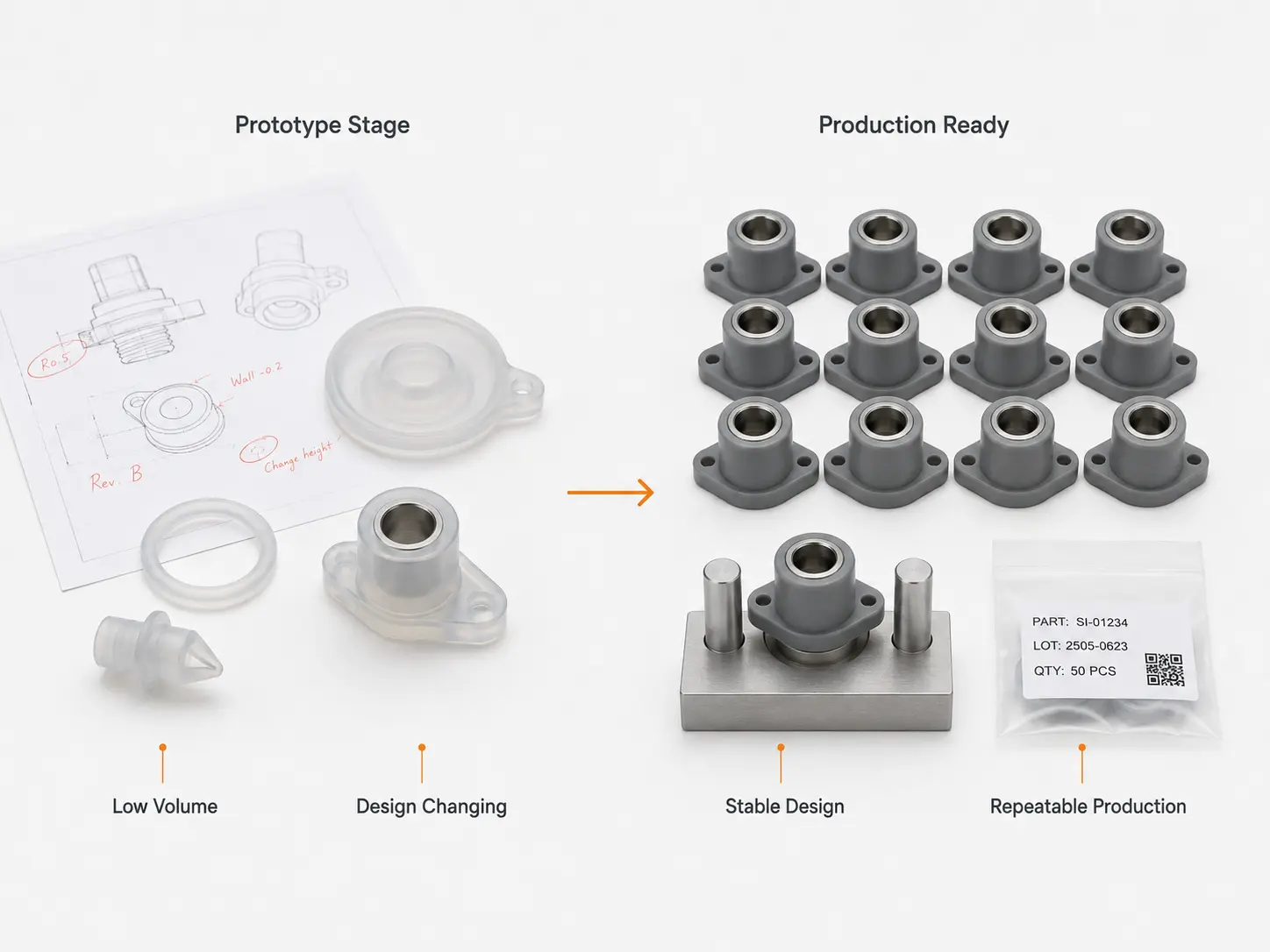
A different process may be better when the design is changing, quantities are low, or exact silicone behavior is not yet required. The alternative is not necessarily lower quality; it may simply match the current development stage more closely.
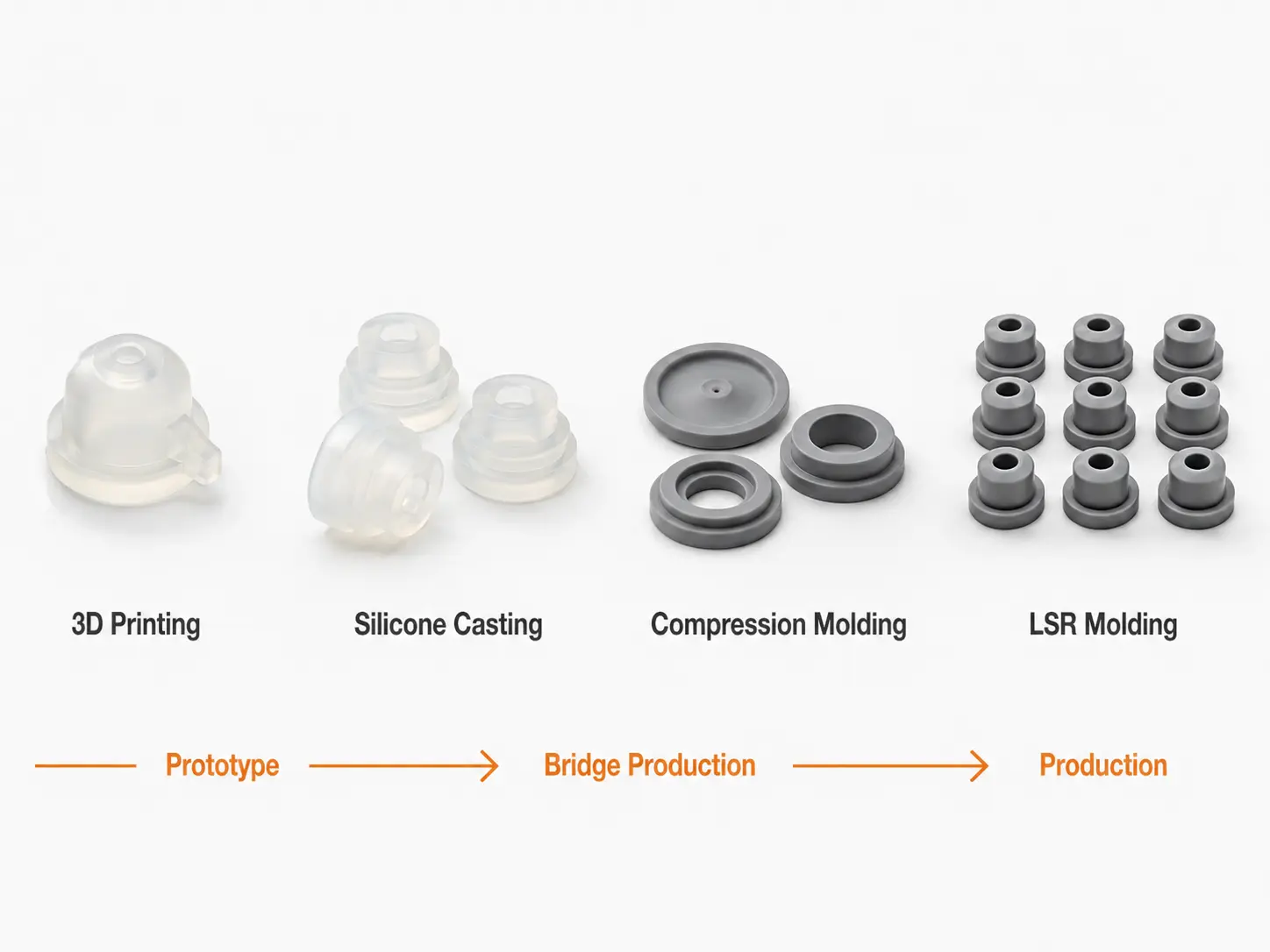
| Project Condition | Process to Consider | Main Reason |
| One-off or very low-volume functional parts | Direct silicone 3D printing | Produces true silicone parts without production tooling, subject to available grades and printer limits |
| Early form-and-fit validation | Flexible resin or TPU printing | Provides fast geometry checks when exact silicone properties are not required |
| Small quantities with changing designs | Silicone casting | Reduces tooling commitment and allows easier design revision |
| Simple parts with a lower tooling budget | Compression molding | Can suit simpler geometry and selected silicone compounds |
| Silicone-specific performance is unnecessary | TPE injection molding | Provides thermoplastic processing with elastomeric behavior |
| The design is not stable | Prototype before production tooling | Keeps design changes out of an expensive metal mold |
Do Not Confuse Material Choice With Process Choice
A final production part may require silicone but still be better suited to casting or printing during EVT and early DVT. These processes can first test fit and hardness, then evaluate sealing behavior, assembly, and user interaction before dedicated tooling is released.
Flexible resin and TPU printing are mainly useful for geometry and handling checks. Direct silicone printing or silicone casting is more appropriate when the prototype must represent actual silicone behavior.
Compression molding may suit less complex silicone components. TPE injection molding should be considered when thermoplastic processing is acceptable and silicone-specific temperature, weathering, sterilization, or compression performance is unnecessary.
How to Make the Final Process Decision
Use this five-question readiness checklist before approving LSR tooling:
- Does the application require true silicone performance?
- Has the functional geometry been validated?
- Can lifetime production demand justify dedicated tooling?
- Are sealing, bonding, and inspection requirements clearly defined?
- Has the design received silicone-specific DFM feedback?
A “yes” to all five questions indicates that the component is a strong candidate for silicone injection molding. The next review should confirm the material grade, mold concept, quality plan, validation requirements, and production forecast.
A “no” to the volume or design-maturity questions usually means the project should remain in a lower-risk prototype process. Casting, direct silicone printing, or flexible polymer printing can provide additional evidence before tooling approval.
How SHBD Metal Supports Silicone Part Development
SHBD Metal supports prototype evaluation and production planning across multiple manufacturing processes, offering instant quotations, DFM feedback, injection molding, and mold making. The capabilities also include insert molding, overmolding, 3D printing, vacuum casting, and NPI services.
This process range allows engineers to compare production molding with lower-volume alternatives before committing to a mold. Before tool steel is cut, the DFM review checks geometry, gate placement, venting, and undercut release against the criteria discussed above. When design review, tooling feedback, and inspection stay in one workflow, fewer handoffs mean fewer delays between engineering and production.
Conclusion
The seven criteria and the five-question readiness checklist share one purpose: preventing a premature tooling decision. When the application genuinely requires silicone performance, the design is stable, and lifetime volume supports dedicated tooling, LSR injection molding is the correct production route. When any condition is uncertain, a lower-commitment process—silicone casting, direct silicone printing, or flexible polymer printing—provides additional validation before mold investment.
If the readiness checklist points toward molding, submit your CAD model together through the SHBD Metal platform with the required material grade and hardness. The project information should specify quantity and critical dimensions, then explain the sealing conditions and bonding requirements. A silicone-specific DFM review can identify filling, venting, demolding, and tolerance risks while they can still be corrected in CAD, before steel is cut.
FAQs
It can produce prototype parts, but dedicated tooling is usually difficult to justify for only a few samples. Silicone casting or direct silicone printing is often more appropriate until the design is stable.
There is no fixed break-even quantity. A part-specific quote should consider tool complexity and cavity count, along with inspection and automation requirements. It then evaluates these factors against annual demand and lifetime volume.
LSR injection molding is one type of rubber molding. It uses metered liquid silicone components that are mixed, injected, and cured in a heated mold.
Yes, but bonding must be validated. Retention depends on substrate compatibility and the selected surface treatment or primer. Mechanical interlocks and insert position also matter, as do the molding conditions.
Consider TPE when silicone-specific temperature, sterilization, weathering, or compression performance is unnecessary. TPE may also suit products that benefit from thermoplastic processing and material reprocessing.

Comment
0 comments
Got thoughts or experiences to share? We’d love to hear from you!