
A laser-cut bracket drops into assembly with a clean edge and no extra steps. The same part from rough plasma cutting needs grinding before it fits. The cutting method determines whether the part ships or sits in rework.
Sheet metal cutting is the first fabrication step that sets the quality ceiling for everything downstream — bending, welding, finishing, and assembly. Getting it wrong adds secondary operations, wastes material, or produces parts that drift out of tolerance before forming even begins.
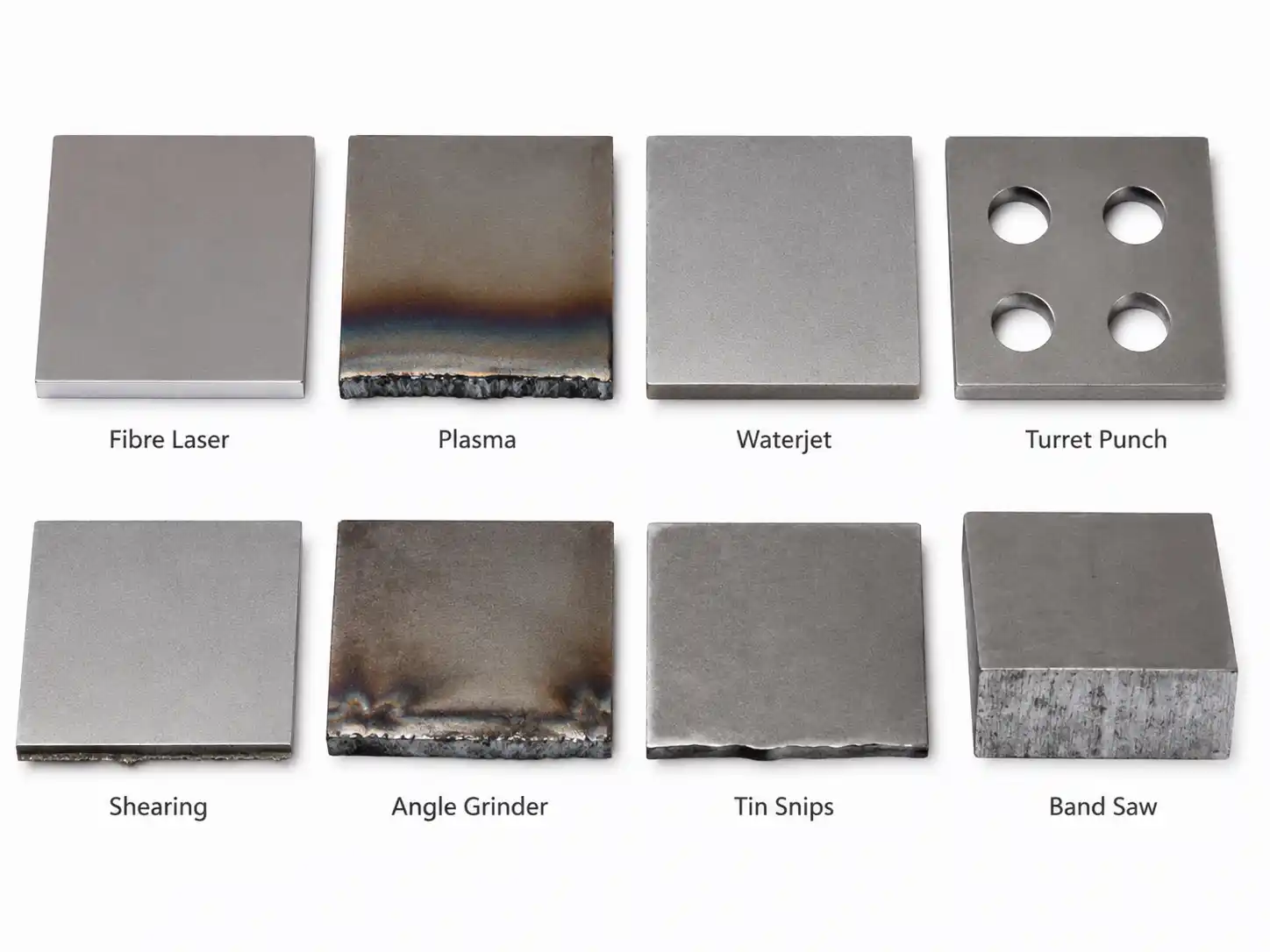
Eight methods cover the practical range from a field repair with tin snips to a 10,000-part production run on a fiber laser. This guide maps each method to its real operating envelope — thickness limits, edge quality, precision, and cost — so the selection matches the part, not the tool availability.
8 Methods for Cutting Sheet Metal at a Glance
| Method | Thickness Range | Typical Tolerance | Edge Quality | Best For | Relative Cost |
|---|---|---|---|---|---|
| Fiber Laser | 0.5–25mm steel | ±0.05mm | Excellent, low burr | Complex profiles, production | $ |
| Plasma | 3–50mm+ | ±0.5–1.0mm | Fair, HAZ + dross | Thick structural plate | $$ |
| Waterjet | 0.5–150mm+ | ±0.1–0.2mm | Excellent, no HAZ | Heat-sensitive alloys, composites | $$ |
| CNC Turret Punch | 0.5–6mm | ±0.1mm | Good | High hole-count parts, volume | $$ (tooling) |
| Shearing | Up to 6mm | ±0.2–0.5mm | Good, slight burr | Straight blanks, high volume | $ |
| Power Tools | Varies by tool | ±0.5–3mm | Rough to good | Field work, one-offs | $ |
| Hand Tools | Up to 22ga | ±1.5mm+ | Fair | DIY, thin-gauge trim | $ |
| Band Saw / Chop Saw | Bars, tubes, sections | ±1–3mm | Rough | Cutting stock to length | $ |
Fiber Laser Cutting
Fiber laser cutting uses a focused high-power beam (typically 2kW–12kW) directed along a CNC-programmed path. The beam melts and vaporizes the metal. An assist gas — nitrogen for stainless and aluminum, oxygen for mild steel — blows the molten material out of the kerf.
The nitrogen-versus-oxygen decision matters downstream. Oxygen-assist on stainless steel creates a chrome-depleted oxide layer on the cut edge. That edge cannot be welded without grinding it off first. Nitrogen produces a bright, oxide-free edge ready for TIG welding immediately. The per-cut gas cost is higher, but the weld-prep savings usually outweigh it.
Operating envelope:
- Mild steel: 0.5–25mm
- Stainless steel: 0.5–20mm
- Aluminum: 0.5–12mm
- Copper and brass: 0.5–5mm (reflectivity limits thicker cuts)
Fiber laser achieves ±0.05mm positional accuracy on thin to medium gauges. Edge quality is the best of any thermal process — clean, square, and low burr. The absence of physical cutting force means thin webs between holes and delicate features stay intact without part distortion.
No tooling is required. Cut programs run directly from DXF files. This makes fiber laser the default choice for prototypes and short runs where punch tooling investment is not justified.
Practical limits. Reflective metals like copper and brass need higher laser power and careful parameter tuning — not every shop runs these materials. Above 25mm on steel, cut quality and speed drop off sharply. For very thick plate, plasma or waterjet takes over.
Plasma Cutting
Plasma cutting passes an electrically ionized gas jet through a constricting nozzle at temperatures above 20,000°C. The arc melts the metal, and the gas velocity blows it clear. Only electrically conductive materials work — mild steel, stainless steel, aluminum.
The speed-to-precision trade-off defines this method. Plasma cuts thick plate faster than laser and at lower capital cost. The trade is a wider kerf, a visible heat-affected zone, and dross that needs secondary grinding for any fit-critical surface.
Operating envelope:
- Mild steel: 3–50mm+ (practical range for sheet metal: 3–25mm)
- Stainless steel: 3–25mm
- Aluminum: 3–25mm
Tolerance sits at ±0.5–1.0mm — an order of magnitude looser than fiber laser. For structural brackets, equipment bases, and construction components, that is often enough. For enclosure panels with tight fit-up or parts going into a press brake with small bend allowance, it usually is not.
The heat-affected zone can alter material properties near the cut edge. On thin sheet below 3mm, the HAZ becomes disproportionate to the part — plasma is not the right tool for thin-gauge work.
Waterjet Cutting
Waterjet cutting forces water at up to 90,000 PSI through a jewel orifice, mixing in garnet abrasive to erode material along a CNC path. It is the only cold-cutting process in the group. No heat means no HAZ, no microstructural changes, and no thermal distortion.
That zero-heat property makes waterjet the go-to for materials where thermal damage is unacceptable: titanium aerospace brackets, hardened tool steels, Inconel, and multi-layer material stacks.
Operating envelope:
- Any material — metals, composites, glass, ceramics, rubber
- Thickness: 0.5–150mm+, material-dependent
- Tolerance: ±0.1–0.2mm
Edge quality is excellent — no burr, no oxidation, no hardened edge layer. A waterjet-cut titanium part can go straight to anodizing or welding with no prep work.
The trade-off is speed and cost. Waterjet cuts 5–10× slower than fiber laser on equivalent steel thicknesses. Operating costs are higher — garnet abrasive is consumed continuously, and pump maintenance is significant. Waterjet makes sense when the material cost or thermal sensitivity justifies it. For run-of-the-mill mild steel brackets, laser does the same job faster and cheaper.
CNC Turret Punching
CNC turret punching uses a rotating tool library of standard punch-and-die sets. The CNC positions the sheet under the selected tool, and the punch drives through to create holes, slots, and simple profiles in a single press stroke.
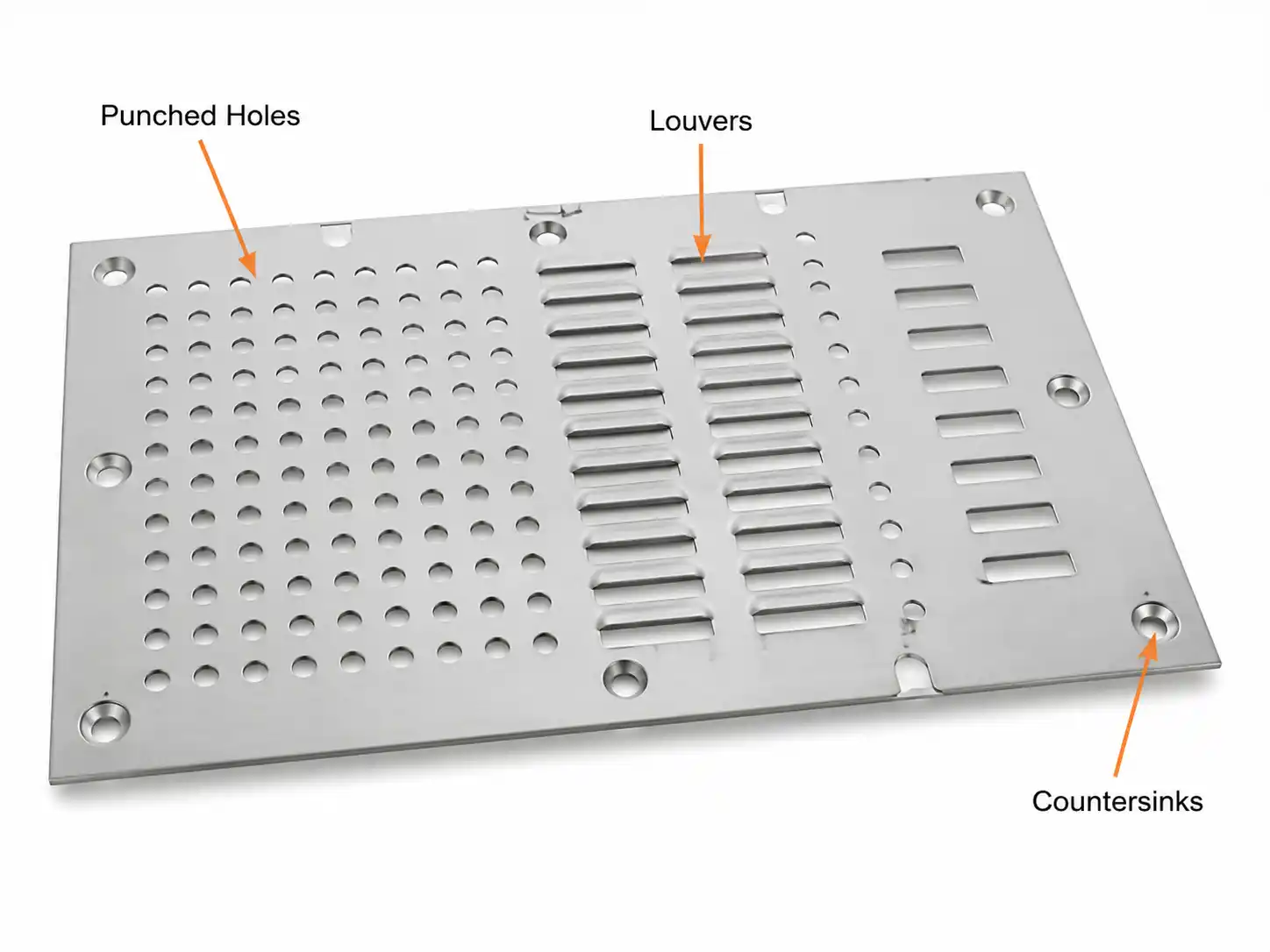
The defining advantage is that turret punching does more than cut. Standard tooling can also form louvers, countersinks, dimples, embosses, and knockouts — features that would require separate operations after laser cutting.
Operating envelope:
- Mild steel, stainless steel, aluminum: 0.5–6mm
- Tolerance: ±0.1mm hole position and diameter
- Speed: 500–1,500 hits per minute on modern machines
For high hole-count parts — electrical enclosures, chassis panels, bus bars — turret punching delivers a lower cost-per-hole than laser at production volumes. The limitation is geometry: punch shapes are limited to the tool library. Complex freeform profiles need laser or waterjet.
Tooling investment is the gating factor. A turret punch requires a tool library, and custom punch shapes carry lead time and cost. For 50 parts with 200 holes each, the tooling pays back quickly. For a 5-part prototype run, laser cutting with zero tooling is the obvious choice.
Shearing (Guillotine Cutting)
Shearing drives a hardened blade pair through sheet metal in a straight line — essentially a giant set of scissors. It is the simplest mechanical cutting method and the cheapest per cut.
There is one shape limitation: straight lines only. No curves, no internal cutouts, no profiles. Shearing cuts rectangular blanks from larger sheets, preparing stock for downstream bending, stamping, or further cutting.
Operating envelope:
- Mild steel, stainless steel, aluminum, galvanized: up to 6mm
- Tolerance: ±0.2–0.5mm
- Speed: 30–80 strokes per minute on powered machines
Edge quality is good — a clean cut with a slight burr on the bottom face. The burr does not interfere with most bending operations. No heat means no thermal distortion on coated or galvanized sheet.
The volume equation. At high volume, shearing rectangular blanks is the lowest-cost way to produce starting stock. A fabrication shop processing 500 enclosures a month will shear thousands of rectangular panels before those panels ever see a press brake. For one-off complex shapes, shearing is the wrong tool — the blank goes to laser or punch instead.
Power Tools: Angle Grinders, Nibblers, and Circular Saws
When a part is on-site and a fabrication shop is not — construction sites, maintenance bays, field repairs — power tools do the cutting. Speed and portability come at the cost of precision and edge quality.
Angle grinder with a cut-off disc is the fastest portable method. It cuts any thickness, any metal. The edge comes out rough — expect burrs, heat discoloration, and slight distortion on thin sheet. Grinding after cutting is routine. Sparks and flying debris make workspace preparation and PPE non-negotiable.
Electric nibbler punches a series of small overlapping slots, producing a clean, undistorted cut on sheet up to about 18 gauge. The nibbler follows curves well and does not generate heat or sparks. The waste comes out as small crescent-shaped chips — messy, but the cut edge needs almost no cleanup. Best choice among portable tools for thin-gauge sheet where edge quality matters.
Circular saw with a carbide metal-cutting blade handles straight cuts in thicker sheet — 10 gauge and up. A clamped straight-edge guide is essential; without it, the cut wanders. Use stick wax lubricant on anything above 22 gauge to extend blade life. The metal chips are hot and sharp — a vacuum attachment rated for metal is worth the setup time.
None of these tools hold tolerance for production parts. They are field tools, not fabrication equipment. If the part needs ±0.5mm or better, it belongs on a CNC machine in a shop.
Manual Hand Tools: Tin Snips, Aviation Snips, and Hacksaws
Hand tools cut sheet metal the old way — muscle power and leverage. They work when power is unavailable, the cut is short, or the material is thin enough that a machine setup would take longer than the cut itself.
Aviation snips (compound-leverage tin snips) use a color-coded system: red handles cut left curves, green handles cut right curves, yellow handles cut straight. The compound leverage mechanism multiplies hand force, making them usable on steel up to about 22 gauge. For aluminum and copper, the gauge ceiling is slightly higher — softer metals require less force.
The cutting technique matters more than with machine methods. Close the blades about 80% on each stroke — fully closing them pinches the metal and creates a jagged edge. Long, smooth strokes produce a cleaner cut than short, choppy ones. Even with good technique, do not expect better than ±1.5mm accuracy on a straight cut over 300mm.
Hacksaw handles small straight cuts on thicker material — up to about 3mm — where snips cannot generate enough force. The cut is slow, the edge is rough, and it is the last resort when no better tool is available.
Hand tools have one clear place: thin-gauge work in the field. HVAC ductwork, metal roofing trim, and quick bracket modifications. For anything that goes into a product drawing with a tolerance callout, hand tools are the wrong answer.
Band Saws and Chop Saws
Band saws and chop saws do not cut sheet metal profiles. They cut stock to length — bars, tubes, pipes, and structural sections that feed into later fabrication steps.
Horizontal band saw runs a continuous toothed blade through the workpiece. The blade speed, feed rate, and tooth pitch all affect cut quality. Set correctly, a band saw produces a reasonably square, straight cut on solid bar and tubing. It is slow but consistent — the standard tool in fabrication shops for cutting raw stock.
Chop saw with an abrasive disc cuts structural sections fast. Steel angle, channel, and square tube go through in seconds. The cut is rough, hot, and leaves a burr — fine for stock prep, not for finished part edges. Carbide-tipped metal-cutting blades on a dry-cut saw produce a cleaner, cooler cut than abrasive discs and are replacing them in many shops.
Neither tool cuts sheet profiles or creates part geometries. They belong in the stock-prep stage — cutting the raw material to a workable length before it moves to the machine that produces the actual part.
How to Choose the Right Cutting Method
Five factors determine which method fits. Work through them in order.
1. Material Type and Thickness
The first question eliminates methods immediately. Cutting 20-gauge stainless? Tin snips might work; plasma will create a HAZ wider than the part. Cutting 15mm mild steel plate? Fiber laser handles it cleanly; shearing does not.
| Material | Up to 1mm | 1–3mm | 3–6mm | 6–12mm | 12–25mm | 25mm+ |
|---|---|---|---|---|---|---|
| Mild Steel | Laser, Punch, Shear | Laser, Punch, Shear | Laser, Plasma, Waterjet | Laser, Plasma, Waterjet | Plasma, Waterjet | Plasma, Waterjet |
| Stainless Steel | Laser, Punch, Shear | Laser, Punch, Shear | Laser, Waterjet | Laser, Waterjet | Waterjet | Waterjet |
| Aluminum | Laser, Punch, Shear | Laser, Punch, Shear | Laser, Waterjet | Laser, Waterjet | Waterjet | Waterjet |
| Copper/Brass | Laser*, Waterjet | Laser*, Waterjet | Waterjet | Waterjet | Waterjet | Waterjet |
*Requires higher laser power and careful parameter tuning — not every shop runs reflective metals.
2. Cut Geometry
Straight-line cuts with no internal features → shearing is the cheapest option. Complex external profiles with internal cutouts → laser or waterjet. Dense hole patterns on a flat panel → turret punching may beat laser on cost at volume.
3. Precision and Edge Quality
±0.5mm tolerance with a cosmetic surface → laser. ±2mm on a hidden structural bracket → plasma. A part going straight into a press brake with a tight bend allowance → the cut edge needs to be square and burr-free; laser or waterjet avoids an intermediate grinding step.
4. Production Volume
One part → the method with zero setup cost wins. Usually laser for complex shapes, hand or power tools for simple ones. Five thousand parts → setup cost amortizes quickly. Turret punch tooling might pay back in 500 parts. Shearing thousands of identical blanks is cheaper per cut than laser.
| Volume | Best Method | Why |
|---|---|---|
| 1–10 parts | Laser, Waterjet, Hand/Power Tools | Zero tooling cost, programming only |
| 10–500 parts | Laser, Waterjet | No tooling, consistent quality, fast turnaround |
| 500–5,000 parts | Laser, Turret Punch, Shear | Tooling amortizes, punch beats laser on high hole-count parts |
| 5,000+ parts | Turret Punch, Shear + Laser combo | Tooling payback complete, lowest per-part cost |
5. Budget and Lead Time
Hand and power tools cost tens to hundreds of dollars — accessible for any shop. A fiber laser is a six-figure capital investment. Most engineering teams do not own one. They send files to a fabrication shop.
For outsourced cutting, the lead-time equation flips. Laser cutting from a DXF file can start the same day — no tooling lead time. Turret punching may need custom tools with a 1–2 week lead time. Shearing is same-day for straight cuts. Waterjet is slower per part, so the queue may be longer.
When to Cut In-House vs. Outsource to a Fabrication Shop
The capital cost line is clear: hand tools and power tools sit below it. Laser cutters, CNC turret punches, waterjet machines, and plasma tables sit above it. Most product development teams use in-house tools for quick modifications and outsource production cutting.
Three signs a job should go to a fabrication shop:
- Tolerances tighter than ±0.5mm. Hand and power tools cannot hold this. Even a well-set-up shear starts to drift above 100 parts.
- Production quantities beyond a handful of parts. Cutting 50 identical brackets with an angle grinder takes hours and produces 50 slightly different parts. A laser cuts them all identical in minutes.
- Edge quality that matters downstream. A plasma-cut edge that needs grinding before welding adds a secondary operation. A laser-cut edge that goes straight to the welding table removes one.
A fabrication shop with in-house fiber laser, press brakes, and welding can cut, form, and weld parts in a continuous flow — no shipping partial assemblies between suppliers, no finger-pointing when dimensions are off.
How Cutting Method Affects Downstream Fabrication
The cutting method sets the starting condition for bending, welding, and finishing. The gating question: does the cut part move to the next operation as-is, or does it need secondary work first?
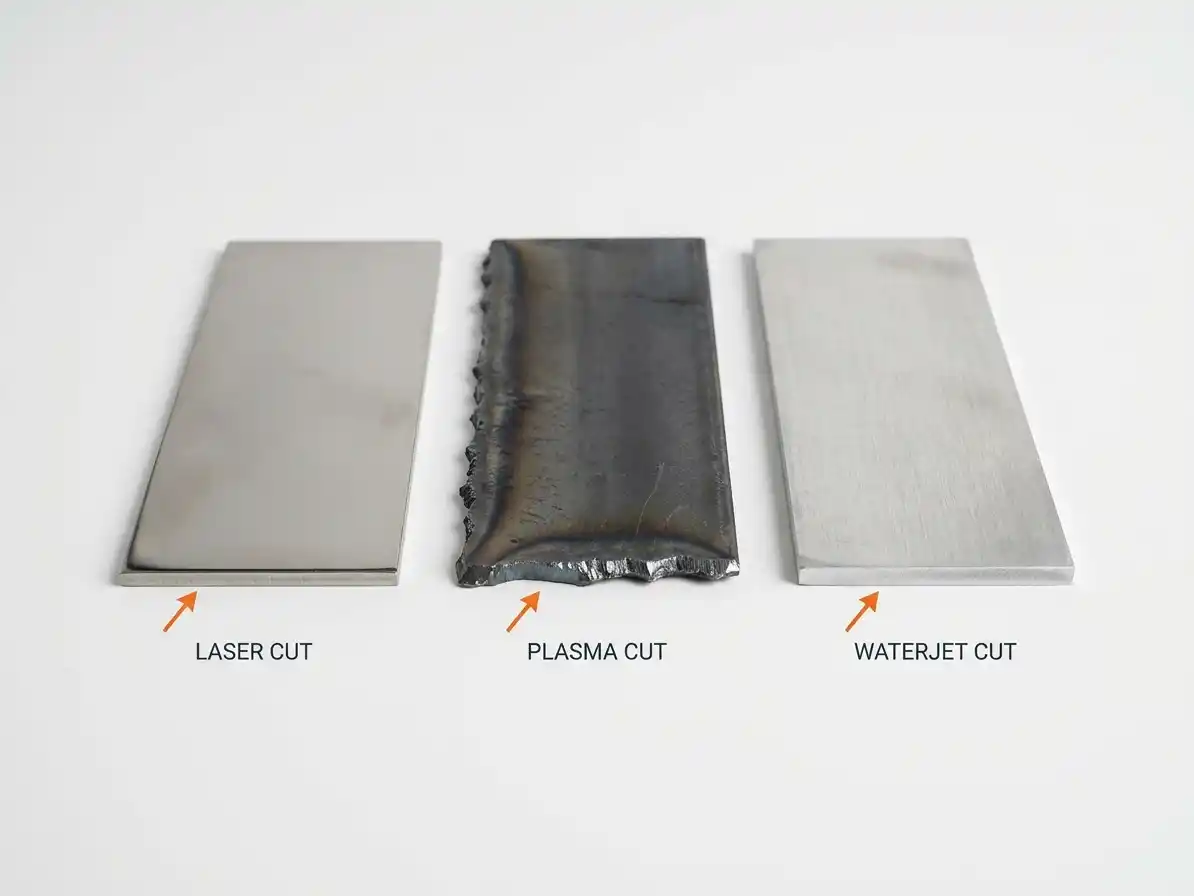
Laser-cut edge → ready for bending and welding. Square, clean, minimal burr. A laser-cut mild steel part goes from the cutting table to the press brake with no intermediate step.
Plasma-cut edge → often needs grinding. The HAZ leaves a hardened edge layer and dross. Welding over it without cleaning produces porosity and weak fusion. The grinding step adds labor and time — cost that the lower per-cut price of plasma may not cover once total processing is tallied.
Waterjet-cut edge → weld-ready on all materials. No HAZ, no hardened layer, no oxidation. Waterjet-cut titanium or stainless can go straight to welding without prep — a key advantage for aerospace and medical parts where contamination risk must be minimized.
Sheared edge → fine for most bending. The slight burr on the bottom face rarely interferes with press brake tooling. For parts with exposed edges, a quick deburring pass handles it.
Hand/power tool edges → variable. Operator skill determines edge quality. Plan for deburring and fettling time proportional to the number of cuts.
The cleanest cutting method reduces total part cost when it eliminates downstream rework. A more expensive cutting process can produce a cheaper finished part when the alternative creates secondary operations. Total the process, not just the cut.
Conclusion
The right cutting method is a function of material, thickness, geometry, volume, and what happens to the part after cutting. A method that works for a one-off bracket may waste budget on a 5,000-part production run. A method that delivers the lowest per-cut price may create downstream grinding costs that erase the savings.
For prototype and production sheet metal parts that need tight tolerances and clean edges, fiber laser cutting is the workhorse. It handles most materials and thicknesses, requires no tooling, and produces edges ready for bending and welding.
If you need sheet metal parts cut, formed, and finished, upload the CAD file for an instant quote. The system generates pricing and a free DFM review that flags bend relief, hole-to-edge clearance, and feature interference before production starts.
FAQs
Fiber laser cutting achieves ±0.05mm positional accuracy — the tightest tolerance of all sheet metal cutting methods. Waterjet follows at ±0.1–0.2mm. Both produce clean, burr-free edges suitable for parts going directly to assembly or welding.
Only on very thin gauges — 24 gauge and thinner. Stainless steel work-hardens as it cuts, making each subsequent stroke harder. Even aviation snips rated for mild steel at 22 gauge will struggle on stainless at the same thickness. For anything thicker than 24-gauge stainless, use power shears, a nibbler, or send it to a shop with laser or waterjet capability.
For straight rectangular blanks at volume, shearing delivers the lowest cost per cut — no consumables, no programming, fast cycle times. For complex profiles at production quantities above roughly 500 parts, CNC turret punching often beats laser on per-part cost when the geometry works with standard tool shapes.
It can, but the effect is minimal compared to plasma. Fiber laser’s small spot size and high speed limit heat input to a narrow zone. Thin sheets below 1mm may show slight edge distortion — nitrogen assist gas and optimized power settings reduce it further. Waterjet cutting eliminates thermal distortion entirely for the most sensitive applications.
Fiber laser with nitrogen assist gas produces the cleanest cut on aluminum up to about 12mm. The nitrogen prevents edge oxidation and produces a bright, weld-ready surface. Waterjet is the alternative for thicker aluminum or when zero thermal effect is required. Plasma cutting aluminum produces a rougher edge and is generally reserved for structural work where finish is secondary.
Count the holes. Parts with dense hole patterns, standard shapes, and quantities above 500–1,000 pieces favor turret punching — the per-hole cost drops below laser. Parts with complex freeform profiles, small batch sizes, or geometries that would require custom punch tooling favor laser. Many production shops use both: punch the holes at high speed, then laser-cut the perimeter profile in the same cell.

Comment
0 comments
Got thoughts or experiences to share? We’d love to hear from you!