

A quick turn PCB is a board built and shipped in days instead of weeks — bare board fabrication, or full turnkey assembly, on an expedited schedule. The spec sheet does not change: the board still meets IPC-6012 / IPC-A-610 and passes the same electrical and visual checks as a standard order. What changes is the clock. Standard fabrication runs 15–25 working days; quick turn compresses that to roughly 24 hours up to 5 working days.
For a prototype team, that compression is the difference between five design iterations in under a month and the same five iterations eating four months of calendar wait. This guide covers how quick turn works, what it costs, where the real risks sit, and how to scope an order that actually hits your deadline.
What Is a Quick Turn PCB?
Quick turn PCB manufacturing prioritizes your order over the normal production queue. The manufacturer assigns dedicated equipment capacity, runs process steps back-to-back wherever chemistry and tooling allow, and minimizes the scheduling gaps between fabrication stages. The output is a board delivered far faster than a standard lead-time order — but to the same technical and quality standard.
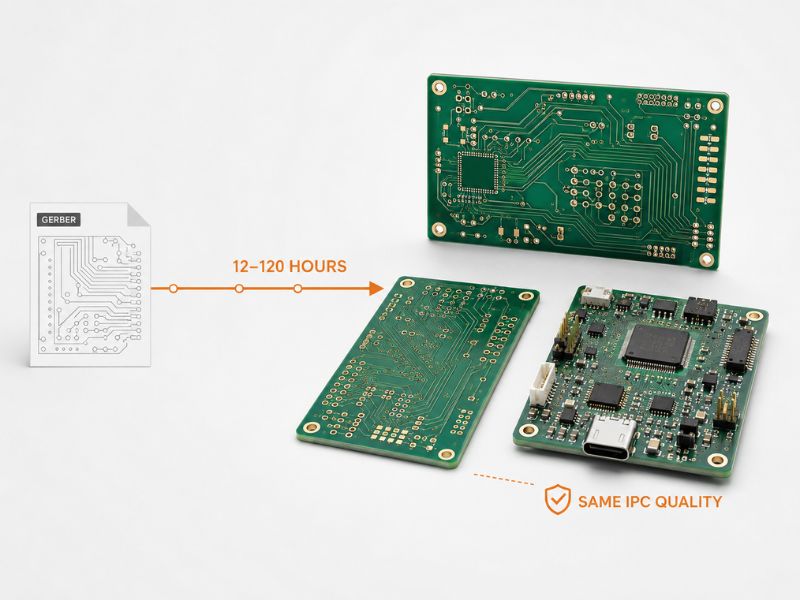
The term covers two scopes:
- Bare board fabrication — the printed circuit board itself, from Gerbers to finished panel.
- Turnkey assembly (PCBA) — component sourcing plus SMT/THT assembly on the same expedited timeline, delivering a populated, tested board.
Quick turn is not a lower-quality product category. The only variable is time.
Why Quick Turn PCB Matters for Development
Speed alone is rarely the point. The value shows up downstream:
- Faster prototype validation. Each design revision needs a new board. At 3-week lead times, five iterations cost roughly four months of wait; at 3–5 day quick turn, the same loop closes in under a month.
- Earlier market entry. A product that reaches customers two to four weeks ahead of competitors captures distribution agreements and brand awareness that are hard to recover later.
- Reduced development risk. Finding a flaw in a
300 prototype beats finding it after a300,000 production commitment and tooling buy-in. - Production gap coverage. A failed inspection batch, a late supplier shipment, or a demand spike needs emergency boards to keep the line running.
- Investor and trade-show demos. Working hardware for a pitch or booth often has a fixed date that standard lead times cannot meet.
Typical Lead Times for Quick Turn PCB Manufacturing
Lead time scales with board complexity, layer count, and whether assembly is included. The tiers below reflect typical expedited offerings:
| Service Tier | Lead Time | Typical Board Complexity | Relative Cost Premium |
| Same Day | 12–24 hours | 1–2 layers, simple design, small qty | 100–200% |
| Quick Turn | 2 days | 1–4 layers, standard specs | 60–100% |
| 3-Day Quick Turn | 3 days | 1–6 layers, controlled impedance | 30–60% |
| 5-Day Quick Turn | 5 days | Up to 8 layers, moderate complexity | 15–30% |
| Standard Time | 10–15 days | Any complexity | Baseline price |
One hard constraint: lamination press cycles cannot be skipped. A 6-layer board in 5 days is realistic; a 6-layer board in 24 hours is genuinely difficult and needs a manufacturer with spare capacity and dedicated quick-turn press lines. When you quote lead time, confirm whether the clock starts at order confirmation or at receipt of approved design files — that distinction alone can shift real delivery by a full day.
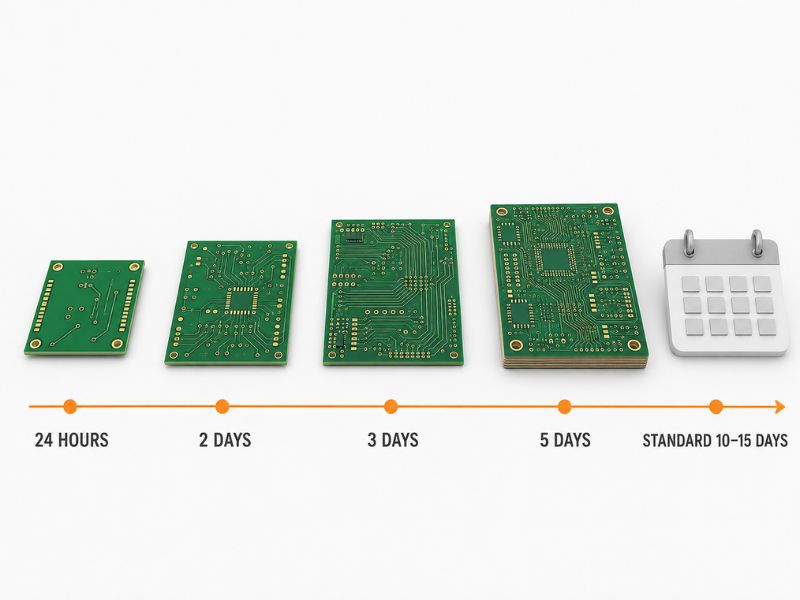
SHBD Metal prototypes fabricate in as fast as 12 hours with no minimum order quantity, and turnkey PCBA prototypes run 3–5 business days, with urgent assembly orders at 1–2 business days.
How Quick Turn PCB Manufacturing Works
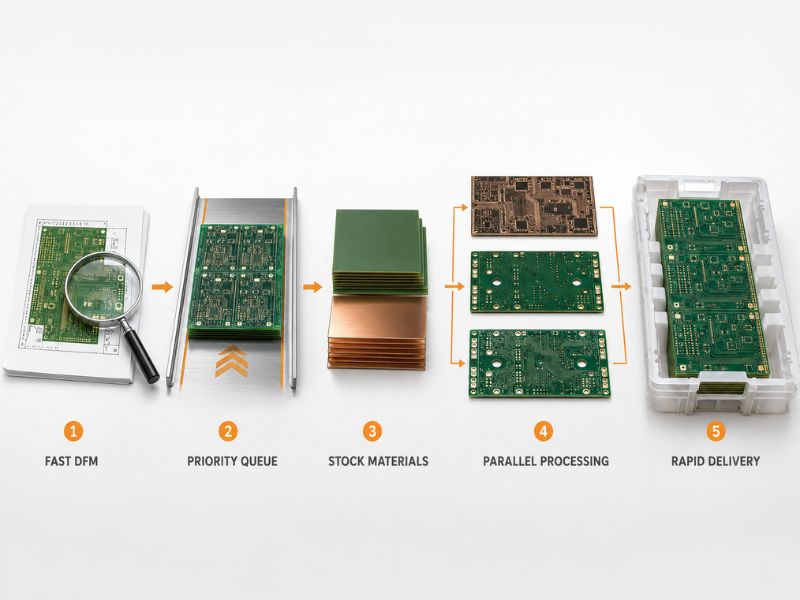
Five mechanics drive the time compression:
- Priority queue placement. Your panels schedule as soon as files pass DFM review — often a few hours after submission — instead of waiting in a multi-day backlog. That alone removes three to five days.
- Dedicated production lines. Accelerated orders get reserved line time and equipment, eliminating the changeover delays that slow shared runs.
- Parallel processing of stages. Inner-layer inspection hands off to drilling, which hands off to plating, with minimal gaps — instead of batched, sequentially scheduled steps.
- Accelerated DFM review. Specialized staff review incoming files in 1–4 hours versus the 24–48 hour window on standard service.
- Streamlined materials management. Common substrates, copper weights, mask colors, and surface-finish chemistry sit in on-hand inventory, removing procurement lead time for standard specs.
Quick Turn PCB vs Standard PCB Manufacturing
| Factor | Quick Turn PCB | Standard PCB Manufacturing |
| Lead Time | 1–5 working days | 10–15 working days |
| Unit Cost | 30–200% premium over standard | Baseline / lowest cost |
| Board Complexity | Best for 1–6 layers | Supports all complexities |
| Material Options | Standard specs for fastest turn | Full material range available |
| DFM Review Speed | 1–4 hours | 24–48 hours |
| Minimum Order Qty | As low as 1 board | Often 5–10 board minimum |
| Best Used For | Prototyping, urgent replacement | Volume production, complex boards |
| Quality Standard | IPC-6012 / IPC-A-610 (same) | IPC-6012 / IPC-A-610 (same) |
| Risk of Error Cost | Higher — less time to catch issues | Lower — more review time available |
The last row is the real insight. Quick turn is faster, but it also compresses the window to catch errors. A DFM hold that costs a day on standard service can mean missing your deadline entirely on a 24-hour order. That is why clean, verified design files matter more here than on any standard run.
Design Considerations to Keep Your Quick Turn On Schedule
Three things cause most quick-turn delays: avoidable DFM issues, non-standard materials that need special procurement, and process steps that add mandatory cycles. Design for the expedite:
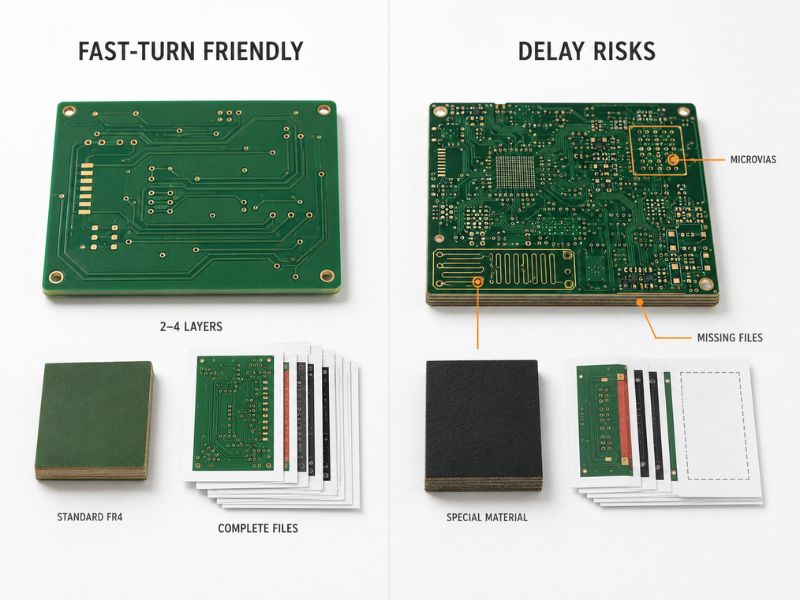
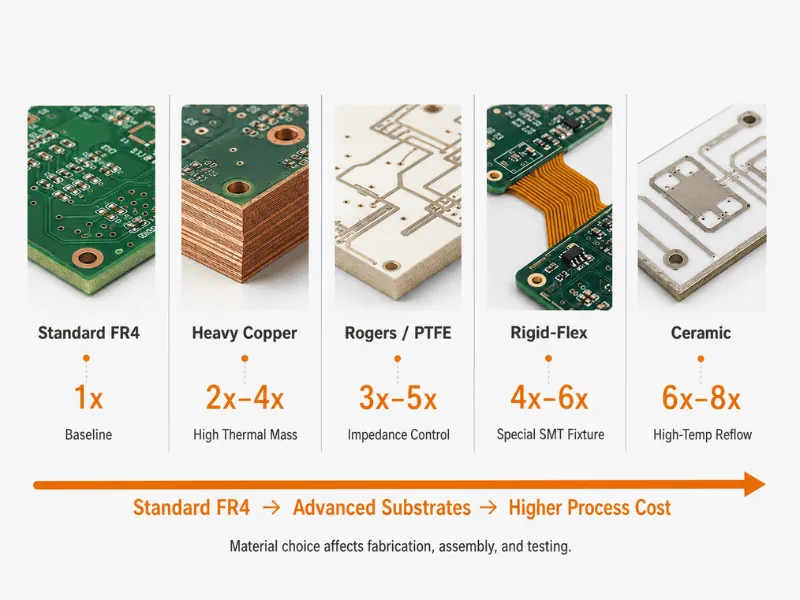
- Stay within standard material specs. Standard FR4, 1 oz copper, green solder mask, ENIG or HASL. Special substrates (Rogers, polyimide, aluminum) or unusual copper weights force a material buy that adds days regardless of tier.
- Minimize layer count. Every layer pair adds a lamination press cycle that cannot be meaningfully accelerated. A 2-layer board can realistically ship in 24 hours; accept that an 8-layer design will take longer.
- Respect minimum feature sizes. Trace widths under 3 mil, via diameters under 0.2 mm, and edge-of-capability clearances need tighter process control and more time. Keep features comfortably inside the manufacturer’s standard window.
- Submit complete, verified files. All copper layers, drill files, board outline, solder mask, silkscreen, and fabrication notes. A missing drill file or conflicting layer definition triggers a DFM hold while the manufacturer waits on you.
- Avoid controlled impedance unless required. Impedance control adds a test-coupon step and extra verification. If signals stay below ~100 MHz, drop the requirement and remove a process step.
- Order small prototype quantities. Five to ten boards validate a design. Ordering 50 quick-turn boards when 10 would do wastes premium pricing on boards you may scrap at the next revision.
Cost Factors in Quick Turn PCB Services
Base pricing follows the usual drivers — board size, layer count, materials — plus the expedite premium:
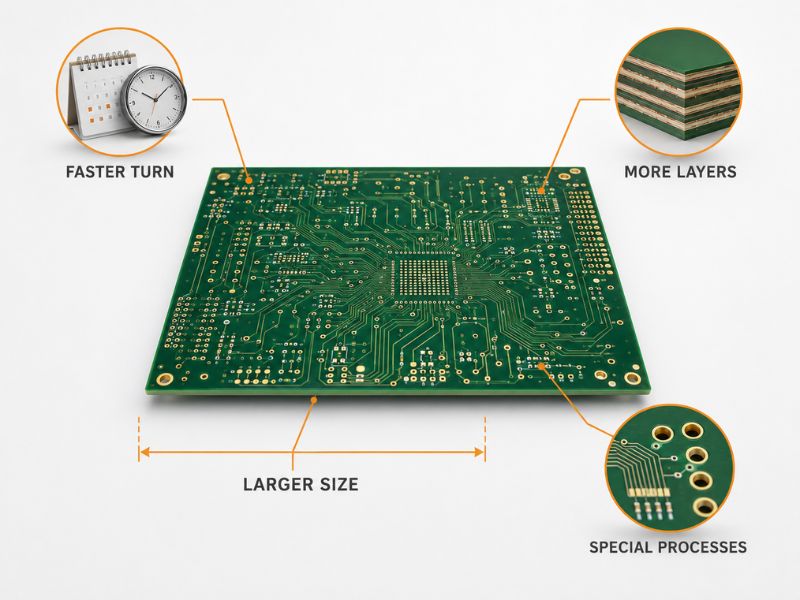
- Expedite premium. A 5-day turn typically carries 15–30% over standard; a 48-hour turn 60–100%; a 24-hour emergency run 100–200%. The premium covers dedicated capacity, priority scheduling, and the extra labor to hold a compressed schedule.
- Layer count. More copper pairs mean more press time that priority scheduling cannot eliminate.
- Board size and panelization. Larger boards consume more material and process time; poor panelization wastes panel space and raises per-unit cost.
- Surface finish. ENIG adds a small premium over HASL; OSP is the lowest-cost option and meets solderability for most prototypes.
- Special requirements. Controlled impedance, via-in-pad, countersunk holes, edge plating, and back-drilling all add steps that extend lead time and cost.
- Order quantity. Setup dominates at low volumes, so 10 boards cost little more than 5. A few extra boards are cheap insurance against assembly damage or an unexpected revision.
Match the tier to the urgency you actually have. Paying a 200% premium for a 24-hour board when a 5-day tier would have met the deadline is the most common way to overspend on quick turn.
Applications of Quick Turn PCBs
Quick turn earns its place at specific points in the product lifecycle:
- Hardware prototype development. Three to seven design iterations before production readiness; each needs a fabricated board.
- Engineering change orders (ECOs). A bug fix, component substitution, or new regulatory requirement needs revised boards without breaking the production schedule.
- Trade-show and investor demos. Fixed-date hardware that standard lead times cannot reach.
- Medical device development. Compressed clinical-validation timelines where a prototype delay pushes submission by months.
- Automotive and industrial electronics. Control modules, safety systems, and automation hardware under tight NPI windows.
- Production gap coverage. Failed batches, supplier slips, or demand spikes that would otherwise stall assembly.
How to Choose a Quick Turn PCB Manufacturer
Not every “quick turn” claim holds up under pressure. Evaluate before you commit:
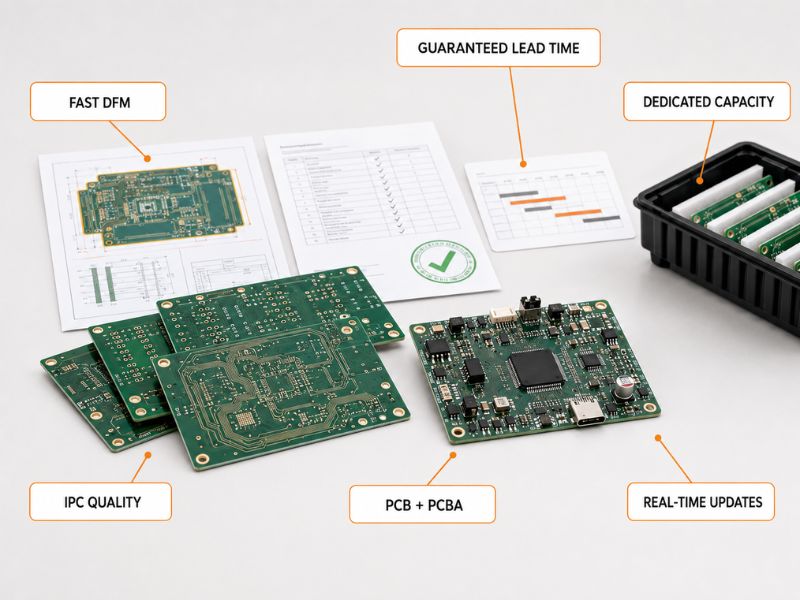
- Guaranteed vs estimated lead times. A manufacturer that guarantees a 5-day delivery and misses should refund the expedite premium at minimum. “Estimated” lead times tell you the schedule is not actually committed.
- DFM review speed and depth. Real quick turn includes a rapid, substantive DFM review — not a file-format check. If DFM takes 24 hours on a 48-hour order, half your deadline is gone before production starts.
- Dedicated capacity vs shared-line prioritization. Ask whether the manufacturer runs reserved quick-turn lines or simply bumps your order on shared equipment. Dedicated capacity is far more reliable when many clients want speed at once.
- Consistent quality at speed. Request first-pass yield and on-time delivery rates for expedited orders specifically, not company-wide averages. Some shops hold quality at standard lead times but see defect rates climb when rushed.
- Communication and real-time updates. A DFM hold, material shortage, or process issue needs to reach you immediately. Radio silence during a quick-turn run is a red flag.
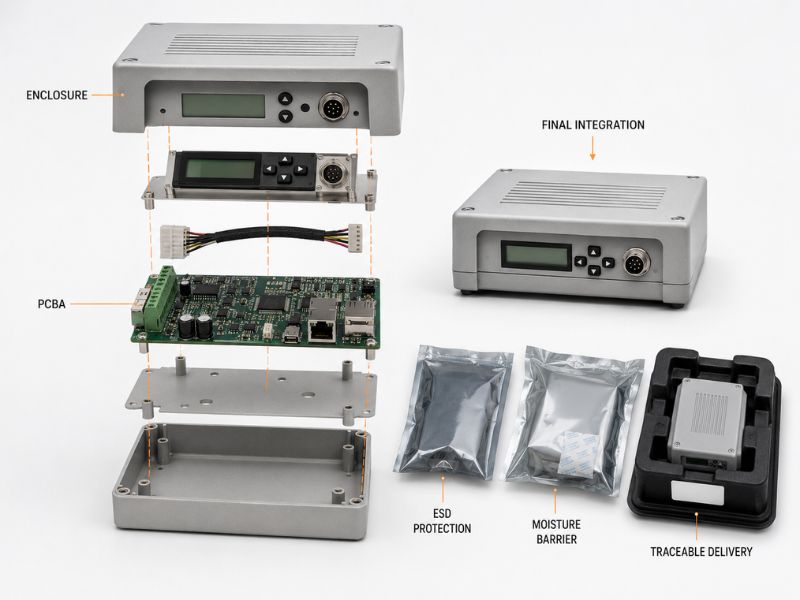
- Assembly capability. If you need populated boards, confirm the quick-turn service extends to component sourcing and PCBA — not just bare fabrication. Turnkey quick-turn assembly, where the manufacturer sources parts and populates on the same expedited timeline, delivers the most value to prototype teams.
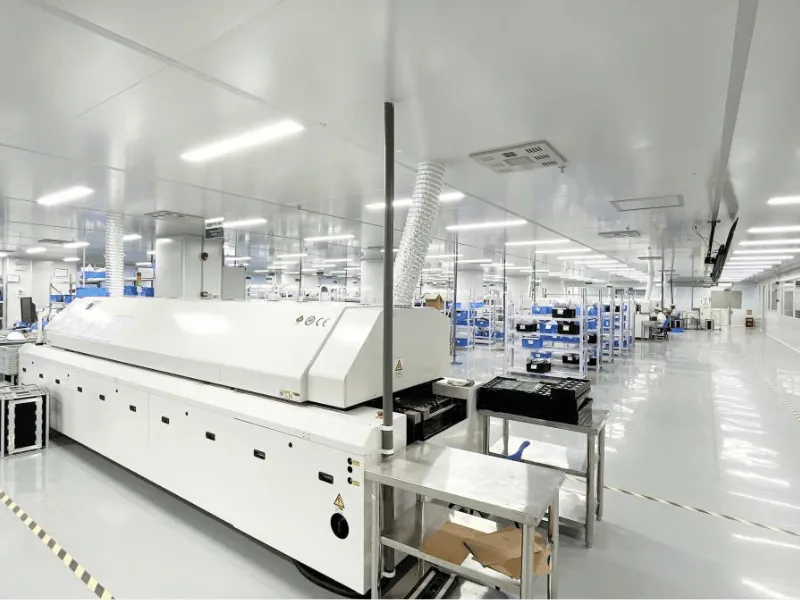
SHBD Metal runs free built-in DFM analysis on every order, fabricates prototypes in as fast as 12 hours with no MOQ, and delivers turnkey PCBA prototypes in 3–5 business days (urgent: 1–2 business days). The EMS operation holds ISO 9001, IATF 16949, and ISO 13485 certifications with IPC Class 2/3 compliance, 6 SMT lines, and instant online quotation across rigid, HDI, flexible, rigid-flex, metal-core, RF/high-frequency, and ceramic PCB types.
Conclusion
Quick turn PCB is a scheduling decision, not a quality compromise. Match the tier to the urgency you actually have, design within standard material specs, submit complete and verified files, and vet any provider on guaranteed lead times plus DFM speed — not on the fastest number in their marketing. The board that arrives correct on a 5-day tier beats the board that arrives late from a 24-hour tier that slipped.
Get an instant quote for your quick turn PCB and scope the right tier for your prototype.
FAQ
Simple 1–2 layer boards can ship in 12–24 hours. Complexity and layer count push the window out: 1–4 layers in about 2 days, up to 6 layers with controlled impedance in 3 days, and up to 8 layers in 5 days. A 6-layer board in 24 hours is feasible only with dedicated quick-turn press capacity and spare line time.
No. Quick-turn boards meet the same IPC-6012 / IPC-A-610 standards and pass the same electrical and visual checks as standard orders. The real tradeoff is a compressed error-detection window — managed by fast DFM review and clean, verified design files.
A complete Gerber package: all copper layers, drill files, board outline, solder mask, silkscreen, and fabrication notes. Include a BOM if assembly is part of the order. Missing or conflicting files trigger a DFM hold that stops the clock until you respond.
The premium scales with speed: about 15–30% over standard for a 5-day turn, 60–100% for 48 hours, and 100–200% for a 24-hour emergency run. Standard lead time is the baseline price.
Yes. Turnkey quick-turn assembly covers component sourcing plus SMT/THT population on the same expedited timeline, delivering a tested board. Prototype PCBA typically runs 3–5 business days, with urgent assembly at 1–2 business days.
Stay within standard material specs (FR4, 1 oz copper, green mask, ENIG/HASL), minimize layer count, keep features inside the manufacturer’s standard window, submit complete verified files, and skip controlled impedance unless the design genuinely requires it.
Comment
0 comments
Got thoughts or experiences to share? We’d love to hear from you!