

Locking in an accurate sheet metal fabrication lead time is the only way to keep your product development schedule intact. Relying on vague supplier estimates usually results in unexpected production delays and costly emergency freight fees when parts fall behind. After manufacturing thousands of custom sheet metal projects, we know exactly how every material choice, bend, and surface finish impacts the production clock. For hardware engineers and procurement managers mapping out strict timelines, here is the exact breakdown you need to schedule your next build without the guesswork.
Standard Sheet Metal Fabrication Lead Times
| Production Stage | Standard Timeline | Expedited Timeline |
| Prototypes & Low-Volume | 2 – 12 business days | 2 – 5 business days |
| Complex / Custom Tooling | 2 – 6 weeks | N/A |
| Metal Stamping | 3 – 6 weeks | N/A |
Prototypes and Low-Volume Runs
Standard prototypes and small batches typically require 2 to 12 business days. Basic bending and laser cutting of standard materials move quickly. If you need a structural bracket or simple chassis rapidly, some suppliers offer standard prototyping turnarounds of 3 to 5 business days.
High-Volume and Complex Assemblies
Scaling up to high-volume production or integrating complex formed geometries extends the timeline to 2 to 6 weeks. This duration accounts for custom die creation, multi-step machining, and quality validation. Metal stamping operations consistently fall into the 3 to 6 week window due to initial mold development constraints.
4 Core Drivers of Sheet Metal Fabrication Lead Time
1. Raw Material Inventory
In-stock standard materials like galvanized steel, aluminum, and common stainless steel yield the fastest turnarounds. Specifying rare alloys or custom material thicknesses forces the manufacturer to order from secondary suppliers. This procurement step adds unpredictable delays to your schedule.
2. Surface Finishing Requirements
Post-processing is the most common timeline bottleneck. Nearly all finishes add 3 to 5 business days to the project.
| Surface Finish | Added Time | Reason |
| Anodizing | 2 – 4 days | Requires multi-stage chemical baths. |
| Powder Coating | 3 – 5 days | Demands masking, application, and thermal curing. |
| Electroplating | 4 – 7 days | Intensive pre-treatment and plating cycles. |
| Passivation | 1 – 2 days | Chemical cleaning for stainless steel. |
| Brushing / Polishing | 2 – 5 days | Manual or automated abrasive processing. |
3. Design Complexity
Parts requiring multiple bends, tight tolerances, and pre-installed hardware demand longer machine setup and programming times. Complex geometries increase the probability of tuning and trial runs. Keep designs simple to maintain velocity.
4. Shop Floor Capacity
Seasonal demand and shop floor saturation dictate queue times. Small orders can suffer from frequent tool changeovers, while massive volumes hit raw machine output limits.
How to Reduce Sheet Metal Fabrication Lead Time
Optimize Files and DFM
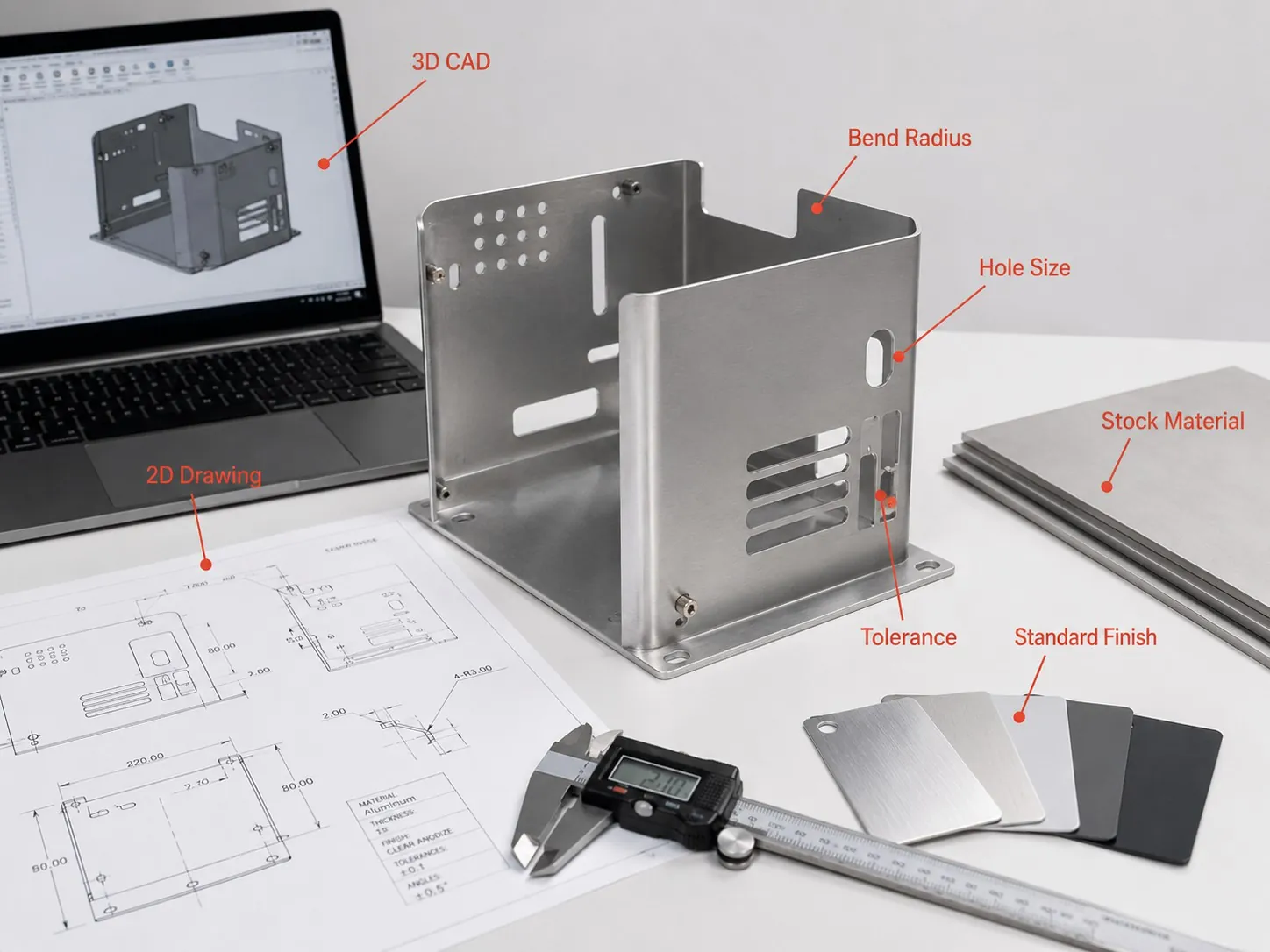
Submit fully defined 3D CAD files alongside complete 2D technical drawings. Clearly state all tolerances, materials, and target dates. Engineers who streamline their Design for Manufacturability (DFM) by standardizing bend radii and hole sizes eliminate design iterations. You can calculate this manually, OR you can upload your STEP file to SHBD Metal’s instant quote engine to get this DFM analysis automatically in minutes.
Leverage Stock Materials and Standards
Design around the manufacturer’s on-hand sheet thicknesses. Avoid custom extrusion profiles or specialized coatings if standard aluminum with clear anodizing meets the functional requirement. Grouping standard components reduces setup times.
Consolidate the Supply Chain
Relying on one shop to cut, another to bend, and a third to coat introduces severe logistical friction. Choose an end-to-end partner. SHBD Metal coordinates multi-process manufacturing within a single ecosystem, executing cutting, bending, welding, and finishing without external handoffs.
How to Choose a Fast and Reliable Sheet Metal Fabrication Partner
Digital Infrastructure and Equipment
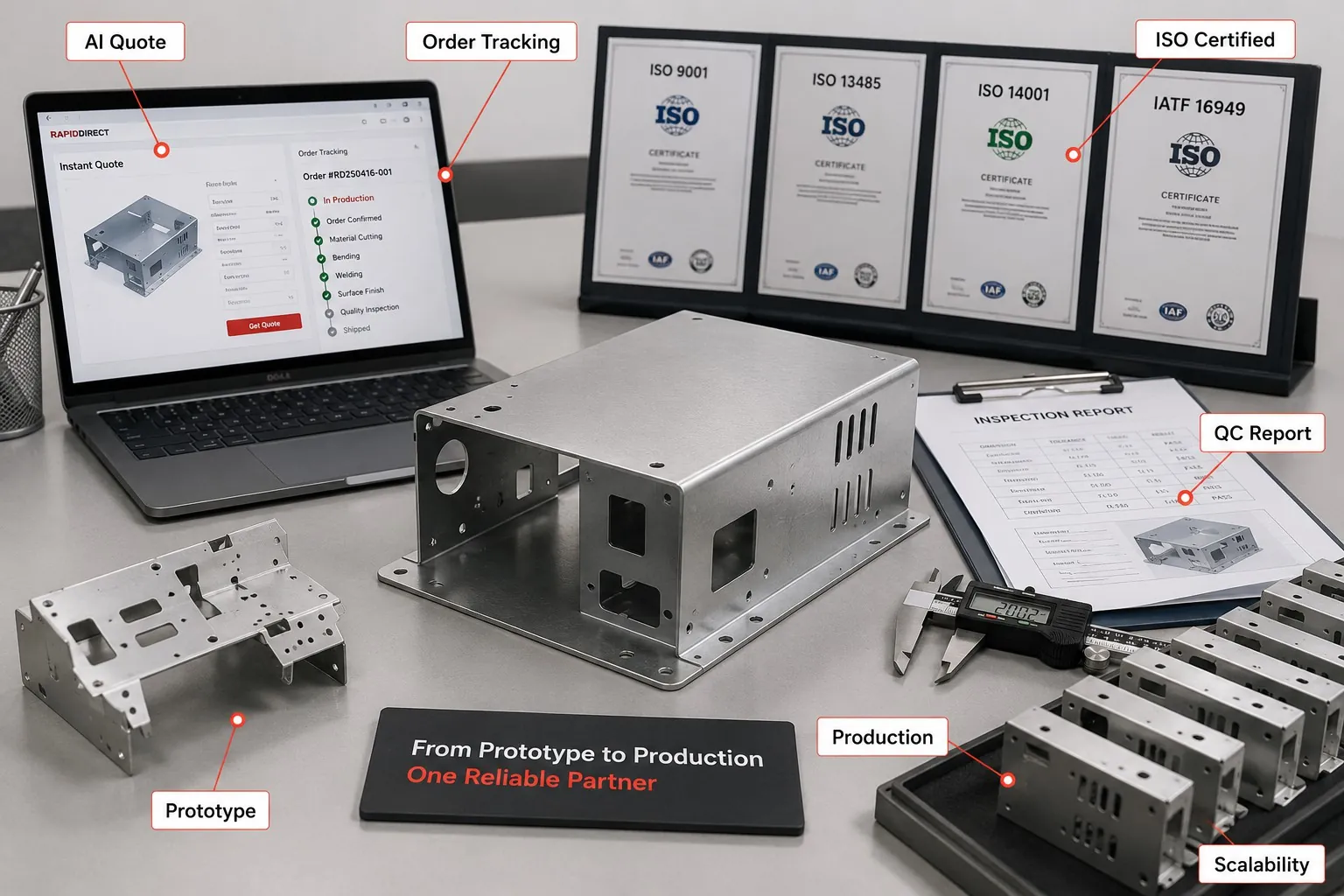
Look for partners running AI-driven quoting platforms and advanced equipment. These tools process orders and sheet metal significantly faster than legacy systems. SHBD Metal provides an intelligent online platform with real-time order tracking, ensuring total visibility into your schedule.
Quality Systems and Scalability
Speed means nothing if the parts fail inspection. Verify your supplier holds robust certifications like ISO 9001, ISO 13485, ISO 14001, and IATF 16949. Additionally, a supplier capable of handling both rapid prototyping and final mass production eliminates the need to validate a second factory later.
Logistics and Delivery Planning for Sheet Metal Fabrication
Production speed must align with your shipping strategy. Local ground shipping takes 1 to 3 business days. International air freight via providers like DHL or FedEx typically takes 3 to 5 days. Ocean freight will add 20 to 45 business days to your total sheet metal fabrication lead time. Plan your transit method before releasing the purchase order.
Securing an Accurate Sheet Metal Fabrication Production Schedule
Accurate scheduling requires understanding material availability, finishing constraints, and logistics. By optimizing your CAD models for standard processes and choosing an integrated manufacturing partner, you eliminate unnecessary delays. Ready to secure your timeline? Upload your CAD files to the SHBD Metal platform today for an instant quote, free DFM analysis, and guaranteed delivery dates.
Frequently Asked Questions
Yes, powder coating adds typical thicknesses of 0.06mm to 0.1mm. Failing to account for this in your CAD model causes assembly interference, forcing time-consuming rework and delaying delivery.
Not necessarily. Lean manufacturers can slot small urgent jobs into production gaps, managing costs effectively. That said, dedicated rush runs inherently carry a premium for prioritizing your project over others.
Usually, no. Prototype fixtures and soft tools cannot withstand high-volume runs. Mass production requires hardened steel tooling, which demands a separate validation and fabrication cycle.
Production time strictly measures shop floor activity. Total delivery time includes material procurement, transit, and customs clearance. Always confirm if the supplier’s quote reflects the ship date or the arrival date.
Traditional shops take 1 to 2 days to process a Request for Quote (RFQ). Digitized platforms return accurate pricing and DFM feedback in about 3 minutes.

Comment
0 comments
Got thoughts or experiences to share? We’d love to hear from you!