
What Decides the Metal Before Stiffness Does
The first question in a medical enclosure programme is not how stiff the metal is. It is what the housing will be wiped, sprayed or soaked with, and how much the finished cart is allowed to weigh — those two answers eliminate alloys far faster than any structural calculation. A ward cart wiped with alcohol and pushed between rooms can be anodised 5052-H32. A surgical console washed with sodium hypochlorite and sterilised with saturated steam cannot: that enclosure is 316L work. Stiffness and price are the second round of the discussion, and they are the round where a hybrid usually wins.
Both alloys are cut, formed and finished on the same equipment, so this is a selection problem rather than a capability problem. What follows is the order we work in: chemistry, then surface treatment, then tolerances and springback, then bend geometry, then heat and weight, and finally the batch economics that decide between anodised aluminium and passivated stainless at a given quantity.
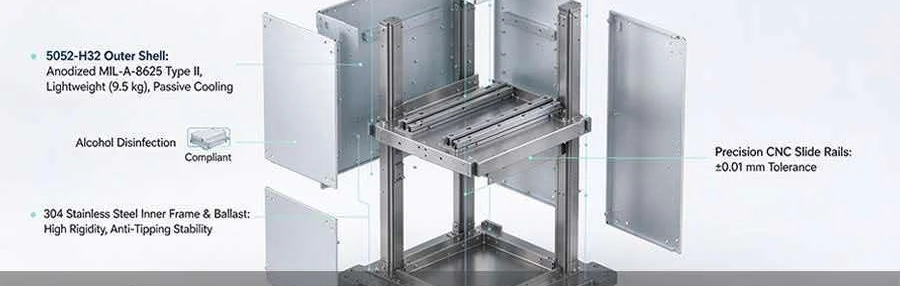
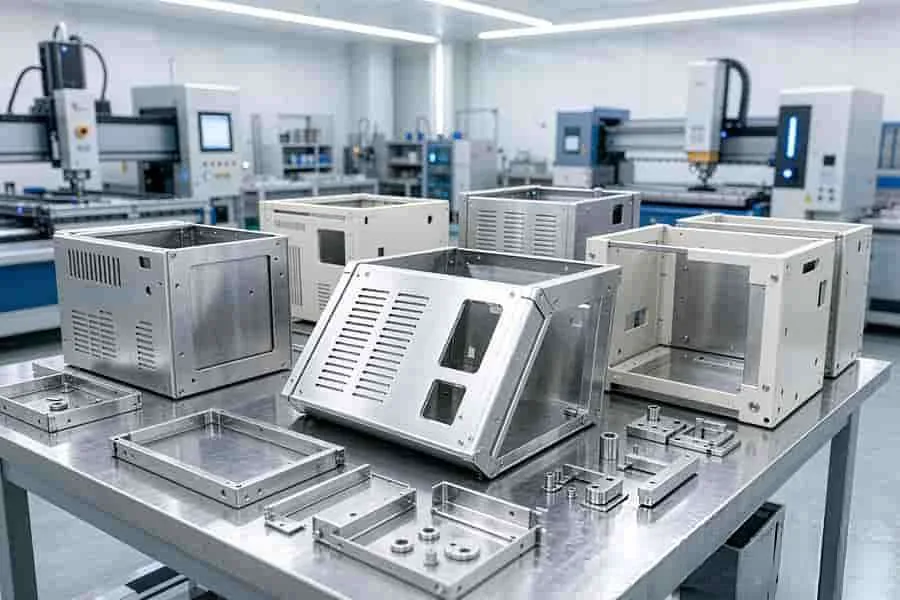
A hybrid chassis in exploded view: anodised 5052-H32 for the outer shell and doors, passivated stainless for the inner frame, ballast and rail seats. Mixing the alloys is often the answer rather than picking a winner.
Start With the Disinfection Chemistry
Halide attack is not gradual. Once chloride ions break through the passive layer the pit keeps growing under the surface film, which is why the answer is to select on the cleaning agent rather than on the appearance of the panel. Molybdenum is the alloying element that interrupts that process, and it is the whole difference between the two stainless grades: 304 sits at a pitting resistance equivalent number of roughly 18–20, 316L at 23–25.
Three screening tests settle most projects before tooling is released. They are cheap, and each one removes a material rather than adding one:
| Exposure | 304 stainless | 316L stainless | Anodised 5052-H32 |
|---|---|---|---|
| Available chlorine above ~500 ppm | Pitting starts; not suitable | Resists | Pits, even sealed |
| Saturated steam at 121 °C | Grade dependent; check with the sterilisation cycle | Passes the usual stress-corrosion screening | Wipe-down only, no steam cycle |
| 75% alcohol or quaternary ammonium only | Fine | Fine | Fine with sealed anodising |
That is why an anodised aluminium cart and a passivated stainless console can both be correct answers to the same functional requirement. They are answers to different cleaning protocols.
Passivation, Anodizing and the Oxide Film
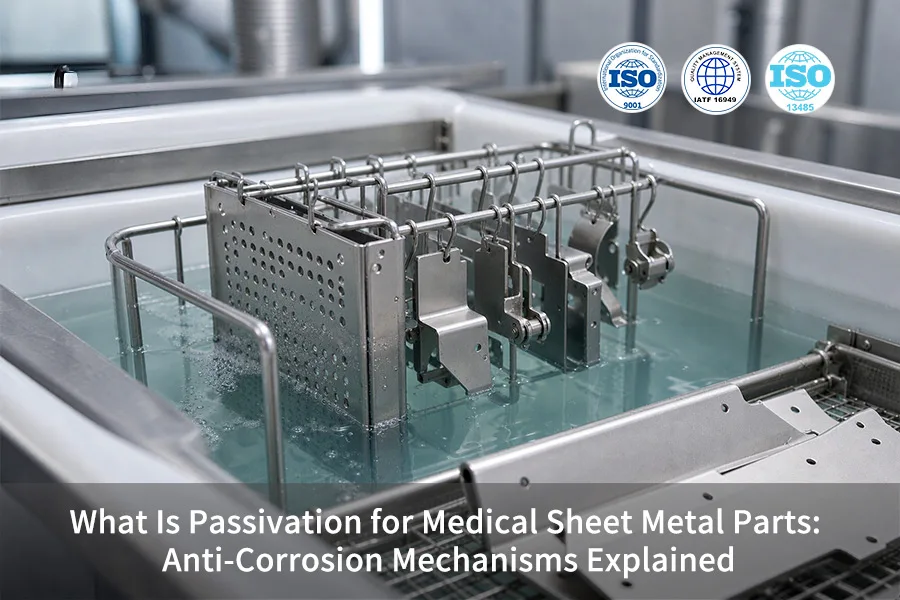
Stainless steel is not passive because it is clean; it is passive because chromium oxide forms on it spontaneously. What gets in the way after laser cutting, forming and handling is free iron smeared onto the surface, which stops the film from forming uniformly and shows up as rust bloom on an otherwise correct part. Citric acid passivation to ASTM A967 strips that free iron and lets the chromium film re-form at roughly 1–3 nm. The film is self-repairing: a scratch exposed to air rebuilds it.
Anodising aluminium to MIL-A-8625 Type II or III grows a much thicker oxide, and its sealing step is what closes the pores. It resists alcohol and quaternary ammonium well, it does not resist strong acids or alkalis, and it does not self-repair. A scratch through the anodised layer stays a scratch. That asymmetry is the reason surface treatment is the second question in the list rather than a detail deferred to the finishing supplier.
Surface roughness sets the rest of the cleanroom argument: electropolished 316L reaches Ra 0.4 µm and anodised 5052-H32 sits around Ra 0.8 µm, roughly twice as rough, which shortens the window in which the surface can be considered clean. Where the specification names a roughness rather than an alloy, the roughness is usually the one that keeps the part in service.
Corrosion screening is done on coupons, not on assemblies: stainless coupons are run in salt spray to ASTM B117-19 and routinely go past 1,000 hours. It is a continuity check on the film, useful evidence to file, and not a promise about how a finished enclosure will behave in a specific chemical exposure.
We name the standard on the purchase order — passivation to ASTM A967, anodising to the MIL-A-8625 class the drawing calls for — and the finishing certificate comes back with the shipment. See stainless steel passivation for the chemistry, and the surface roughness chart for how Ra values translate between processes.
Tolerances, Springback and Closed-Loop Bending
Both alloys hold the same tolerance bands when the press brake is under control: ±0.05 mm standard, ±0.01 mm precision, ±0.005 mm on features that are laser cut to size. What differs is how much of the stroke has to be spent getting there. Elastic modulus is 193 GPa for 304/316L and 70.3 GPa for 5052-H32, so the aluminium springs back less in absolute terms — 1.5°–2.5° against 3.0°–5.0° — but the stainless keeps its geometry better once formed, which matters for slots and rail seats that are loaded repeatedly.
Closed-loop servo bending is what makes the two predictable. An angle sensor reads the actual bend and the control adjusts the bottom dead centre position within the stroke, so the programmed over-bend for each alloy is corrected rather than guessed. The practical result on a cart chassis: rail slots that assemble without hand reaming, and window apertures that hold their fit after the frame is welded.
Dimensioning carries the rest. Position and profile callouts follow ASME Y14.5-2018; anything left unlabelled falls back to ISO 2768-1. On a hybrid chassis, tolerances should be assigned per material rather than copied across the drawing — the aluminium shell and the stainless sub-frame do not expand at the same rate, and the fasteners that join them should not be the only feature absorbing that difference. More on that in precision sheet metal forming and metal bending.
| Dimension | 304 / 316L stainless | 5052-H32 aluminium | How it decides the choice |
|---|---|---|---|
| Dimensional capability | ±0.05 / ±0.01 / ±0.005 mm | ±0.05 / ±0.01 / ±0.005 mm | Same bands; stainless needs more over-bend, aluminium more attention to grain direction |
| Corrosion and surface | ASTM A967 passivation, self-repairing film, Ra 0.4 µm electropolished | MIL-A-8625 anodising, sealed film, Ra 0.8 µm | 316L for chloride and body-fluid exposure; anodised 5052 for ward and laboratory wiping |
| Heat and mass | Density 7.93–8.00 g/cm³, 16.2 W/(m·K) | Density 2.68 g/cm³, 138 W/(m·K) | Aluminium for sealed fanless enclosures and mobile carts; stainless where mass is ballast |
| Forming and finishing effort | Higher forming load, high-purity nitrogen assist gas on production laser cutting, chemical passivation bath | Lower forming load and less tool wear, no high-purity assist gas, anodising line with racking and sealing | Drives the cost crossover in the next section, not the technical verdict |
Bend Geometry and the Defects Each Alloy Brings
The two alloys fail differently, and the fix follows the failure. 304 stainless work-hardens quickly, so its characteristic defect is cracking or ovality at holes that sit on a bend line, and it needs relief slots where two bends intersect. 5052-H32 is soft and ductile but anisotropic: bent across the grain it forms cleanly, bent along the rolling direction it tears, and sharp bends with a tight inside radius produce warping and an orange-peel surface.
Three rules remove most of it before the first tool is set:
- Hole edge to bend tangency: keep d ≥ 2t + R. This alone removes the ovality that shows up in stainless panels with holes placed close to a formed edge.
- Relief slots at bend intersections: laser-cut water-drop relief where two bends meet, so the material is not asked to deform in two directions at once.
- Form before machining: holes that sit next to a flange are formed first and finished afterwards, which is also the point at which a light CNC pass on the hole pattern often costs less than chasing the hole positions in the press brake.
Minimum inside radius follows the material: 1.0t–1.5t for 304/316L and 1.0t–1.2t for 5052-H32 across the grain, with bend lines laid at roughly 45° or 90° to the rolling direction. Where the cut edge itself is a datum, laser cutting holds about ±0.005 mm on both alloys; the geometry of the part, not the alloy, is what varies most between shops. See how to cut sheet metal for the cutting routes and laser cutting for what the fibre process holds on each material.
Heat Path and Weight Budget
Once the enclosure is sealed to IP65, convection through vents is off the table and every watt leaves through the walls. That makes thermal conductivity a design parameter rather than a footnote: 16.2 W/(m·K) for 304 stainless against 138 W/(m·K) for 5052-H32, roughly eight and a half times more. An aluminium shell spreads a hot spot across the panel and reaches a fairly uniform temperature; a stainless shell with the same internal load holds a local hot spot and needs either a fan, a heat pipe or a larger surface area to move the same heat.
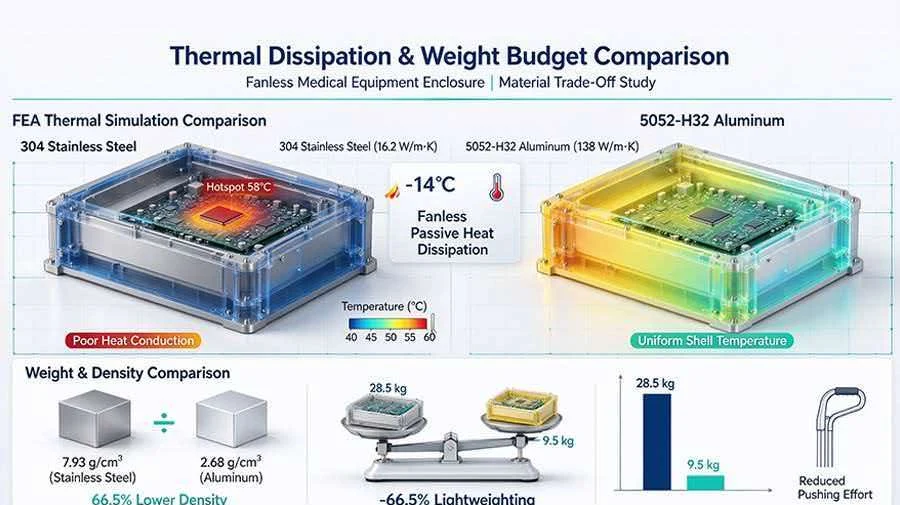
The same internal load in a stainless shell and an aluminium one: 16.2 against 138 W/(m·K) spreads the hot spot across the panel, and 2.68 against 7.93–8.00 g/cm³ takes two-thirds of the mass out.
The same eight-and-a-half-times difference does not apply to strength, and that is where the trade turns. Density falls from 7.93–8.00 g/cm³ to 2.68 g/cm³, so the aluminium route is about two-thirds lighter, which is exactly what a pushed cart needs and exactly what a floor-standing console must not have. A console that has to resist tipping wants mass low in the frame; there, stainless is doing structural work rather than being a heavy compromise.
That is the case for the hybrid: passivated 304/316L for the inner frame, ballast and rail seats, anodised 5052-H32 for the outer shell and doors. The service-temperature figures (approximately 798 °C for 304 against 816 °C for 5052-H32) are not a differentiator at ward temperatures, and neither alloy is the limiting factor in a sealed electronics enclosure — the electronics are.
Where the Cost Crossover Sits
The crossover between an anodised aluminium enclosure and a passivated stainless one is not a fixed unit count, and any quoted number should be treated with suspicion because it moves with four things at once:
- Forming load. 5052-H32 forms with substantially less tonnage than 304 and wears the tooling less, which shows up as press time and tool maintenance rather than as material cost.
- Assist gas. Production laser cutting of stainless normally runs on high-purity nitrogen; aluminium does not need the same gas specification, so the cut edge costs less per part on the aluminium route.
- Finishing route. Passivation is a chemical bath with a rinse and a dry; anodising is a bath plus racking, anodising current and a sealing step, and it typically takes a larger share of the part cost than passivating stainless does.
- The rigidity the design actually needs. The aluminium route often pays back part of its saving in extra thickness or in a bolted stainless sub-frame, so the comparison has to be made on the assembly rather than on the panel.
Practical method: quote the same enclosure three ways at the real batch size — all-stainless, all-aluminium, hybrid — with the finish each route would actually use, and compare the delivered assembly. Batch size decides which route wins far more often than material price does, and anodising belongs in the volume quote rather than being added afterwards. See what drives anodising cost for the finishing side of the comparison.
Running the Selection at SHBD Metal
Both alloys are routine work here: 304 and 316L stainless sheet, and 5052-H32 aluminium, cut on fibre lasers, formed on CNC press brakes with servo angle compensation, hardware inserted, and welded into frames and sub-assemblies. Housings, brackets, rail seats, panels and complete cart chassis are all built from the same material pair, and the decision of which alloy goes where is made with the customer's cleaning protocol and weight budget in front of us rather than from a preference for one process.
Surface treatment is specified explicitly rather than left to the drawing's intent: passivation to ASTM A967, anodising to the MIL-A-8625 type and class required, with the finishing certificate supplied with the parts. Inspection runs to the drawing's datums under ASME Y14.5-2018, and general dimensions follow ISO 2768-1 unless the drawing says otherwise.
On the quality system, plainly: we work to ISO 9001:2015, which has been in place at this company since 1994, across a plant of 150+ people, 100+ machines and 7 dedicated inspectors. If a programme is written around IATF 16949 or ISO 13485, say so at the RFQ stage and we will tell you whether the route fits rather than implying a certificate we do not hold.
Send the drawings, the cleaning protocol and the weight target, and we will come back with a route comparison for the three options and the questions that decide between them — see sheet metal fabrication, medical manufacturing, and how we control quality. The closest worked example on this site is medical sheet metal fabrication.
FAQs
Which alloy should I choose for a chloride-washed enclosure?
316L. Molybdenum at roughly 2–3% lifts its pitting resistance equivalent number to 23–25 against 18–20 for 304, and that gap is what decides the question once sodium hypochlorite is in the cleaning protocol. In screening, available chlorine above 500 ppm pit bare 5052-H32 aluminium and leave 304 visibly attacked, while 316L comes through. Choose 316L where body fluids, chloride fogging or peracetic-type chemistry are possible; 304 is fine for general ward and laboratory housings wiped with alcohol.
When can 5052-H32 aluminium replace stainless on a medical cart?
When the cleaning chemistry is alcohol or a quaternary ammonium wipe, and when weight is a design constraint rather than an afterthought. Anodised 5052-H32 handles both of those conditions. It does not handle saturated steam at 121 °C (wipe-down only, and no steam sterilisation) and it does not handle strong acids or alkalis, sealed anodising notwithstanding. The reward for switching is real: density falls from 7.93–8.00 g/cm³ to 2.68 g/cm³, about two-thirds less mass, and thermal conductivity rises from 16.2 to 138 W/(m·K).
How do the two alloys compare on bending tolerance and springback?
Both hold the same ±0.01 mm precision band once the press brake is compensated, but they get there differently. Elastic modulus is 193 GPa for 304/316L against 70.3 GPa for 5052-H32, so springback runs 3.0°–5.0° on stainless and 1.5°–2.5° on aluminium. A closed-loop brake measures the angle and corrects the bottom dead centre position within the stroke, which is why the thinner, springier alloy is not the harder one to hold. Datum and feature callouts follow ASME Y14.5-2018; unlabelled dimensions fall back to ISO 2768-1.
What does passivation actually do, and when is it required?
Citric acid passivation to ASTM A967 removes free iron left on the surface by laser cutting, forming and handling, and lets a chromium oxide film around 1–3 nm thick re-form. That film is self-repairing: oxygen in air rebuilds it after a scratch. Anodising aluminium produces a thicker oxide but not a self-repairing one, so a deep scratch in an anodised panel stays visible and stays a corrosion site. On stainless it is standard practice after any cut or formed edge that will see chlorides; salt-spray screening to ASTM B117-19 is a coupon test, useful for continuity checks but not a guarantee about a finished part.
Why does grain direction matter more for aluminium than for stainless?
5052-H32 tears along the rolling direction, so a bend line running parallel to the grain is the one layout that produces cracking regardless of tooling. Bend lines are laid at roughly 45° or 90° to the grain, and the minimum inside radius across the grain is 1.0t–1.2t against 1.0t–1.5t for 304/316L, which also has to be watched for through-thickness cracking at holes that sit on a bend line. The practical rule for both: keep the hole edge at least d ≥ 2t + R from the bend tangency point, laser-cut relief slots where two bends intersect, and form before machining holes that sit close to a flange.
How do I decide quickly between stainless, aluminium and a hybrid enclosure?
Work in this order. First list every cleaning agent and sterilisation method the enclosure will meet — any chloride, acid, alkali or steam route sends you to 304/316L. Second, decide whether the mass is load or ballast: a cart pushed between wards wants aluminium, a floor-standing console that must not tip may want the stainless ballast. Third, fix the fit grade — ±0.005 mm ultra-precision work usually means machining the rail features as well as forming the panels. Fourth, size the batch. Then compare three quotes (all-stainless, all-aluminium, hybrid) on the assembly rather than on the panel, because the hybrid route is the one most often mispriced by quoting the shell alone.
Summary
Material selection for a medical enclosure runs in a fixed order: disinfection chemistry first, surface treatment second, tolerances and bend geometry third, heat and mass fourth, batch economics last. Get the chemistry wrong and nothing later in the programme recovers it, because a pitted panel is not a tolerance problem. Get the chemistry right and the remaining decisions are engineering trades with known numbers attached — modulus, springback, conductivity, density, roughness — rather than opinions about metals.
In practice the answer is often a hybrid: passivated 304/316L where the enclosure is washed with chlorides, sterilised with steam or used structurally as ballast, and anodised 5052-H32 where it is wiped with alcohol, pushed between wards, or sealed and fanless with the panel doing the heat spreading. Send us the cleaning protocol, the weight budget and the drawings, and we will compare the all-stainless, all-aluminium and hybrid routes on the assembly — request a quote.

Comment
0 comments
Got thoughts or experiences to share? We’d love to hear from you!